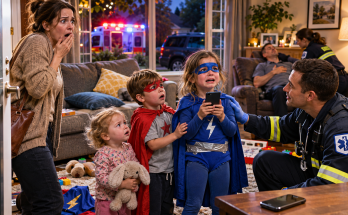
Denise had already given the children dinner when I arrived home.
She'd helped them change out of the strange costumes and into their pajamas.
I was grateful for the ordinary things she'd managed while I'd been at the hospital.
Feeding them.
Getting them comfortable.
Making the house feel like a place where children could spend an evening without constantly thinking about ambulances.
I hadn't realized until that day how comforting ordinary routines could be.
Denise looked at me when I entered.
I told her James was awake.
I explained that the doctors were still investigating what had happened and that he wouldn't be returning that evening.
She listened quietly.
I thanked her and her husband for coming so quickly.
There weren't words that seemed sufficient.
Knowing the children had been with someone familiar while I'd gone to the hospital had allowed me to concentrate on James.
Without Denise, I didn't know how I would have managed.
Then I saw Emma.
She was sitting on the couch.
The blue tights were gathered in her lap.
I recognized them immediately.
Earlier that day, she'd marched across the living room wearing them.
She'd looked proud of her ridiculous superhero costume.
Now she was holding the material between her fingers.
I went over and sat beside her.
She looked toward the doorway behind me.
“Where's Daddy?”
“He's staying with the doctors tonight.”
She looked disappointed.
“He can't come home?”
“Not yet.”
I put my arm around her.
“He's awake, sweetheart. I saw him.”
She looked up quickly.
“He talked?”
“Yes.”
“What did he say?”
“He wanted to know if you were all alright.”
She considered that.
Then she asked another question.
“Is he going to sleep again?”
I understood what she meant.
She wasn't asking whether her father would eventually go to bed.
She wanted to know whether he might become unconscious again.
I chose my words carefully.
“The doctors are watching him. They're trying to find out why he felt so sick.”
She looked down at the tights.
I could see that she was thinking.
I waited.
Eventually, she spoke.
“I couldn't make him get up.”
I pulled her a little closer.
“I know.”
“I kept trying.”
Her voice was so quiet that I leaned toward her.
I wanted her to feel that she could tell me everything she remembered without worrying about my reaction.
She'd experienced enough uncertainty that afternoon.
I wasn't going to make her feel frightened of discussing it.
“Daddy wouldn't look at me.”
I stroked her arm.
“That must have been scary.”
She nodded.
“I thought he wasn't going to open his eyes anymore.”
I felt my throat tighten.
There was nothing complicated about the way she'd said it.
No dramatic description.
No attempt to make me understand the seriousness of what had happened.
She'd simply told me what she'd believed.
Her father might never wake up.
At five years old, she'd been left to consider a possibility that even I found unbearable.
I hugged her.
She rested against me.
For a moment, neither of us spoke.
I looked around our living room.
It was the same room where James had played with the children that afternoon.
The couch.
The coffee table.
The cushions.
Ordinary objects that had suddenly acquired memories I wished we didn't have.
I thought about James's phone.
I'd found it lying there when I returned home.
I'd been so frightened that I hadn't immediately understood what its presence meant.
Now I could picture Emma using a telephone while trying to help him.
The little girl beside me had managed something many adults would have struggled to do calmly.
“You helped Daddy today,” I told her.
She didn't respond.
“You knew you needed someone to come.”
She nodded.
“And calling was exactly the right thing to do.”
She looked uncertain.
“But I didn't keep talking to the lady.”
I turned toward her.
“What happened?”
“Daddy got up.”
She moved her fingers through the blue material.
“He said it was okay.”
I remembered the paramedic explaining that she'd stopped responding to the dispatcher.
Now I understood why.
Her father had awakened.
The person she'd been trying to help had told her things were alright.
Naturally, she'd believed him.
“What did you do with the phone?”
“I put it down.”
“Did the lady stop talking?”
Emma shook her head.
“She was still saying something.”
I imagined the dispatcher continuing to speak while James was moving around the house.
Emma hadn't understood that she needed to tell the person on the telephone what was happening.
She'd thought the emergency was over.
Her father had said so.
“Did you think you were supposed to stop talking to her?”
She nodded.
“Daddy said it was finished.”
I felt a familiar anger returning.
Not toward Emma.
Never toward Emma.
She'd done everything she could reasonably be expected to do.
She was a child who believed her father when he told her she no longer needed help.
James should have taken over.
He should have spoken to the dispatcher himself if he was capable of doing so.
Or he should have remained where he was until assistance arrived.
Instead, he'd made arrangements with Ben.
I didn't tell Emma any of that.
She didn't need to hear another adult criticize her father.
She needed to understand that she hadn't caused the confusion.
“You did a very good thing when you called.”
She glanced at me.
“Even when I put it down?”
“Yes.”
I meant that.
I didn't want her looking back at the moment and finding another reason to blame herself.
She'd recognized an emergency.
She'd sought assistance.
The mistakes that followed belonged to adults.
Not to her.
Thomas climbed onto the couch beside us.
He leaned against me.
I put my other arm around him.
He'd experienced the same afternoon, but he hadn't spoken as much about it.
I looked at his little face.
“How are you doing?”
He shrugged.
Then he began talking about their game.
“Daddy kept having to stop.”
I turned toward him.
“What do you mean?”
“He sat on the couch.”
Emma nodded.
“A lot.”
I listened.
Thomas explained that James had needed to sit down during their superhero activities.
He'd complained that everything seemed to be moving around him.
Thomas described it in the straightforward language of a four-year-old.
“Daddy said the room was going round.”
I felt my stomach tighten.
James had been experiencing symptoms while the children were playing.
They'd noticed.
They'd heard him describe what was happening.
And because they trusted him, they'd accepted whatever explanation he'd given.
“What did Daddy tell you when he sat down?”
Emma answered.
“He said we were having superhero breaks.”
Thomas nodded enthusiastically.
“Everybody needed a break.”
I looked at the blue tights.
I could imagine James trying to turn his physical symptoms into another part of the game.
Instead of saying he felt unwell, he'd announced a break.
Instead of explaining why he needed to sit, he'd made it sound like a rule of superhero training.
It was exactly the sort of creative thing he usually did.
Only this time, there had been something frightening underneath it.
I wondered how many times that afternoon he'd felt close to fainting.
How many times he'd looked at his children and decided he could continue for a little longer.
I couldn't know.
But I knew he'd been dizzy often enough for both Emma and Thomas to remember it.
That frightened me.
I thought again about the doctor's instructions.
Until James had been properly evaluated, another adult needed to be present whenever he looked after them.
There could be no exceptions.
Not because he was a bad father.
Because his body had given him warnings that he wasn't able or willing to respond to properly.
I looked at Thomas.
“Daddy wasn't feeling very well today.”
He nodded.
“His head was funny.”
“Yes.”
“Is his head better?”
“The doctors are helping him.”
Thomas seemed satisfied with that explanation.
He settled against me.
Emma remained quiet.
She was still holding the tights.
I watched her pull one of the legs straight across her lap.
The material stretched and then returned to its original shape when she released it.
I wondered whether she was remembering the game.
Whether those tights still reminded her of the happy moments from earlier in the day.
Or whether she'd begun associating them entirely with the moment everything changed.
I didn't want to take them away from her.
They seemed to offer her some comfort.
After a while, she looked at me.
“Mommy?”
“Yes?”
“Can Daddy still be a superhero?”
The question surprised me.
I looked down at her.
“Of course he can.”
She frowned slightly.
“But he couldn't do it today.”
“Couldn't do what?”
“Be strong.”
I didn't know how to respond immediately.
She wasn't teasing him.
She wasn't criticizing him.
She was trying to understand something.
To her, superheroes were the people who helped everybody else.
The people who could get up when they fell.
The people who weren't frightened.
And her father had spent the afternoon teaching her that he was one of them.
Then he'd collapsed.
I realized that she was trying to reconcile those two things.
I looked at Thomas.
He was listening, although he didn't appear to understand why his sister was so concerned.
I turned back to Emma.
“Daddy doesn't stop being special because he gets sick.”
She thought about it.
“But he's supposed to be strong.”
“Why do you think that?”
“Because he told me.”
I waited.
She looked down.
“He said he'd always be strong for us.”
I felt something shift inside me.
That sounded like James.
It sounded like something he would say with the best possible intentions.
Something meant to make his daughter feel secure.
But Emma hadn't understood it as a promise that her father would love her or do his best to protect her.
She'd understood it as a promise that nothing could happen to him.
And that afternoon, she'd discovered that something could.
I thought about how many times James had reassured me using almost the same idea.
He could manage.
He could handle things.
He didn't need anyone to worry.
I'd accepted those assurances because I was an adult who understood that sometimes people were simply trying to be encouraging.
Emma was five.
She'd believed every word.
I looked at the tights in her lap.
Something about her question made me wonder whether James's game had meant more to him than I'd realized.
I moved a little closer.
“Did Daddy tell you that today?”
Emma shook her head.
“Before today.”
“When?”
She paused to remember.
Then she started telling me about a conversation she'd overheard the previous week.
A conversation between James and me.
About money.
I hadn't known she'd been listening.
I certainly hadn't understood that anything we'd said had worried her.
But apparently, our little girl had been paying attention.
And she'd been thinking about her father long before the Saturday when she had to call for an ambulance.