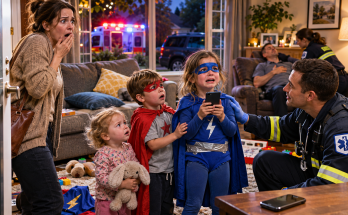
Three weeks had passed since the ambulance came to our house.
Some things felt more familiar by then.
Others still required effort.
We had childcare arrangements.
We had changed our schedules.
James had spoken to his supervisor about temporary adjustments while his medical evaluation continued.
We were following the advice we'd received.
But we still didn't know everything we wanted to know about his health.
There wasn't a neat medical explanation that allowed us to put the entire experience behind us.
There were still questions.
Still appointments.
Still days when James became frustrated with the things he couldn't do as easily as before.
The difference was that he was telling me about those difficult days.
I didn't have to discover them afterward.
I didn't have to look for clues.
I didn't have to wait for someone else to explain what my husband had been experiencing.
That made a considerable difference to how I felt.
It didn't eliminate my concern.
But it allowed concern to become something we could address together.
I was beginning to feel comfortable in our routines again.
Not the routines we'd followed before Saturday.
The ones we'd developed afterward.
They weren't perfect.
They weren't always convenient.
But they were safer.
And they required both of us to pay attention to what was happening rather than what we wished was happening.
James was sitting on the couch when Emma entered the living room.
I noticed what she was carrying before she spoke.
The blue tights.
I felt something tighten inside me.
I hadn't forgotten them.
Of course I hadn't.
I'd seen those tights in the video at work.
I'd seen them on Emma when the paramedic was sitting with her and Thomas.
I'd seen them gathered in her lap that evening while she asked whether her father could still be a superhero.
They had become connected to so many different feelings that I wasn't sure how I would react the next time I saw her playing with them.
And now she was carrying them toward James.
She looked excited.
There was no hesitation in the way she approached him.
She wasn't holding them as though they were something frightening.
She was holding them as though they were part of a game she wanted to play.
“Daddy!”
James looked up.
“Yes?”
She lifted the tights.
“It's superhero school!”
I looked at James.
He smiled.
It was a genuine smile.
The kind I'd always loved seeing when the children invited him into one of their games.
For a moment, I wondered whether he would feel compelled to stand up.
Whether the excitement in Emma's voice would make him forget everything we'd discussed.
But he remained seated.
I watched him.
Emma moved closer.
She clearly expected her father to participate.
Thomas was nearby.
Lily was there, too.
The scene reminded me of the video James had sent that Saturday.
Only this time, I was in the room with them.
There was no need for me to wonder what might be happening beyond the edge of the recording.
No need to guess whether James was feeling alright.
No reason for him to pretend there was another adult present when there wasn't.
I was there.
And I was watching him make a decision.
He looked at Emma.
Then he looked at the material she was holding.
“What if we work on our superhero outfits from here?”
She glanced at the couch.
“Here?”
“Sure.”
He smiled again.
“We don't have to run around to make costumes.”
Emma seemed perfectly willing to accept that.
She wasn't disappointed.
She didn't complain that superhero school had to happen in a particular way.
She simply considered the new arrangement.
Then she came closer.
I felt myself relax.
That was all it had taken.
James hadn't needed to explain his medical situation.
He hadn't needed to make the children feel responsible for adjusting their game.
He'd offered them a different way to play.
And because they wanted to be with him, they'd accepted it.
I thought about how much pressure he'd placed on himself during the previous month.
How he'd apparently believed that giving the children less than his usual level of energy would disappoint them.
Yet here was Emma, completely satisfied with the idea of making costumes while her father remained seated.
She wanted the game.
But more than that, she wanted James to share it with her.
The details could change.
Thomas became interested.
He brought a towel.
It was going to become a cape.
I watched him carry it toward the couch with the serious enthusiasm only a four-year-old could bring to something so ridiculous.
James smiled at him.
Lily wanted to contribute as well.
She produced a sock.
I laughed quietly.
There was something wonderfully ordinary about the three objects appearing together.
Blue tights.
A towel.
A sock.
Nothing impressive.
Nothing expensive.
Just whatever the children considered appropriate equipment for their superhero adventure.
James looked amused.
The children were delighted.
I remembered the flour-covered counter from the photograph he'd sent me three weeks earlier.
The scattered toys.
The cushions everywhere.
At the time, I'd thought the mess was evidence that the children had enjoyed a wonderful afternoon.
Now I could see that their enjoyment didn't require James to use every bit of energy he possessed.
They could have a wonderful time sitting near him.
They could invent something ridiculous without turning the entire house upside down.
They could make him laugh while allowing him to rest.
He didn't have to prove anything.
I wondered whether he understood that.
Then I saw the way he looked at the children.
I thought perhaps he did.
Emma unfolded the tights.
She moved toward James and arranged the blue material over his shoulders.
It looked absurd.
Completely absurd.
He sat there wearing his daughter's strange costume with no apparent concern about how silly he looked.
Thomas had his towel.
Lily had her sock.
They were building their little superhero world around their father.
Not waiting for him to construct it for them.
That was another small difference.
Before, James had usually directed their adventures.
He invented the rules.
He supplied the ideas.
He turned ordinary objects into things the children could imagine differently.
Now they were participating in creating something for him.
And he was allowing them to.
I liked seeing that.
It reminded me that the children weren't merely receiving something from their father.
They were capable of giving him affection in their own little ways.
Emma had always enjoyed making him smile.
Thomas loved showing him things.
Lily offered whatever she happened to consider valuable at the time.
That afternoon, her contribution was a sock.
James didn't need something more impressive.
He needed the little girl who'd brought it to him.
I watched her.
Then I looked back at Emma.
She was studying her father's face.
The excitement in her expression had become something quieter.
I recognized that thoughtful look.
She seemed to be considering something important.
For a moment, I wondered whether seeing him sitting beneath the blue tights had reminded her of that frightening Saturday.
I didn't interrupt.
I didn't want to assume what she was thinking.
James looked at her.
She adjusted the material on his shoulders.
Then she asked him a question.
“Daddy, do superheroes get worn out?”
I held my breath.
It was such a simple question.
But I knew how much it contained.
Three weeks earlier, she'd asked me whether her father could still be a superhero.
She'd been trying to understand why someone who'd promised to be strong could become unresponsive.
She'd believed that strength and vulnerability couldn't exist together.
Now she was asking James himself.
I looked at him.
There were several answers he might once have given.
He might have laughed and told her that her father never got tired.
He might have assured her that he could always keep going.
He might have turned the question into another joke.
Those responses would have sounded loving.
I could imagine how naturally they would have come to him.
But he didn't give any of them.
He looked directly at Emma.
“Sure they do.”
She watched him.
James smiled.
“Pretty often, actually.”
I felt tears gather in my eyes.
He'd answered honestly.
He hadn't suggested that superheroes were exceptions to the ordinary rules of being human.
He hadn't told her that strength meant having endless energy.
He'd admitted that even the people she thought of as heroes could become tired.
Emma appeared to accept the answer.
It didn't upset her.
It didn't make her look disappointed in him.
She was simply learning something new.
I thought about James sitting beside the kitchen counter that Saturday morning.
How he'd insisted that he was perfectly fine.
I thought about the moment when he'd admitted in the hospital that he'd been embarrassed by his symptoms.
I thought about our conversations concerning his father.
He'd carried a particular understanding of strength for years.
And now he was changing the way he explained that idea to his daughter.
Not through a speech.
Not through a complicated discussion.
Through a simple answer.
Yes.
Superheroes got tired.
I hadn't realized how much I needed to hear him say that.
James looked comfortable on the couch.
The blue tights were resting across his shoulders.
He wasn't trying to appear particularly impressive.
He wasn't attempting to make the children forget that he sometimes felt unwell.
He was enjoying a moment with them.
And that was enough.
Thomas stood nearby with his towel.
Lily remained interested in her sock.
Emma looked at James as though she was still thinking.
I could see that she wasn't finished asking questions.
I remembered the conversation we'd shared on the couch that first evening.
How she'd asked whether superheroes could visit doctors.
I'd told her that seeking medical assistance was sensible when someone needed it.
She'd accepted the explanation.
But now she had an opportunity to hear her father's understanding of those same ideas.
I wanted him to answer her himself.
There was nothing I needed to add.
I stayed where I was.
I watched Emma move a little closer to him.
She wasn't frightened.
She wasn't holding the telephone.
She wasn't trying desperately to make him respond.
She was simply a little girl asking her father something she wanted to understand.
That was what she deserved to be.
A child.
Not an emergency responder.
Not the person responsible for ensuring her father received medical attention.
Not someone who had to worry whether the adults in her life were making sensible decisions.
I thought about the courage she'd demonstrated that Saturday.
I was immensely proud of her.
But I didn't want that pride to become another burden.
I didn't want her believing she always had to be the brave one.
She'd done something remarkable because the circumstances had required it.
Now the adults needed to make sure she could return to being a little girl who played ridiculous games with her family.
James seemed to understand that.
He wasn't asking her to reassure him.
He wasn't making her responsible for his feelings about his own limitations.
He was listening to her.
Answering her questions.
Allowing himself to remain seated.
Those were small things.
But they represented the change we'd been trying to make.
I watched him adjust the blue material on his shoulders.
He looked at Emma with affection.
She looked back at him.
And I realized that the little costume no longer represented only the worst afternoon of our lives.
It was becoming part of another memory.
One that was quieter.
Safer.
And considerably more honest.
I stayed in the living room with them.
For once, I wasn't watching James because I was trying to detect something he might be hiding.
I was watching him because I wanted to enjoy seeing him with our children.
There was a difference.
And I was grateful to feel it again.