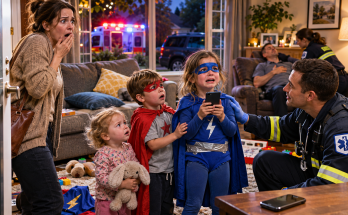
Emma looked at her father.
The blue tights were hanging loosely over his shoulders.
Thomas was holding his towel.
Lily still had her sock.
James was sitting exactly where he'd been when Emma entered the living room.
Nobody seemed bothered by that.
The children weren't demanding that he get up.
They weren't asking him to do anything he couldn't manage comfortably.
They were simply enjoying having him participate.
Emma thought for another moment.
Then she spoke.
“When superheroes get tired, who takes care of them?”
I looked at James.
I hadn't expected her to ask that.
Perhaps I should have.
After everything she'd experienced, it made sense that she would want an answer.
She knew superheroes were supposed to help other people.
She'd spent the previous three weeks discovering that her father sometimes needed help himself.
Now she wanted to know how those two things fitted together.
James looked at her.
He didn't rush to respond.
I could see him considering what he wanted to say.
“Sometimes their family helps them.”
Emma listened.
“Sometimes they need doctors.”
He paused.
“And sometimes a superhero is lucky enough to have a little girl who knows how to ask for help.”
Emma's face changed.
James smiled.
“A little girl who knows the number to call when there's an emergency.”
She straightened.
“That's me!”
He nodded.
“That's certainly you.”
Emma beamed.
I felt something inside me loosen.
For weeks, I'd carried the memory of her asking whether she'd done something wrong.
I'd remembered the uncertainty in her face as she stood beside the paramedic.
Her little hand holding mine.
Her fear that calling for help might somehow have caused everything that followed.
Now she was smiling because her father was acknowledging what she'd done.
Not criticizing her for becoming frightened.
Not questioning whether she'd misunderstood the situation.
He was recognizing that she had helped him.
I was grateful to hear it.
I remembered what he'd asked me to tell her before I left the hospital that first evening.
That he was proud of her.
That she'd made the correct decision.
Now she was hearing that recognition directly from him.
It mattered.
James looked at Emma with so much affection that I found myself blinking back tears.
She was pleased with herself.
And she had every reason to be.
But there was something else about the moment that I appreciated just as much.
James hadn't described her as the only person who could help him.
He hadn't suggested that she needed to remain responsible for his safety.
He'd mentioned family.
He'd mentioned doctors.
He'd recognized that help could come from different people in different circumstances.
That was the lesson I wanted all three children to learn.
They didn't need to handle frightening things alone.
Neither did the adults.
I watched Thomas with his towel.
He was interested in the costume rather than the meaning of everything being said.
Lily was too young to understand much of the conversation.
She simply wanted to be included.
And that was perfectly alright.
Not every moment needed to become a lesson.
Sometimes a child could just enjoy wearing a towel.
Sometimes a sock was simply a sock.
I was glad our living room could contain those ordinary things again without everything becoming serious.
James laughed.
The children laughed with him.
I smiled.
The sound was familiar.
It reminded me of the video he'd sent me around noon on that Saturday.
I'd laughed when I watched it with my coworker.
I'd felt relieved that James appeared to have enough energy to entertain the children.
At the time, I hadn't understood what he was trying to prove.
Now there was nothing he needed to prove.
That was what made this particular moment so different.
He was sitting down.
The children had brought him their costumes.
He'd admitted that superheroes became tired.
He'd explained that they needed help.
And nobody loved him any less.
I wished he'd understood that three weeks earlier.
I wished we'd been able to reach this point without Emma having to call 911.
Without the unlocked front door.
Without the second ambulance at the gas station.
Without those two nights in the hospital.
But wishing couldn't change what had happened.
We had to work with the experience we'd actually lived through.
And we had to make sure we didn't waste what it had taught us.
I looked at James.
For years, I'd considered him the person who kept things moving when something went wrong.
He was good at solving practical problems.
He was good at making the children laugh.
He was good at providing reassurance when I was worried.
I loved those qualities.
I still did.
But I'd learned that they couldn't become requirements he imposed on himself every minute of every day.
He was allowed to be uncertain.
He was allowed to be frightened.
He was allowed to experience something he couldn't fix.
And when that happened, he needed to tell me.
I didn't want a marriage in which one person had to remain strong enough to protect the other from every difficult truth.
That wasn't the relationship I'd thought we had.
And it certainly wasn't the relationship I wanted going forward.
I wanted to know James as he actually was.
Not only when he felt confident.
Not only when he had an answer.
Not only when he could tell me everything was going to be alright.
I wanted him to trust me with the parts of his life that frightened him.
That didn't mean I could solve every problem.
I couldn't.
There were medical questions I didn't understand.
There were financial concerns neither of us could completely eliminate.
There were circumstances beyond our control.
But sharing those things meant neither of us had to make every difficult decision without the other's knowledge.
That was important.
I remembered how hurt I'd felt when Ben told me that James had already visited a clinic.
I'd been standing outside our house, trying to establish where my husband was.
And there was a man I'd never met telling me something about James that I should have heard directly from him.
I didn't want to experience that again.
Not because I expected to know absolutely everything my husband ever discussed with another person.
Because this particular information had affected our entire family.
I needed to know it.
James needed to recognize that.
We'd made progress in that regard.
He was telling me when he felt unwell.
We were discussing the expenses together.
We were taking the medical follow-up seriously.
We were respecting the restrictions his doctors had placed on him.
Those things didn't guarantee that nothing frightening would happen again.
But they meant we weren't deliberately making ourselves less prepared.
That was something.
Something considerable.
I thought about how much effort I'd once put into trying to determine whether James was alright without making him feel as though I doubted him.
I'd questioned his tiredness.
I'd suggested he rest.
I'd watched him move around our kitchen and wondered whether something was wrong.
He'd reassured me.
And I'd accepted his reassurance.
Now I understood that reassurance wasn't always the most helpful thing a person could offer.
Sometimes a difficult truth provided more comfort than a pleasant answer.
I preferred knowing when James was having a bad day.
Even if knowing made me concerned.
Even if we needed to change our arrangements.
At least then we could respond to the situation that actually existed.
And James didn't have to spend the entire day pretending he felt differently.
I could see how much energy that pretending must have required.
Energy he hadn't possessed in abundance.
Energy he could have used to rest.
I watched him laugh with Thomas.
He seemed more relaxed than I'd seen him in quite some time.
Perhaps that was because he wasn't being asked to demonstrate anything.
Perhaps it was because the children had accepted his limitations more easily than he'd feared.
Whatever the reason, I was grateful.
Emma was still delighted by his answer.
She knew she'd helped her father.
She knew that doctors could help superheroes.
And she knew that her father didn't stop being important simply because he sometimes became tired.
Those were the answers she'd needed.
I thought about her previous question.
Whether James could still be a superhero.
At the time, I'd told her that he could.
But I hadn't fully understood how important it would be for James to show her what that meant.
He was showing her now.
He was sitting beneath a ridiculous pair of tights.
He was allowing his four-year-old son to create a cape from a towel.
He was accepting a two-year-old's contribution of a sock.
He was answering his daughter's questions without disguising the truth.
Nothing about that required him to exhaust himself.
Nothing about it placed the children in danger.
Nothing about it required him to conceal his symptoms from me.
It was just a father enjoying his children.
And they were enjoying him.
I felt grateful for the simplicity of it.
There was still work ahead of us.
James's medical condition hadn't been fully explained.
The outpatient monitoring and follow-up appointments remained necessary.
We didn't know how long the restrictions on driving and childcare would continue.
There were still practical arrangements we needed to make.
And there were still days when money worried us.
I couldn't honestly say our lives had suddenly become easy.
They hadn't.
But ease wasn't what I was looking for anymore.
I wanted safety.
Honesty.
A willingness to face problems together.
I wanted James to understand that his health mattered even when the household needed money.
I wanted him to understand that our children needed a father who was present, not a father who performed strength until his body couldn't support him anymore.
I also wanted him to understand that rebuilding my trust would take more than being sorry.
He was beginning to demonstrate that understanding.
Every time he told me how he was feeling, he helped repair something.
Every time he followed the medical advice instead of deciding he could manage without it, he helped repair something.
Every time he included me in a difficult decision, he helped repair something.
It wasn't dramatic.
Nobody was going to announce that our marriage had officially recovered from what had happened.
There would be no particular moment when everything became exactly as it had been before.
And I didn't think I wanted everything to become exactly as it had been before.
Some of our old habits needed to remain behind us.
I wanted us to keep the affection.
The laughter.
The ordinary ways we cared for each other and our children.
I wanted us to lose the assumption that James needed to handle frightening things before he could tell me about them.
That assumption had cost us too much.
I looked at Emma again.
She was laughing.
The same little girl who'd tried shaking her father awake.
The same little girl who'd put water on his face.
The same little girl who'd found a telephone and asked strangers to help her.
I was enormously proud of her courage.
But watching her laugh, I felt something beyond pride.
I felt relief that she was able to enjoy this moment.
She wasn't responsible for her father.
She wasn't monitoring his condition.
She wasn't trying to determine whether an ambulance was necessary.
She was playing.
And that was exactly what she should have been doing.
I hoped that as she grew older, she would remember both things about that period.
That she'd been brave when something frightening happened.
And that bravery didn't mean she needed to manage every frightening situation by herself.
She could always ask for help.
So could Thomas.
So could Lily.
So could their father.
And so could I.
That last part mattered, too.
I'd accepted help from Denise when I needed someone to stay with the children.
I'd relied on emergency personnel to keep them safe before I reached home.
I'd needed the physicians to evaluate James.
There had been several moments when I couldn't have managed alone.
I didn't feel ashamed of that.
I felt grateful that people had been there.
James was learning to feel the same gratitude rather than treating assistance as evidence that he'd failed.
I knew that change would take time.
But I could see it happening.
He looked at Emma wearing an expression I recognized from years of bedtime stories and ridiculous games.
She was pleased.
He was pleased.
Thomas had his towel.
Lily had her sock.
The blue tights were still over James's shoulders.
I stood watching them for a while.
There were cushions around the room.
The couch was where it had always been.
The coffee table was nearby.
Beyond them was the kitchen counter I'd looked at so differently since the morning of his collapse.
Everything was familiar.
Yet something important had changed.
James wasn't pretending that the ordinary objects of our home could support him through something he refused to acknowledge.
He was letting the people around him support him.
He was participating in his children's lives without insisting that participation required him to ignore his own needs.
He was allowing himself to be seen as someone who could become tired.
Someone who might need a doctor.
Someone who couldn't promise that every difficult thing would disappear.
And the children loved him.
Exactly as they always had.
I loved him, too.
That love didn't erase the anger I'd felt.
It didn't make his earlier decisions acceptable.
It didn't remove the necessity of rebuilding trust.
But it gave us something worth working toward.
A family in which nobody needed to conceal the truth in order to remain valuable.
I looked at James one more time.
He was laughing beneath those ridiculous blue tights.
I thought about the man I'd found in the hospital, lying under a thin blanket with an IV in his arm.
I'd wanted so desperately for him to be alright.
Now I understood that being alright didn't mean never becoming ill.
It meant being willing to acknowledge when something was wrong and allowing the people who loved him to help.
We still had unanswered questions.
We still had responsibilities.
We still had changes to make.
But my husband was home.
Our children were safe.
And when James became tired, he no longer needed to pretend that he wasn't.
He could sit down.
He could tell me.
He could ask for help.
He could continue being the father our children loved.
Watching him that afternoon, I finally understood what I wanted Emma to remember whenever she thought about superheroes.
Not that her father could carry everything.
Not that he could solve every problem.
Not that he would always be strong enough to stand on his own.
That when he needed somebody, he was strong enough to say so.
And that the people who loved him would still be there.
The End
Read more original stories on lastestdrama.com.