James spoke to his supervisor about his situation at the warehouse.
I knew that conversation wasn't easy for him.
He'd spent weeks worrying that medical appointments would interfere with his income.
Now he was discussing the possibility of temporary changes to his duties while the doctors continued investigating his symptoms.
It was exactly the sort of conversation he'd been trying to avoid.
But avoiding it was no longer an option he could reasonably consider.
He understood that.
I was glad he'd reached that understanding himself.
I didn't need to stand beside him and insist that he make every difficult decision.
I needed him to recognize when a decision had to be made.
That distinction mattered.
There was a difference between supporting my husband and becoming responsible for managing his entire life.
I didn't want the second arrangement.
Neither did he.
He was still capable of participating in decisions.
He was still capable of explaining what he needed.
He simply had to stop believing that admitting those needs would somehow diminish him.
The situation at work remained a concern.
There wasn't a sudden disappearance of our financial worries.
We still depended on our earnings.
We still had three children.
We still had the household expenses we'd been discussing before James collapsed.
Those things hadn't changed.
What had changed was the way we approached them.
Before, James had apparently been trying to protect our finances by delaying the things his health required.
Now we were trying to consider his medical needs and our finances together.
It wasn't always comfortable.
Sometimes the numbers worried me.
Sometimes they worried him.
But we were talking about the same numbers.
And that was important.
I remembered sitting beside his hospital bed while he explained that medical insurance didn't replace wages lost by missing work.
At the time, I'd been angry.
I hadn't been angry because his concern was unreasonable.
I'd been angry because he'd used that concern to justify keeping something important from me.
There was nothing wrong with worrying about money.
We both worried about it.
What mattered was whether we allowed that worry to prevent necessary medical attention.
James had done exactly that.
He'd placed the hope of maintaining his usual working arrangements ahead of finding out why he kept feeling faint.
And in the end, he hadn't protected those arrangements anyway.
The collapse had disrupted everything.
There was a lesson in that which neither of us needed explained repeatedly.
We'd lived through it.
Now, whenever the subject of further testing or monitoring came up, we considered what needed to happen.
Then we considered how to make it happen.
The order mattered.
We couldn't begin with the question of whether we wanted to lose working hours.
Of course we didn't.
Nobody wanted that.
But some things needed to be done regardless of whether they fitted conveniently into our schedules.
James was beginning to accept that.
I appreciated the effort it took.
There were still occasions when he expressed frustration.
He wanted to feel useful.
He wanted to know when he could resume his ordinary responsibilities.
He wanted an explanation for what had happened to him.
I wanted those things, too.
But the medical uncertainty wasn't something either of us could remove by becoming impatient.
We had to live with it while the investigations continued.
That meant following the restrictions.
It meant arranging transportation when necessary.
It meant making sure another adult remained responsible for the children when I was unavailable.
There were several moving pieces.
Some days seemed easier than others.
But each day gave us another opportunity to practice the arrangement we'd agreed upon at the hospital.
James would tell me when he wasn't feeling well.
I would listen.
We would make whatever changes were necessary.
It sounded straightforward.
In practice, it required both of us to change habits we'd barely understood before.
James had to resist the temptation to minimize his symptoms.
I had to resist the temptation to interpret every sign of tiredness as proof that another terrible emergency was about to happen.
Neither response was particularly helpful.
We needed to stay somewhere between denial and constant fear.
That wasn't easy.
But we were trying.
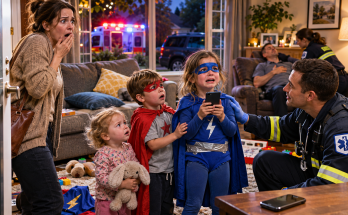
I thought about Ben from time to time.
I remembered standing outside the house while he explained the events of that afternoon.
His palms moving against his jeans.
His discomfort as I asked why he'd left the children without supervision.
He'd made an incredibly poor decision.
James had made an incredibly poor decision.
I hadn't forgotten either fact.
But I also knew Ben had been worried about my husband for weeks.
He'd encouraged him to seek medical attention.
He'd come by our house because he wanted to check on him.
And when James became unresponsive in the SUV, Ben had stopped and called emergency services.
His intentions hadn't been cruel.
His judgment had been poor.
Both things could remain true.
I didn't need to turn him into someone dangerous in order to acknowledge the seriousness of his mistake.
There was no mysterious man threatening our family.
There was no hidden situation involving the dark vehicle outside the window.
There had been a worried coworker.
A frightened husband.
A confused little girl.
And a series of decisions that should have been handled differently.
Understanding that had brought a certain amount of relief.
It hadn't made the consequences disappear.
I still thought about Emma's words when she'd told me her father wanted them to hide.
The memory of watching the video remained uncomfortable.
I'd been so focused on the unfamiliar man beyond the glass that I'd missed the larger truth.
James hadn't been afraid of Ben.
He'd been afraid of being seen in a state he considered humiliating.
That was the part of the story I wished had been different.
There was nothing humiliating about becoming sick.
There was nothing shameful about needing an ambulance.
But James had apparently believed otherwise strongly enough to act against his own best interests.
Now he was being asked to challenge that belief in smaller, less frightening situations.
When he needed to rest.
When he couldn't complete a task.
When another person needed to help with the children.
When he had to discuss temporary changes to his work.
Those were opportunities to behave differently.
And slowly, he was doing that.
I didn't expect him to enjoy every part of it.
I didn't expect him to wake up one morning and suddenly become comfortable with all his limitations.
But I expected honesty.
That was the commitment he'd made to me.
And I was beginning to see it becoming part of our ordinary life.
There were times when James admitted he was tired without immediately following the admission with an explanation.
I noticed that.
Before, he'd always seemed to need a reason that made the tiredness acceptable.
The warehouse had been busy.
He hadn't slept well.
He'd had a long day.
Now he was beginning to understand that he didn't have to defend how he felt.
He could tell me.
That was enough.
I appreciated those small changes more than any dramatic declaration he could have made.
A declaration was easy when emotions were high.
Keeping a promise on a difficult, ordinary afternoon was something else.
That was where trust lived.
Not only in the hospital conversation.
Not only in the apologies.
In the choices that followed.
The children continued adjusting to the arrangements.
Denise remained an important part of our childcare plans.
James continued spending time with them while another adult was present.
The distinction became easier as the days passed.
He wasn't being separated from his family.
He was being supported while he dealt with a medical issue that hadn't yet been fully explained.
I hoped he could see that more clearly.
I also hoped Emma was beginning to understand that her father's need for help didn't mean he was disappearing.
She'd already experienced enough uncertainty.
I wanted her to see him in the familiar places around our home.
I wanted her to hear his voice and enjoy his company.
And I wanted her to observe something she hadn't seen enough before.
Her father recognizing when he needed assistance.
It was important that she saw it without hearing a long explanation every time.
Children learned from what adults did.
We'd discovered that when Emma revealed what she'd overheard about our finances.
She'd watched us.
She'd listened.
She'd drawn conclusions.
Some of those conclusions hadn't been accurate, but they'd made sense to her.
We needed to be more thoughtful about what we demonstrated through our behavior.
I didn't want her growing up believing that people had to conceal their problems to protect those they loved.
I didn't want Thomas believing that asking for help meant he wasn't strong.
I didn't want Lily learning that exhaustion was something she should ignore because somebody else might be disappointed.
Those ideas could follow children into adulthood.
I knew that now.
I'd seen how a memory from James's own childhood had shaped his understanding of fatherhood.
He'd made a promise to himself that his children would never feel the way he'd felt when his father lost his job.
That promise had come from a good place.
But it had also placed an impossible expectation on him.
He'd believed he needed to keep working, keep smiling, and keep entertaining the children no matter what was happening.
The more frightened he became, the harder he tried to maintain that appearance.
Until his body wouldn't allow him to continue.
I didn't want our children carrying their own version of that promise into their adult lives.
I wanted them to have a different understanding of responsibility.
Taking care of someone didn't always mean doing something for them.
Sometimes it meant allowing them to do something for you.
Sometimes it meant acknowledging a limitation.
Sometimes it meant recognizing that a situation required professional assistance.
Emma had already demonstrated that last lesson better than the adults involved in Saturday's emergency.
She'd recognized that she couldn't wake her father.
She'd asked for help.
She'd provided our address.
She hadn't needed to understand the medical cause of his collapse before deciding that assistance was necessary.
There was something remarkably sensible about that.
James could learn from it.
So could I.
We didn't need every answer before accepting that something required attention.
We simply needed enough information to know we shouldn't ignore it.
By then, the arrangements for James's continued medical evaluation were part of our plans.
There would be monitoring.
There would be follow-up appointments.
We would respect the advice we'd received.
I couldn't pretend I was satisfied with not knowing exactly what had caused his collapse.
Sometimes the uncertainty frightened me.
I wanted to know whether it would happen again.
I wanted someone to explain why he'd been experiencing dizziness for weeks.
I wanted to understand which parts of our future we needed to prepare for.
But we couldn't manufacture answers that the doctors hadn't established.
We had to continue with the process.
And James needed to remain honest throughout it.
I watched him doing his best to accept that.
There was something reassuring about seeing him approach his health as a responsibility rather than an inconvenience.
He wasn't magically free of his old worries.
He still cared about money.
He still disliked needing help.
He still wanted to be able to do more.
But those feelings no longer determined every decision he made.
At least, that was what I was beginning to observe.
I didn't take it for granted.
The trust between us was improving because he was doing something to improve it.
I couldn't have achieved that simply by deciding to stop being angry.
He needed to participate.
He was participating.
And that allowed me to think about other parts of our life without constantly wondering what information I might be missing.
I began enjoying the children's laughter again.
Not because I had stopped being concerned about James.
Because I could be concerned about him and still enjoy being with our family.
Those things didn't need to exclude each other.
That was another lesson we'd both been learning.
Happiness didn't require pretending there was nothing difficult happening.
Sometimes happiness existed right beside uncertainty.
Sometimes the children laughed while the adults still had problems they hadn't solved.
That didn't make their laughter less genuine.
It didn't make us irresponsible for enjoying it.
It simply meant life was continuing.
James was home.
He was receiving medical attention.
We were making the necessary adjustments.
And our children still wanted the same thing they'd always wanted.
Their father nearby.
I watched him becoming more comfortable with giving them his attention without offering some impressive display of energy.
It took time.
But he was learning that sitting down didn't mean removing himself from their lives.
He could be present without exhausting himself.
He could be playful without pretending to feel stronger than he did.
I was grateful to see him discover that.
And I began to believe that when the children eventually asked him to play their favorite game again, he might respond differently.
Not by refusing to spend time with them.
Not by forcing himself to do everything.
By finding a way to be with them that was honest about how he felt.