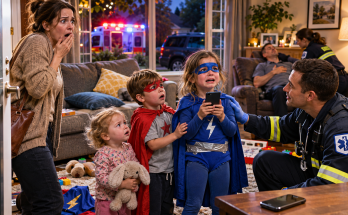
After two nights in the hospital, James was able to come home.
I was grateful for that.
But I didn't confuse being discharged with being completely recovered.
The initial medical investigations hadn't uncovered an emergency that required him to remain in the hospital for further inpatient treatment.
That was encouraging.
It didn't mean the doctors had established exactly why he'd collapsed.
They hadn't.
There was more monitoring to arrange.
There were follow-up appointments to attend.
There were still questions about the dizziness he'd experienced throughout the previous month.
I wanted those questions answered as much as James did.
But until they were, we needed to live with a certain amount of uncertainty.
That was something neither of us found particularly easy.
I looked at my husband when the time came to leave.
He seemed relieved.
I understood why he wanted to get away from the hospital bed, the thin blanket, and the equipment surrounding him.
He wanted to see the children.
He wanted familiar surroundings.
He wanted to be somewhere that didn't constantly remind him he'd lost consciousness twice in one afternoon.
I wanted those things for him, too.
I just didn't want him to mistake familiarity for proof that everything had gone back to normal.
We had discussed what needed to happen after he came home.
The doctor's restrictions remained important.
He couldn't drive.
He couldn't look after the children without another adult present.
And he needed to follow through with the planned medical evaluation.
Those things weren't going to change because he felt better that morning.
When we returned to the house, I looked at the front entrance differently.
I'd walked through that doorway on Saturday expecting to find my husband surrounded by emergency personnel.
Instead, I'd found three children and no James.
Now he was returning through the same entrance with me.
I felt relief.
I also felt a familiar tightening in my chest.
There were memories attached to that doorway that hadn't existed a few days earlier.
I wondered whether James was thinking about them, too.
He looked toward the living room.
The children were delighted to have him home.
Seeing their excitement brought back something ordinary and lovely.
James was their father.
They'd missed him.
They wanted to be near him.
None of them needed a complicated explanation of our marriage or the decisions we'd discussed at the hospital.
They needed to see him.
They needed to hear his voice.
They needed the comfort of his presence.
I watched him with them.
Emma looked particularly interested in how he was feeling.
I couldn't blame her.
The last time she'd spent an afternoon with him at home, she'd ended up speaking to an emergency dispatcher.
I hoped seeing him awake and responsive in familiar surroundings would help her feel more secure.
But I knew it wouldn't immediately erase what she'd experienced.
Children didn't necessarily forget things simply because adults wanted them to.
James settled on the couch.
I noticed that he didn't attempt to remain standing simply because the children wanted his attention.
That was a small thing.
A few days earlier, I might not have noticed it at all.
Now it mattered.
He was allowing himself to sit.
He was letting the children come to him.
He wasn't trying to demonstrate that he could immediately return to doing everything he'd done before.
I hoped he would continue making those kinds of decisions.
The house itself looked ordinary.
The kitchen counter was the same kitchen counter.
The couch was the same couch.
The coffee table was still where it had always been.
But I couldn't look at those things quite the same way.
I remembered James holding the counter.
I remembered discovering his phone on the coffee table.
I remembered Emma sitting on the couch with the blue tights in her lap.
Our home contained all the familiar objects of our everyday life.
It also contained reminders of the afternoon when our ordinary arrangements had failed.
I didn't want those reminders to define everything from that point onward.
I wanted our children to continue enjoying their home.
I wanted James to enjoy being with them.
But enjoyment needed to exist alongside sensible precautions.
Not instead of them.
Once James was home, we had to begin working out the practical details.
The children still needed supervision.
I still needed to work.
He had medical appointments ahead of him.
And neither of us knew exactly how long the restrictions would remain in place.
It was tempting to think about everything at once.
To try to solve the next several weeks before we'd even established how he would feel from one day to the next.
But we didn't have enough information to make every decision immediately.
We needed to start with what we knew.
First, James couldn't be the only adult responsible for the children.
That meant our previous childcare arrangements weren't going to work.
Before Saturday, I had sometimes been able to accept additional shifts because James was available.
Now availability and medical suitability were two different things.
He could be home.
He could want to look after the children.
But that didn't mean he should be responsible for them alone.
We spoke with Denise about helping us.
She was already familiar with the children.
They trusted her.
And after what had happened, I was particularly grateful that we had someone nearby whom we could approach.
I didn't want to assume she could simply rearrange her life whenever we needed assistance.
She had responsibilities of her own.
But together, we began working out childcare arrangements that would allow us to respect James's restrictions.
It wasn't as simple as returning to the way things had been.
There were schedules to consider.
There were times when one of us needed to make adjustments.
There were practical difficulties that would have been easier to avoid if James had been able to continue his usual routine.
But convenience wasn't the deciding factor anymore.
Safety was.
I thought about how different Saturday might have been if we'd arranged for another adult to be there from the beginning.
I couldn't change that particular day.
What I could do was make sure we didn't repeat the circumstances that had made it possible.
James participated in those conversations.
I could see that discussing childcare was uncomfortable for him.
He had always considered himself someone capable of looking after his children.
Now we were making plans specifically because he couldn't safely do that alone.
I understood why it bothered him.
But I was glad he didn't argue against the arrangement.
He didn't try to persuade me that we could make an exception if he happened to be feeling particularly well.
He listened.
He helped consider what would work.
And when we needed to make adjustments, he accepted that his preferences weren't the only thing that mattered.
That was progress.
Not dramatic progress.
The kind that occurred through ordinary conversations about ordinary responsibilities.
But it mattered to me.
We also needed to discuss our working hours.
Before the collapse, James had been concerned about the warehouse reducing shifts.
He'd worried that taking time off for medical appointments would make our finances even more difficult.
Coming home hadn't magically solved that concern.
His medical condition still needed investigation.
Appointments still required time.
Money was still something we needed to think about carefully.
I didn't want to dismiss his financial worries simply because I'd been angry about the way he'd handled them.
He had been worried about something real.
Missing work could affect our income.
Changing childcare arrangements could create additional difficulties.
There wasn't anything unreasonable about acknowledging those facts.
What had been unreasonable was allowing them to determine his medical decisions without discussing those decisions with me.
We began adjusting our schedules.
There were things we couldn't control.
There were arrangements we could try to make.
And there were decisions that depended on information we didn't yet have.
I reminded myself that we didn't need to solve every possible future problem before addressing the one immediately in front of us.
We could work with the situation as it developed.
James seemed to find that difficult.
He liked knowing what was going to happen.
He liked being able to tell me that he'd arranged something or resolved a problem.
Now we were dealing with a medical uncertainty that couldn't be resolved simply by working harder.
I could see his frustration.
Sometimes he looked toward the children as though he wanted to get up and join whatever they were doing.
Sometimes he seemed irritated by the limitations of his own body.
I understood.
It must have been difficult to remember how easily he'd once done those things.
To want to participate and have to consider whether he felt well enough.
But there was something important happening beneath that frustration.
James was beginning to tell me how he felt.
Not every conversation about his symptoms was easy.
I could see that admitting he wasn't feeling particularly well still bothered him.
But he was making the effort.
He no longer insisted that every uncomfortable sensation was simply the result of working too much.
He no longer treated my questions as unnecessary concern.
That changed the way I responded, too.
Instead of looking at him and trying to work out whether he was hiding something, I could listen to what he was actually telling me.
Instead of guessing whether he needed to sit down, I could trust him to communicate that need.
The uncertainty remained.
But at least it was uncertainty we were sharing.
One of the things that helped was finally looking at our expenses together.
We'd discussed money before.
We weren't strangers to the household bills.
But the conversation had a different purpose now.
We weren't simply deciding whether an additional shift would be useful.
We were considering how to manage our responsibilities while James continued receiving medical attention.
We needed to see the situation as it actually was.
Not as James feared it might become.
Not as I wished it would be.
I looked at the expenses with him.
There were the ordinary things we needed to cover.
There was the income we depended on.
There were adjustments we might have to make depending on his appointments and working arrangements.
It wasn't an especially enjoyable conversation.
But it was honest.
I noticed James becoming quiet at certain points.
I knew he was probably thinking about the wages he'd feared losing.
I didn't tell him money was unimportant.
It was important.
We had three children to raise.
We needed to be able to meet our responsibilities.
But money couldn't be the only consideration.
I looked at him.
“We'll make decisions when we know what we're dealing with.”
He nodded.
I remembered him explaining that insurance wouldn't replace the income he'd lose by taking time away from work.
He hadn't been wrong.
But that wasn't the end of the discussion.
It was the beginning of one.
We needed to consider his health alongside our finances.
We needed to make arrangements that accounted for both.
And we needed to stop treating every difficulty as something one person had to resolve before the other person could be informed.
James looked at the bills.
He seemed uncomfortable.
Then he looked at me.
“I should've talked to you about this before.”
I nodded.
“Yes.”
I didn't add anything more.
He already understood what I meant.
There was no benefit in making him repeat the apology every time we encountered a reminder of his earlier decision.
What mattered was what he did now.
We continued looking at the expenses.
We discussed the schedules.
We considered the appointments he still needed to attend.
There wasn't a perfect solution waiting for us at the end of the conversation.
We didn't suddenly have more money.
We didn't suddenly know the cause of his collapse.
But we had something that had been missing for much of the previous month.
We were working with the same information.
I glanced toward the living room.
James's phone was nearby.
On Saturday, I'd found that phone sitting uselessly on the coffee table while I desperately tried to reach him.
Now it was simply his phone again.
Something he could use to communicate.
Something he could use to arrange appointments and discuss work.
Something that no longer needed to represent the distance between what he knew and what I knew.
There would still be conversations he found difficult.
There would still be moments when asking for help felt unnatural to him.
And there would still be days when I worried about his health.
I couldn't pretend those things had disappeared.
But when we finished discussing the bills, I felt more hopeful than I had expected.
Not because we'd solved every problem.
Because James had stayed in the conversation.
He hadn't dismissed my concerns.
He hadn't promised that he would somehow take care of everything by himself.
He had sat beside me and faced the numbers.
And when we reached things we couldn't settle immediately, he accepted that we would need to return to them together.
It wasn't the kind of strength he'd spent years trying to demonstrate.
But it was a beginning.