There were moments during those first days at home when I caught myself watching James without realizing I was doing it.
He would get up from the couch, and my eyes would follow him.
He would walk toward the kitchen, and I would listen for his footsteps.
Sometimes he would pause beside the counter.
That was enough to make me stop whatever I was doing.
I remembered the Saturday morning when Lily dropped her spoon.
I remembered his fingers gripping the edge of the counter before he bent down.
It was such a small memory.
But it had become difficult to separate that memory from everything that followed.
One of the things I had to learn was that being attentive to James didn't mean watching him every second of the day.
He needed to communicate with me.
And I needed to give him the opportunity to do that.
Otherwise, we would replace one unhealthy arrangement with another.
Before, he'd hidden how he felt.
Now, I was in danger of becoming someone who questioned everything he did.
Neither of us wanted that.
There were times when James noticed me looking at him.
He knew what I was thinking.
I knew he knew.
Sometimes neither of us said anything.
Those silences were uncomfortable, but I tried not to rush past them.
We were learning how to behave around each other after something frightening.
It wasn't going to happen immediately.
The children, meanwhile, continued being children.
They needed breakfast.
They needed attention.
They had endless little things they wanted to tell us.
There was something comforting about that.
Our responsibilities didn't disappear because we'd experienced a difficult weekend.
But the ordinary nature of those responsibilities helped us find our way back into family life.
Emma still liked her toast cut into triangles.
Thomas still wanted to participate in whatever his older sister was doing.
Lily still expected the adults around her to respond whenever she needed something.
James loved those things.
I could see how much he'd missed them during his two nights in the hospital.
I could also see how tempted he was to resume every responsibility he'd handled before.
That was where things became difficult.
There were days when he felt reasonably well.
On those days, it was easy for him to imagine that the worst had passed.
I sometimes felt the same temptation.
Seeing him laugh with the children made me want to believe we'd already reached the end of the frightening part.
But we still didn't know what had caused him to lose consciousness.
Feeling well for a few hours wasn't the same as having an explanation.
The doctors had made that clear.
We had to remind ourselves of it.
Especially when following their instructions became inconvenient.
James didn't enjoy needing another adult nearby whenever he spent time with the children.
I understood that.
He'd been involved in their care since they were born.
He'd never considered looking after them something that required supervision.
Now our arrangements had changed.
There was no way to make that feel completely natural.
Denise helped us with childcare.
We adjusted our schedules.
Whenever I needed to work, we had to make sure the children wouldn't be left entirely in James's care.
It required more planning than before.
Sometimes arranging something that had once been simple took an entire conversation.
James occasionally grew quiet during those discussions.
I could see that he was frustrated.
He wanted to contribute more.
He wanted me to have fewer responsibilities.
And he wanted to feel useful.
I understood all three of those desires.
But there were other ways for him to contribute without disregarding the restrictions he'd been given.
We needed to discover those ways.
One thing I appreciated was that James didn't attempt to bargain his way out of our arrangement.
He knew how I felt.
More importantly, he knew why.
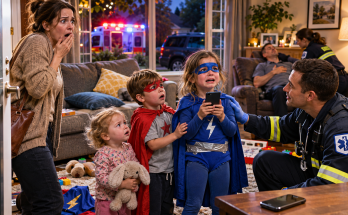
I didn't need to remind him every morning about the ambulance outside our house.
We both remembered it.
There was no benefit in constantly returning to the most frightening moment of our lives.
I wanted us to use what we'd learned.
Not live inside the memory.
Whenever James acknowledged that he needed to sit down, I tried to respond without making him feel uncomfortable.
Sometimes it was difficult.
The words themselves could frighten me.
I wanted to know whether he was experiencing the same dizziness that had preceded his collapse.
I wanted to know whether something more serious might be happening.
But I also wanted him to feel safe telling me the truth.
If every admission led to an overwhelming reaction, I worried that he might return to his habit of keeping things to himself.
So I listened.
I paid attention.
And I reminded myself that the recommended medical follow-up was important precisely because we didn't have all the answers.
James gradually became more willing to say when he felt tired.
He told me when he wasn't feeling quite right.
Those conversations were rarely dramatic.
They were small exchanges between two people learning to communicate differently.
And that was what made them meaningful.
He no longer needed to make an announcement.
He didn't need to wait until he had something definite to report.
He could simply acknowledge what he was experiencing.
I could respond.
We could make whatever adjustment was appropriate.
Then we could continue with our day.
I hadn't realized how much I'd missed that simplicity.
For weeks before the emergency, I'd noticed something was wrong and received explanations that didn't quite satisfy me.
Now I wasn't being asked to disregard my own observations.
That helped me feel more secure.
It also helped me understand that James was still struggling with feelings he hadn't previously expressed.
He didn't like being limited.
He didn't like depending on other people.
And although he knew our arrangements were necessary, knowing that didn't make them enjoyable.
There were moments when he looked disappointed in himself.
I recognized the expression.
It was the same expression he'd worn in the hospital when we'd discussed his inability to supervise the children alone.
I wished I could remove that disappointment.
But I couldn't do it by telling him something that wasn't true.
I couldn't say he was capable of everything he'd done before.
I couldn't promise that the restrictions would end quickly.
I couldn't give him a diagnosis.
What I could do was make sure he understood that his place in our family hadn't changed.
He was still my husband.
Still Emma's father.
Still Thomas's father.
Still Lily's father.
Those relationships weren't dependent on the amount of work he could complete.
I thought about what he'd told me concerning his own father.
How financial worries had gradually taken away the time they'd once spent together.
I could understand why that memory had stayed with him.
But James was facing a different situation.
He had the opportunity to remain emotionally present with his children while also accepting the physical limitations he was experiencing.
He didn't have to choose between those things.
He could sit on the couch and listen to Emma.
He could talk with Thomas.
He could smile at Lily and enjoy being near her.
He didn't need to carry her upstairs to demonstrate that he loved her.
I hoped that understanding would become easier for him.
It certainly became clearer to me.
I began noticing how little the children required from him in certain moments.
They didn't always need an elaborate game.
They didn't always need something exciting.
Sometimes they simply wanted his attention.
They wanted him to hear what they were saying.
They wanted him to look at something they'd brought him.
They wanted him to laugh.
None of those things depended on him proving how strong he was.
That realization seemed obvious once I paid attention.
But I hadn't paid enough attention before.
I'd admired James for the extraordinary amount of effort he sometimes put into entertaining our children.
Perhaps I'd forgotten to appreciate the quieter ways he was present with them.
Now those quieter moments mattered enormously.
I remembered Emma's question about whether her father could still be a superhero.
I'd answered her immediately.
Of course he could.
But the meaning of that answer needed to become visible in our everyday life.
James needed to show her that he could be her father while admitting he was tired.
That he could love her while accepting help.
That he could experience a frightening medical problem without pretending it didn't exist.
I wanted those lessons to come naturally.
Not through another serious conversation that placed more worry on her little shoulders.
She'd already had enough serious things to think about.
She deserved to be five.
Thomas deserved to be four.
Lily deserved to be two.
And none of them deserved the responsibility of protecting their father from his own embarrassment.
That responsibility belonged to James.
He was beginning to accept it.
I could see that in the way he approached the practical difficulties we faced.
When our schedules needed adjusting, he participated.
When we discussed childcare, he listened.
When the subject of his medical follow-up came up, he didn't dismiss it as something he could arrange eventually.
There were appointments to attend.
Further investigations were necessary.
He understood that now.
I was relieved to see him taking those things seriously.
But I also reminded myself that attending appointments wouldn't automatically restore the trust that had been damaged.
Trust was going to return through a series of ordinary decisions.
It would return when James told me something uncomfortable without waiting for me to ask.
It would return when he respected the doctor's instructions even though he felt well enough to do more.
It would return when we made decisions together instead of discovering afterward what the other person had decided.
That was a slower process than either of us might have preferred.
There was no particular day when I woke up and felt that everything had been repaired.
There were simply moments when I noticed that I felt less afraid.
Moments when James said he needed a rest, and I was grateful that he'd told me.
Moments when we discussed our plans without either of us becoming defensive.
Moments when the children laughed and I didn't immediately remember the ambulance.
Those moments began accumulating.
I didn't expect them to erase what had happened.
I didn't want to erase the importance of what we'd learned.
But I wanted our home to become a place where we could enjoy being together without constantly reliving Saturday afternoon.
One evening, I looked at James sitting near the children.
There was nothing remarkable about what he was doing.
He wasn't performing some impressive trick.
He wasn't organizing an elaborate adventure.
He was simply there.
I thought about how desperately I'd wanted to see him alive when I reached the emergency department.
How I'd stood near his bed and watched him breathe before I could think about anything else.
I hadn't cared then whether he could lift a truckload of boxes.
I hadn't cared whether he could earn overtime.
I hadn't cared whether he could turn the living room into a superhero academy.
I'd wanted my husband.
The man himself.
Not a collection of things he was capable of doing for other people.
I wished he could understand that as deeply as I did.
Perhaps he was beginning to.
I certainly hoped so.
As the days passed, there was another practical matter James needed to address.
His job.
The warehouse had been the place where some of his symptoms first became noticeable to someone else.
Ben had seen him struggle.
James had nearly fallen while unloading a truck.
The concerns that had led him to delay medical testing were closely connected to that work.
Now he couldn't pretend those concerns didn't exist.
His health needed attention.
His income mattered.
His duties needed to be considered in light of what was happening.
And for the first time, he seemed prepared to discuss those realities instead of silently trying to manage them.
He needed to speak to his supervisor.
We talked about that.
I didn't tell him what every word of the conversation should be.
It was his workplace.
He knew the people there.
He understood the nature of his duties better than I did.
But we agreed that he needed to be honest about his situation.
There was no point in protecting the appearance of being perfectly well when doing so might put him at risk again.
He looked uncomfortable.
I could tell it wasn't a conversation he wanted to have.
But this time, he wasn't suggesting that he would wait until everything became more convenient.
He wasn't waiting for a definite diagnosis before acknowledging that something was happening.
He was prepared to ask whether his duties could be adjusted while the doctors continued evaluating him.
It was a practical decision.
A necessary one.
And for James, it was also an admission that he couldn't keep doing everything exactly as he had before.
I watched him accept that.
And I felt proud of something I once would have considered too ordinary to notice.
He was finally preparing to ask for help before another emergency made the decision for him.