James held my hand for a while without speaking.
I was glad he didn't try to rush the moment.
There had been times during our marriage when a difficult conversation ended with one of us reaching for the other.
Usually, that was comforting.
It meant we'd understood each other.
It meant whatever had happened didn't need to stand between us anymore.
This time was different.
I wanted the comfort of holding my husband's hand.
But I didn't want him to mistake that comfort for permission to forget what we'd discussed.
Emma had still been frightened.
Thomas and Lily had still been left without adult supervision.
James had still kept important medical information from me.
Nothing about holding his hand changed those facts.
He looked at our fingers.
“I'm sorry.”
I nodded.
He continued.
“I shouldn't have gone with Ben.”
“No.”
“I should've waited.”
“Yes.”
He looked up.
“And I shouldn't have kept any of the medical stuff from you.”
I took a breath.
Hearing him acknowledge both decisions mattered.
One had happened while he was physically unwell and frightened.
The other had continued for weeks.
They weren't exactly the same mistake.
But both had come from his insistence on managing things without allowing me to help.
I needed him to understand that.
“I'm glad you're saying that.”
He nodded.
“I mean it.”
I believed he meant it at that moment.
He was lying in a hospital bed.
He'd heard what the children had experienced.
He'd admitted that his fear of becoming a burden had influenced his choices.
He seemed genuinely remorseful.
But the real test would come when he returned home.
When the children wanted him to play.
When the warehouse needed someone to cover a shift.
When a medical appointment interfered with his working hours.
When money was tight and he started wondering whether another test was worth missing work.
Those were the moments that concerned me.
Because those were the circumstances under which he'd convinced himself that remaining silent was the sensible thing to do.
I looked at him.
“Things have to be different when you come home.”
He nodded immediately.
“I know.”
I waited.
He looked at me as though he expected me to explain what I meant.
So I did.
“If you're feeling dizzy, you tell me.”
“Okay.”
“If you feel like you're going to pass out, you don't try to carry on as though nothing's happening.”
He nodded again.
“And if a doctor recommends something, I need to know about it.”
He tightened his fingers around mine slightly.
“I understand.”
I wanted to be careful about the way I explained it.
James was still an adult.
He didn't need my permission to attend medical appointments.
I wasn't going to treat him as though his body belonged to me.
But he couldn't conceal information that was relevant to whether our children were safe in his care.
That wasn't a demand I considered unreasonable.
It was a basic responsibility we shared.
I looked at the blanket.
“I'm not asking you to tell me every time you're a little tired.”
He waited.
“I'm asking you not to hide things because you're frightened of what they might mean.”
He nodded.
I thought about his explanation for delaying the tests.
The concern about missing wages.
The fear that reducing his hours might create a financial problem.
“We'll have to talk about the money.”
He looked uncomfortable again.
I expected that.
Money had been at the center of so much of his worrying.
“We'll look at what comes in and what goes out.”
He nodded.
“And if we need to make changes, we'll make them together.”
He looked at me.
“I don't want you having to work more because of me.”
“I don't know yet what either of us will need to do.”
He started to speak.
I stopped him gently.
“We haven't looked at everything.”
He closed his mouth.
I continued.
“You don't need to decide today how we're going to afford the next six months.”
He gave a small nod.
“We need to know what your doctors want you to do. Then we can work around that as best we can.”
The uncertainty was uncomfortable.
I felt it, too.
I liked having a clear idea of how we would manage the household.
I liked knowing when we were working and who was looking after the children.
I didn't enjoy the possibility of losing income.
But I couldn't allow that discomfort to become a reason for ignoring his medical needs.
We'd already seen what could happen when we did.
James looked toward the side of the bed.
“I'll figure something out at work.”
I recognized the phrase.
It was exactly the sort of thing he usually said.
I looked at him.
“We can figure something out.”
He turned toward me.
Then he nodded.
It seemed like such a small correction.
One word.
But that word mattered.
For weeks, James had apparently been saying the equivalent of that sentence to himself.
He'd decide when to have tests.
He'd decide how much work he could manage.
He'd decide whether his symptoms were serious enough to mention.
And he'd decided, after collapsing at home, how he would get medical help.
I wasn't going to continue living with the consequences of decisions I hadn't known were being made.
“There are restrictions from the doctor,” I reminded him.
He looked down.
“I know.”
“You're not supposed to drive.”
He nodded.
“And you can't be alone with the children until they've said it's safe.”
He didn't immediately respond.
I could see that the second restriction affected him differently.
Driving was practical.
It was something he needed to arrange around.
But being unable to look after his own children seemed to touch the very part of his identity we'd been discussing.
I waited.
He finally said something.
“I hate that.”
“I know.”
“They're my kids.”
“Yes.”
He looked at me.
“I've been looking after them since they were babies.”
I nodded.
“That doesn't mean you can safely do it right now.”
His expression became sad.
I understood why.
He wasn't being told he couldn't love them.
He wasn't being told he couldn't spend time with them.
He was being told that another responsible adult needed to be nearby until his health had been properly evaluated.
But I knew it probably felt like losing an important part of his everyday life.
I wasn't insensitive to that.
I just couldn't let my sympathy become another reason to overlook the risk.
“You can still be with them,” I said.
He nodded.
“You can still read them stories.”
He looked down.
“You can still talk to them, play with them when you're feeling well, and be part of whatever they're doing.”
He listened.
“The difference is that somebody else needs to be there.”
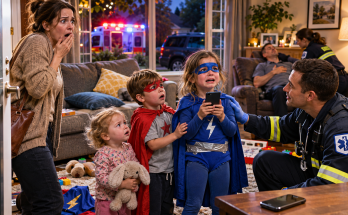
I thought about the unlocked front door.
The three children inside the house.
The absence of an adult.
I wasn't prepared to experience that again.
And more importantly, I wasn't prepared to allow the children to experience it again.
“There's no exception to that arrangement,” I said.
James looked at me.
“Even if you have a really good day.”
He nodded.
“Even if you think you feel completely normal.”
“I understand.”
“And even if changing our schedules is inconvenient.”
He swallowed.
“Okay.”
I held his gaze.
I wanted him to know that I wasn't saying those things casually.
I wasn't making a suggestion that he could disregard if he decided circumstances justified it.
The restriction had come from his physician.
It was necessary for everyone's safety.
I needed him to respect it.
He looked down at our hands.
“I don't want you thinking you can't trust me.”
I felt something tighten inside me.
I didn't want that either.
Trust had been one of the most comfortable parts of our marriage.
I'd rarely questioned whether James would do what he'd said he would do.
I'd trusted him with the children.
I'd trusted him to tell me if something went wrong.
I'd trusted him to make sensible decisions when I wasn't there.
Saturday had damaged that trust.
Not completely.
Not irreparably.
But enough that I couldn't honestly tell him nothing had changed.
I took a slow breath.
“I want to trust you.”
He looked at me.
“But I need you to understand why I'm worried.”
He nodded.
“I know.”
“When you told me you were fine Saturday morning, I believed you.”
His eyes filled again.
“I shouldn't have said that.”
I continued.
“You had information I didn't have.”
He listened.
“And I made a decision based on what you told me.”
He nodded slowly.
“That can't happen again.”
He looked at me.
“It won't.”
I hesitated.
Normally, those words would have been enough.
I would have accepted his promise and moved on.
But after what had happened, I didn't need another general assurance that everything would be fine.
I needed something more specific.
“If you're frightened, tell me you're frightened.”
He nodded.
“If you don't know what something means, tell me you don't know.”
He listened.
“And if you're worried about losing money because you need a medical appointment, talk to me before deciding not to go.”
He took a breath.
“I can do that.”
I hoped he could.
I knew it would take practice.
James had spent a long time responding to uncomfortable situations by reassuring the people around him.
He wasn't going to abandon that habit simply because we'd discussed it once.
There would probably be moments when his first instinct was still to say he felt perfectly alright.
But I needed him to catch himself.
I needed him to recognize that being honest wouldn't make him less valuable to us.
I squeezed his hand.
“I love you.”
He looked at me.
“I love you, too.”
I swallowed.
“But loving you doesn't mean I can pretend Saturday didn't happen.”
He nodded.
“I wouldn't ask you to.”
I was grateful he understood that.
I didn't want to punish him.
I didn't want to bring up his mistake every time we disagreed about something.
I wanted us to learn from it.
That meant acknowledging the damage without making the damage the only thing we could see.
James looked at me.
“I really am sorry.”
I nodded.
“I know.”
He held my hand a little tighter.
“I'll tell you what's happening from now on.”
For once, he wasn't promising that nothing bad would happen.
He wasn't promising that he could handle every problem.
He was promising to let me know when he couldn't.
That was different.
It was also the kind of promise he could actually keep.
I stayed beside him.
The medical equipment continued doing its quiet work.
Beyond that hospital bed, there were still three children waiting for their father.
There were expenses waiting to be paid.
There were appointments waiting to be arranged.
None of those responsibilities had disappeared.
But we had finally agreed that we would face them without withholding the information the other person needed.
I looked at James.
He looked exhausted.
I asked whether he wanted to rest.
For once, he didn't immediately tell me he wasn't tired.
He nodded.
“Yes.”
I moved my chair back slightly.
And I let him rest.