I looked at James for a long time before speaking again.
He seemed smaller beneath that thin blanket than he ever had at home.
There was something about seeing him connected to medical equipment that made it difficult to be angry.
But I was angry.
And pretending otherwise wouldn't help either of us.
“Do you understand what Emma went through today?”
He nodded slowly.
“I know she was frightened.”
“She thought she couldn't wake you up.”
James closed his eyes.
I continued.
“She tried shaking you. She even put water on your face.”
He brought his hand toward his forehead.
I could see him struggling to listen.
But I needed him to hear it.
“She was trying to make you respond, James. She didn't understand why you weren't moving.”
He covered his eyes.
I stopped for a moment.
I'd spent years wanting to protect my husband from unnecessary worries.
When things went wrong at home, I sometimes waited until he'd finished a difficult shift before discussing them.
I considered that ordinary kindness.
Now I was sitting beside him, deliberately telling him something painful.
It felt wrong.
It also felt necessary.
“She had to find the telephone herself.”
He nodded.
“And then she had to explain what was happening to someone she'd never spoken to before.”
He wiped his face.
“I can't believe she had to do that.”
“Neither can I.”
I pictured Emma standing in our living room.
She was so little.
There were things she couldn't reach without assistance.
There were buttons she sometimes needed help fastening.
And yet she'd somehow managed to give our address to an emergency dispatcher while believing something terrible had happened to her father.
That was an enormous responsibility for a child.
She'd handled it remarkably well.
But she should never have been expected to handle what happened afterward.
“When you came around, she probably thought everything was alright again.”
James nodded.
I leaned toward him.
“Then you left.”
His face changed.
“I know.”
“You left Thomas and Lily with her.”
He looked away.
I waited for him to say something.
Nothing came.
“Why would you do that?”
“I don't know.”
“James.”
“I really don't know what I was thinking.”
He sounded miserable.
I tried to understand what it must have been like for him.
He'd lost consciousness.
He'd awakened to find his frightened daughter beside him.
He might have been confused.
He was physically unwell.
I accepted all of that.
What I couldn't understand was why he'd insisted on leaving when someone was already coming to help.
“Ben told you to wait.”
James nodded.
“He said we shouldn't go.”
“And you wouldn't listen?”
“No.”
“Why?”
He rubbed his face again.
“I couldn't stand the idea of the kids seeing somebody carry me outside.”
I looked at him.
The answer was so simple.
And so upsetting.
He'd been worried about how he appeared to our children at a moment when their actual safety should have been his only concern.
He hadn't wanted them to see their father unable to walk out of the house by himself.
So instead, they'd watched him disappear without understanding where he was going.
I sat back.
I didn't know what to say.
James turned his face toward me.
“I wanted to get out before they saw how bad it was.”
“But they'd already seen it.”
He stopped moving.
I continued quietly.
“Emma had already found you unconscious.”
His eyes filled again.
“You couldn't protect her from seeing that by leaving afterward.”
He looked toward the ceiling.
I knew he understood.
His silence told me that much.
But understanding after something had happened was different from making a sensible decision while it was happening.
I needed to know that he recognized that difference.
For most of our marriage, James had been the person I turned to when something unexpected happened.
If the car had a problem, I called him.
If one of the children had a fever and I was worried, I called him.
If a pipe started leaking, James was usually the first person looking for a way to stop the water.
I loved having someone who made difficult moments feel manageable.
He didn't always know what to do immediately.
But he was usually willing to try.
Sometimes just hearing his voice made me feel better.
I'd come to depend on that quality in him.
Perhaps I'd depended on it more than I'd realized.
Whenever James said things would be alright, I wanted to believe him.
And when he said he could deal with a problem himself, I rarely questioned whether he actually needed assistance.
I thought he liked being dependable.
I thought it made him happy.
I hadn't understood that being dependable might also have become something he felt incapable of giving up.
There was a difference between wanting to help your family and believing that your family couldn't see you struggle.
James seemed to have crossed that line without either of us noticing.
I looked at the IV tubing beside his arm.
He was being looked after by people whose entire job was to help him.
He couldn't pretend he didn't need them.
And for the first time that day, he couldn't pretend he didn't need me.
“I didn't want them to be scared,” he said.
I shook my head.
“That's exactly what happened.”
He nodded.
I remembered Emma asking whether she'd done something wrong.
That question stayed with me.
Of everything she'd said that afternoon, it was the thing that hurt in a particularly quiet way.
She'd been the person who had responded properly.
Yet she'd been sitting in our house wondering whether the adults were upset with her.
“Emma thought she was in trouble.”
James looked at me sharply.
“For calling?”
“I think she was confused about everything.”
He lowered his head.
“She didn't do anything wrong.”
“I told her that.”
He looked relieved.
But I wasn't finished.
“She shouldn't have had to ask.”
He sat quietly.
I wanted to reach for him when I saw the tears gathering in his eyes.
It was a familiar instinct.
When someone I loved was hurting, I wanted to make the hurt stop.
But I didn't want to offer him reassurance before we'd properly acknowledged what had happened.
There were times when comforting someone too quickly allowed an important conversation to disappear.
I didn't want this conversation to disappear.
Not after today.
“I'm not angry because you got sick.”
He looked at me.
“I know.”
“No, listen to me.”
He waited.
“If you'd called me this morning and said you couldn't look after them, I would've come home.”
His face tightened.
“If you'd told me three weeks ago that the clinic wanted you to have tests, we would've figured something out.”
I paused.
“You didn't give me the opportunity.”
He nodded slowly.
“I thought I was saving you from having something else to worry about.”
“Now I'm worrying about more than I ever would've been if you'd just told me.”
He didn't argue.
I could see him considering those words.
He'd thought he was reducing the pressure on me.
Instead, he'd created a situation in which I'd left work believing my husband might be seriously injured or worse.
I'd returned home to an ambulance and three frightened children.
I'd searched rooms.
I'd stared at an unfamiliar man in a video.
I'd stood outside our home listening to a coworker tell me about a medical problem that had apparently existed for weeks.
None of that had spared me from worrying.
It had only delayed my opportunity to understand what was happening.
I looked at him.
“You couldn't control how frightened they were by hiding how sick you felt.”
He wiped his cheek.
“I see that.”
“Do you?”
“Yes.”
I hoped he meant it.
I desperately wanted him to mean it.
But there would be time to find out whether anything had genuinely changed.
For now, he needed to remain at the hospital.
And our children needed me at home.
I thought about the doctor's instructions.
James wasn't going to be allowed to drive.
He couldn't look after the children alone.
Those changes were going to affect our routines.
Our working hours.
Our finances.
Everything James had been trying to protect by keeping his symptoms private.
We would have to deal with those things anyway.
Only now, we'd be dealing with them after a frightening emergency.
I felt exhausted.
The morning seemed impossibly far away.
I'd started the day watching my husband cut toast.
Now I was looking at a hospital blanket and wondering how we'd reorganize our lives.
James reached toward his face again.
“I'm so sorry.”
I looked at him.
“I know you're sorry.”
He appeared to be waiting for me to tell him that everything was alright.
I couldn't do that.
Not yet.
I was grateful he'd survived the afternoon.
I loved him.
I wanted him to recover.
But our children had been placed in a situation that neither of us could ever allow to happen again.
That required more than an apology.
I spoke quietly.
“The children needed you to remain there.”
He nodded.
“They needed you to let the ambulance come.”
Another nod.
“Even if it meant they saw you being taken away.”
He swallowed.
“I should've stayed.”
“Yes.”
There was nothing else to add to that particular point.
I let the silence remain.
For once, James didn't fill it with a promise or a joke.
He cried quietly.
I sat beside him, watching the equipment near his bed and trying to accept that the man I'd always considered so capable was genuinely frightened.
Eventually, I looked at the time.
Denise was looking after the children, but I couldn't leave them waiting all evening without speaking to them myself.
Emma needed to know her father was alive.
Thomas needed reassurance.
Lily needed the ordinary comfort of having someone familiar nearby.
I told James I would return home.
He asked whether I would tell the children he was alright.
I considered my answer.
“I'll tell them you're awake and the doctors are helping you.”
He nodded.
That was the truth.
It wasn't a promise that nothing else would happen.
It wasn't a guarantee that he'd be home soon.
It was simply what I knew.
James looked at me.
“Tell Emma I'm proud of her.”
“I will.”
He looked down at the blanket again.
“And tell her she did the right thing.”
I nodded.
There was something painful about hearing him say that after he'd ignored the help she'd called for.
But I was glad he recognized it.
I wanted Emma to hear those words from him eventually.
I wanted him to explain that asking for help wasn't something she needed to feel ashamed of.
For that explanation to mean anything, though, he would have to start believing it himself.
I stood beside his bed.
I looked at him once more before leaving.
That morning, he'd kissed my cheek and assured me that he had everything under control.
Now neither of us could honestly say we knew what would happen next.
The cause of his collapse was still unknown.
The tests weren't finished.
Our plans for the following days would have to change.
But there was one thing I was certain about.
I wasn't going to return to the arrangement we'd had before.
Not until someone could tell us that James was medically able to care for the children safely.
And not until my husband understood that keeping me informed wasn't optional when his decisions affected all five of us.
I left the emergency department.
Outside, I took a moment before heading home.
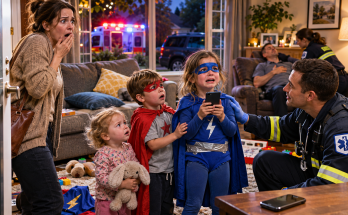
I thought about Emma's blue tights.
The flour covering the counter.
The silly little video that had made me laugh at work.
My daughter had started her Saturday believing she was attending superhero school.
She'd ended it wondering whether her father would ever open his eyes again.
I couldn't take that experience away from her.
But I could go home and make sure she understood that none of it had been her fault.