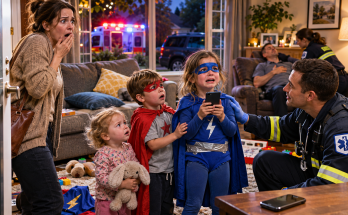
I asked Emma what she remembered hearing.
She looked toward the kitchen.
“You and Daddy were talking.”
I nodded.
“About the bills?”
“Yes.”
She wasn't able to repeat the conversation word for word.
I didn't expect her to.
What mattered was what she'd understood from it.
James and I had been discussing money the previous week.
We'd been talking about the things we needed to pay for and the additional work that might help us manage.
It wasn't an unusual conversation for us.
We hadn't been having a terrible argument.
There hadn't been some enormous announcement about our finances.
We were simply discussing the expenses that came with having a home and three children.
But Emma had been listening.
She'd noticed our expressions.
She'd heard the concern in our voices.
And she'd apparently connected that concern with something else she'd been seeing.
Her father's tiredness.
I looked at her.
“Did you ask Daddy about it afterward?”
She nodded.
“What did you ask him?”
“If he was getting too tired.”
My chest tightened.
I waited for her to continue.
She gathered the tights into a small bundle.
“I asked if he was too tired to be a superhero anymore.”
I looked away for a moment.
I didn't want her to see the expression on my face and think she'd said something upsetting.
She'd noticed.
Of course she had.
Children didn't necessarily need adults to explain that something had changed.
Sometimes they understood changes through little things.
A father who no longer carried his youngest daughter upstairs.
A father who went to bed before they expected him to.
A father who sat watching them instead of joining their games.
Emma had seen those things.
And unlike me, she hadn't accepted his tiredness as something that would necessarily disappear after a good night's sleep.
She'd been worried.
She'd asked him a question that was much more important than it sounded.
“What did Daddy say?”
Emma smiled faintly.
“He said nobody was stronger than him.”
I looked down at the blue tights.
James had apparently told her he was still the strongest father she could imagine.
Then he'd promised to organize superhero school on Saturday.
I felt tears gathering in my eyes.
I hadn't understood.
When James sent me that video around noon, I'd assumed he'd simply invented another ridiculous game.
Something to entertain the children while I worked.
I'd laughed at Emma's costume.
I'd laughed at Thomas.
I'd loved hearing Lily giggle in the background.
I hadn't realized James was trying to keep a promise he'd made to a worried little girl.
He wanted to show Emma that he could still be the father she'd always known.
That whatever she'd overheard about bills didn't change anything.
That his tiredness wasn't something she needed to worry about.
And that he was still strong enough to make their Saturday wonderful.
There was something deeply loving about that intention.
There was also something terribly sad about it.
He'd been feeling unwell for weeks.
He'd already visited a clinic.
He knew he needed further tests.
Yet he'd apparently believed the best way to reassure his daughter was to continue behaving as though none of those things mattered.
He wanted to give her evidence that he was alright.
Instead, he'd given her a memory of finding him unconscious.
I looked at Emma.
“Were you excited about superhero school?”
She nodded.
“Daddy promised.”
I could hear the importance of that promise in her voice.
I imagined how much she'd looked forward to Saturday.
The costumes.
The cushions.
The silly games James always managed to invent.
For most of the day, she'd probably believed her father had proven everything he wanted to prove.
He could still play.
He could still laugh.
He could still be the strongest person in her little world.
Then the game had stopped.
I thought about Thomas saying that James needed frequent breaks.
I could imagine those breaks gradually becoming longer.
James sitting down.
Waiting for his dizziness to improve.
Then returning to the children because he'd promised them something special.
He hadn't wanted to disappoint Emma.
He hadn't wanted her to believe that her concerns were justified.
But the concerns were justified.
And the person who needed to acknowledge that wasn't our daughter.
It was James.
I wished he'd understood that before the afternoon had ended the way it did.
I looked at Emma's little hands.
She was holding the costume as though it contained an answer she couldn't quite find.
I wanted to give her that answer.
But I knew I needed to be careful.
I couldn't promise that her father would never become unwell again.
I couldn't tell her that superheroes never got hurt.
Those were the kinds of assurances that had helped create her confusion in the first place.
Instead, I tried to explain something that I wished James had understood himself.
“Sweetheart, getting sick doesn't mean somebody isn't strong.”
She looked at me.
“It doesn't?”
“No.”
She thought about that.
“But Daddy couldn't get up.”
“Sometimes people's bodies need help.”
“Even Daddy?”
“Especially when he feels the way he felt today.”
She leaned toward me.
“Can superheroes go to the doctor?”
I felt myself smile despite everything.
“Yes. They're allowed to do that.”
She looked surprised.
“Really?”
“Of course.”
I adjusted the tights in her lap.
“If they need help, going to the doctor is a very sensible thing to do.”
Emma seemed to consider whether this new information fitted with everything she'd believed about superheroes.
I could almost see her working through it.
“Then they can get better?”
“The doctors try to help them get better.”
She nodded.
I didn't promise more than that.
I wanted her to feel safe.
But I also wanted the words I used to be true.
She'd heard enough promises that hadn't turned out the way she'd expected.
I looked at Thomas.
He seemed much less concerned with defining what a superhero was.
He simply wanted his father home.
Lily, at two, couldn't have understood the conversation in the same way.
But all three of them needed the same thing from us.
Adults who would make sensible decisions.
Adults who would ask for assistance when necessary.
Adults who wouldn't leave them responsible for situations they were too young to understand.
I couldn't change what they'd experienced that afternoon.
I could change how James and I responded to it afterward.
Emma rested her head against me.
I held her.
There was no need to keep asking questions.
She'd told me what she remembered.
She'd explained why the game mattered to her.
And she'd revealed something about James that I hadn't understood when I'd spoken to him at the hospital.
His determination to remain strong hadn't been directed only at me.
He'd been trying to reassure his children, too.
I thought about all the times I'd praised him for being dependable.
All the times I'd felt grateful because he could make the children laugh when I was too tired.
I'd never expected him to be invulnerable.
But had I made that clear enough?
Had we ever actually discussed what would happen if one of us needed to stop working for a while?
We discussed bills.
We discussed schedules.
We discussed who would handle breakfast and who would take care of appointments.
Those were practical conversations.
What we rarely discussed was how frightened we sometimes felt.
Perhaps James believed admitting those fears would make everything harder.
Perhaps he thought a good husband was supposed to keep them to himself.
I didn't know yet.
I would have to ask him.
For now, I stayed beside Emma.
She gradually became quieter.
Her fingers stopped moving through the fabric.
Her head grew heavier against me.
Eventually, she fell asleep.
I looked down at her face.
She seemed peaceful in a way that made the events of the afternoon feel almost impossible to imagine.
This little girl had been able to give an emergency dispatcher our address.
She'd tried to help her father.
She'd listened to his instructions even when she didn't understand them.
And afterward, she'd worried that she'd done something wrong.
I kissed her hair.
I wished more than anything that she could forget the frightening parts of the day.
But I knew that memories didn't work that way.
I couldn't decide which parts of Saturday she would remember.
I couldn't remove the image of James lying unresponsive.
What I could do was make sure the adults around her responded differently from that point forward.
James remained in the hospital that night.
The physicians wanted to continue evaluating him.
There was still no definite explanation for his collapse.
I didn't know whether I should be relieved that they hadn't immediately identified something serious or frightened that we still didn't have an answer.
Both feelings seemed reasonable.
I thought about the medical appointment he'd attended three weeks earlier.
There had been a chance then to investigate what was happening.
He'd allowed that chance to pass because he was worried about missing work.
Now he was missing work anyway.
And our entire household had been affected.
The irony wasn't lost on me.
But I didn't want to turn every thought about James into another accusation.
He was unwell.
He was frightened.
And beneath all the mistakes he'd made, I knew he loved us.
What mattered was whether he could begin expressing that love differently.
He would have to accept that looking after himself was part of looking after his children.
I wasn't going to persuade him of that by pretending he'd done nothing wrong.
Nor was I going to persuade him by treating him as though he was incapable of making any good decisions again.
There needed to be a change in how we dealt with problems together.
I thought about the finances.
We would need to make arrangements.
I couldn't leave the children alone with him while the doctors were investigating his symptoms.
Neither of us knew how long that restriction would last.
There would be appointments.
There would probably be changes to our work schedules.
And there would still be bills arriving.
Those were genuine problems.
But they were problems we could discuss.
We could look at the numbers.
We could ask Denise whether she was available to help with childcare.
We could consider whatever adjustments our employers might allow.
What we couldn't do was continue acting as though ignoring a problem made it less expensive or less frightening.
James had tried that.
It had brought us to a hospital.
The following day, the medical evaluation continued.
I remained concerned about the absence of a clear explanation.
James had been experiencing difficulties for approximately a month.
The afternoon's collapse hadn't come entirely without warning.
Yet knowing that didn't tell us what had caused it.
I understood that the medical team needed time.
I tried not to demand certainty from people who didn't yet have enough information to provide it.
James eventually spent two nights in the hospital.
During that time, the initial investigations didn't identify an immediate problem that required him to remain hospitalized for additional treatment.
That was reassuring.
But it wasn't the same as having a diagnosis.
There were arrangements to make for further monitoring and appointments after he returned home.
His doctors still needed to investigate the repeated episodes.
I was going to make sure he followed through this time.
Not by treating him like another child.
By insisting that we deal with the situation as two adults whose decisions affected an entire family.
On the second morning, I went to sit beside him.
The hospital blanket was still covering his legs.
I pulled my chair toward the bed.
He looked at me with a tired smile.
“How are they?”
“The children are alright.”
He appeared relieved.
I sat down.
There was something I needed to tell him.
Something Emma had explained while holding those blue tights on our couch.
I wanted James to understand how carefully his daughter had been watching him.
How much she'd believed the things he'd promised.
And how her question about superheroes revealed a fear neither of us had recognized.
I looked at my husband.
“Emma told me why you planned that game for Saturday.”
His smile faded.
He looked down at his hands.
I knew then that he remembered the conversation.
And I realized that our daughter's question had probably meant even more to him than I understood.