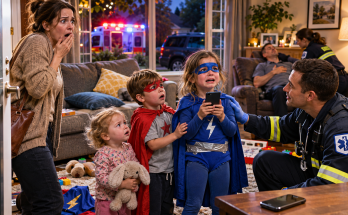
James looked down at the blanket.
For a man who usually had an answer for everything, he suddenly seemed unable to find a single useful word.
I waited.
The equipment beside his bed made quiet sounds that I couldn't identify.
I kept glancing at the IV in his arm.
Part of me wanted to forget my question and simply be grateful that he was alive.
But I couldn't.
“Why did you leave the children?”
He swallowed.
“I thought Ben could get me somewhere quicker.”
“Quicker than an ambulance that was already coming?”
“I wasn't thinking properly.”
I pulled my chair closer.
“Emma had already called for help, James.”
“I know.”
“She told you that?”
“Yes.”
I looked at his hands.
They were resting on top of the hospital blanket.
Those were the hands that had cut Emma's breakfast into triangles that morning.
The hands that had helped Lily when she dropped her spoon.
I couldn't stop thinking about how tightly he'd held the kitchen counter.
“Emma said you were hiding from Ben.”
James looked up.
“What?”
“She thought you didn't want him to find you. She was frightened.”
His expression changed.
“No. That's not what I meant.”
“Then what did you mean?”
“I didn't want him coming in and seeing me lying there.”
He rubbed his forehead.
“I was embarrassed. I didn't want anybody seeing me like that.”
I stared at him.
My daughter hadn't understood the difference between her father being afraid of another man and her father being ashamed of appearing helpless in front of him.
She'd heard words that frightened her.
Then she'd watched him leave with that same man.
Of course she'd been confused.
James closed his eyes briefly.
“I must've said something she misunderstood.”
“She thought somebody had taken you away.”
“Oh, God.”
He looked genuinely distressed.
I could see that he hadn't intended to frighten her.
But intentions hadn't protected our children that afternoon.
They hadn't prevented Emma from believing that something terrible was happening.
Before I could ask another question, a physician entered the room.
I moved my chair slightly to give her space.
She introduced herself and began speaking to us about James's condition.
He was stable.
Hearing that word gave me a little comfort.
But the physician made it clear that losing consciousness wasn't something we could simply dismiss because he was awake again.
They needed to investigate.
They were examining his blood pressure, his heart rhythm, and other possible explanations for what had happened.
I listened carefully.
I wanted something definite.
A name.
An explanation.
Something that would tell me what we were dealing with and what needed to happen next.
But she didn't have that answer yet.
She turned toward James.
“Has anything similar happened before today?”
James hesitated.
I recognized that hesitation immediately.
It was the same uncomfortable silence I'd experienced when Ben first started telling me about the warehouse.
I looked at my husband.
“Tell her everything.”
He glanced at me.
Then he looked back at the physician.
“I've been feeling dizzy occasionally.”
“How long has that been happening?”
“About a month.”
The physician asked him to explain what he meant by dizzy.
James described the times he'd felt unsteady.
The moments when he'd needed to sit down.
The occasions when he'd thought he might faint.
I sat quietly beside him.
Every answer seemed to uncover another piece of information that should never have been news to me.
He wasn't talking about one unusual morning.
He wasn't describing a sudden illness that had surprised him while playing with the children.
He was describing weeks.
Weeks during which we'd slept beside each other.
Weeks during which we'd shared meals and discussed our schedules.
Weeks during which I'd asked him whether he was alright.
The physician continued asking questions.
James answered them more honestly than he'd answered mine.
Then he mentioned something that made me turn toward him.
“I went to a clinic a few weeks ago.”
The physician asked when.
“Three weeks, approximately.”
I interrupted before I could stop myself.
“You went to a clinic?”
James nodded.
I stared at him.
“You actually saw someone?”
“Yes.”
“And what did they say?”
He explained that additional medical tests had been recommended.
The physician asked whether those tests had been completed.
James shook his head.
I felt my chest tighten.
It was difficult to sit there without saying everything that was suddenly going through my mind.
He'd known enough to seek medical advice.
Someone had told him that his symptoms needed further investigation.
And he'd come home afterward without mentioning any of it.
Not one word.
I tried to remember what we'd been doing three weeks earlier.
There hadn't been any conversation about a medical appointment.
Nothing about arranging time off.
Nothing about tests.
If he'd told me, I would have remembered.
I would have asked questions.
I would have wanted to know when the follow-up was scheduled.
But apparently, he'd decided to handle the entire situation without involving me.
The physician didn't criticize him.
She explained why repeated episodes of dizziness and near-fainting needed proper attention.
Feeling better between episodes didn't necessarily mean that the problem had gone away.
James listened.
I watched his face.
He looked uncomfortable, but this time there was nowhere for him to go.
He couldn't change the subject by asking whether the children needed breakfast.
He couldn't announce that he was tired and head upstairs.
He was lying in a hospital bed.
And someone was telling him that his symptoms mattered.
The physician explained that until they had a better understanding of his condition, there were activities he needed to avoid.
Driving was one of them.
Looking after the children without another adult present was another.
James looked at me when she said that.
I didn't look away.
It was difficult hearing a stranger tell my husband that he couldn't safely supervise his own children.
But it was also necessary.
That afternoon had demonstrated exactly why.
I thought of Emma sitting beside him, trying to understand why he wouldn't respond.
I thought of Thomas and Lily being entirely dependent on a five-year-old child for help.
There was no argument James could make that would persuade me to allow that situation to happen again.
He nodded toward the physician.
She explained that further results would help determine what happened next.
Then she left us alone.
I listened to the sounds around the bed.
James shifted beneath the blanket.
Neither of us spoke immediately.
Eventually, I turned toward him.
“Three weeks?”
He looked at me.
“What?”
“You went to that clinic three weeks ago?”
“Yes.”
“And you didn't think I needed to know?”
He exhaled slowly.
“I didn't want to upset you.”
I shook my head.
“You didn't want to upset me?”
“I thought I'd get it sorted out.”
“But you didn't.”
He looked down.
“No.”
I wanted to understand his reasoning.
Not because I thought it would excuse anything.
Because I couldn't understand how my husband had reached the conclusion that keeping something like this from me was a sensible thing to do.
“What stopped you from arranging the tests?”
He rubbed his thumb against the edge of the blanket.
“Work.”
I waited.
He explained that the warehouse had already been reducing working hours.
Taking time away for medical appointments meant losing income.
He was worried about what that would do to our finances.
I thought about the unexpected Saturday shift I'd accepted.
I'd been pleased that morning because the extra money would help us.
James had encouraged me to go.
Now I wondered whether he'd been pushing himself harder because he was afraid of earning less.
“We could've worked something out,” I said.
He shook his head slightly.
“It's not that simple.”
“We have medical insurance.”
“That doesn't replace my wages when I'm not there.”
I couldn't argue with that particular fact.
We both knew how much difference missing work could make.
But there were other things to consider.
His health.
The children.
The possibility that something might happen while he was unloading a truck.
Or driving.
Or standing in our kitchen with Lily beside him.
“Why wasn't that a conversation we had together?”
He didn't answer.
I continued.
“You knew you weren't feeling right. You knew someone wanted you to have more tests.”
“I kept hoping it would improve.”
“And when it didn't?”
He stared toward the end of the bed.
“I thought I could manage a little longer.”
A little longer.
That was apparently what he'd been telling himself for weeks.
I wondered how many mornings he'd gotten dressed for work while feeling uncertain about whether he'd manage the day.
How many times he'd come home and smiled at us because he didn't want us to know how frightened he was.
I wanted to feel sorry for him.
In some ways, I already did.
But there were three children involved.
His decision hadn't affected only him.
I remembered a recent afternoon at the park.
James hadn't participated the way he normally did.
He'd stayed seated while the children played.
At the time, I'd assumed he was simply enjoying a chance to rest.
I hadn't thought there might be another reason.
Then there was the evening when he'd asked Emma to bring him some water.
She'd been pleased to help.
I'd barely noticed.
Children liked doing small things for their parents, and James had thanked her.
Now I wondered whether he'd asked because getting up seemed too difficult.
I looked at him.
“Were you dizzy at home, too?”
He hesitated.
“Sometimes.”
I pressed my lips together.
There it was.
Another answer I hadn't received when I'd asked about his tiredness.
Another explanation for something I'd observed without understanding it.
I remembered how he'd stopped carrying Lily upstairs.
The early nights.
The tired expression that seemed to remain even after he'd slept.
None of those things looked quite the same anymore.
I couldn't change what I'd believed at the time.
But I could finally understand why those little moments had bothered me.
James hadn't simply been working too hard.
He'd been experiencing symptoms that worried him enough to visit a clinic.
And he'd deliberately avoided telling me.
“Did you really think it was alright to spend the whole day alone with the children?”
“I didn't expect this to happen.”
“That isn't what I asked.”
He looked at me.
“I thought I'd be okay.”
I shook my head.
He'd been uncertain enough to ask Ben for help.
He'd been worried enough to see a physician weeks earlier.
Yet he'd allowed me to leave for work believing that he was perfectly capable of looking after Emma, Thomas, and Lily.
I couldn't get past that.
“You told Ben how you were feeling.”
James looked uncomfortable.
“He knew because he'd seen it happen.”
“But you could've told me.”
“I know.”
I leaned back in the chair.
For years, I'd believed that if something serious happened to one of us, the other person would be the first to know.
I'd never considered that James might think differently.
I understood that financial worries had frightened him.
I understood that he hadn't wanted to burden me.
But sitting beside his hospital bed, I finally understood something else.
My husband had made a decision about our family's safety without allowing me to participate in it.
And our five-year-old daughter had been the one left to deal with the consequences.