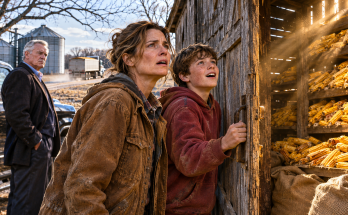
The following morning, I went into the workshop and found Earl standing beside B193.
He was holding a piece of chalk.
I stopped just inside the entrance.
For a moment, I simply watched him.
He was examining the burl from one side, his head tilted slightly as though something about its shape required careful consideration.
I knew that expression.
I also knew the trouble he could cause while wearing it.
"What are you doing?"
He turned toward me.
"Not much."
I looked at his hand.
"Why have you got the chalk?"
He glanced down as though he had only just discovered it.
"Can't a man carry a piece of chalk?"
"Not when he's standing beside that particular burl."
He grinned.
I walked toward him.
"Leave it where it is, Earl."
"I haven't touched anything."
"Good."
He looked at B193 again.
There was something amusing about the scene.
Years earlier, I had been standing beside B38 holding chalk while Earl warned me against making an expensive mistake.
Now he was the one considering a piece of maple that I hadn't given him permission to mark.
I suspected he understood the resemblance.
That was probably why he looked so pleased with himself.
He rested one hand against the bark.
"How many more years are you planning to make this thing take up space?"
I didn't answer immediately.
The question would once have irritated me.
B193 had become a particular reminder of the beginning of the business.
I hadn't wanted to change its appearance.
I hadn't wanted to turn it into a collection of blocks carrying the same identification number.
There had been something comforting about knowing it remained exactly where I had left it.
But I had been thinking about that the previous evening.
The walk toward the creek had made me reconsider several things.
I looked at the burl.
It was still an ordinary-looking growth.
There was no guarantee it contained interesting material.
Nothing about its size or appearance demanded the attention B38 had received.
I hadn't preserved it because I expected some extraordinary financial result.
In fact, I had deliberately avoided attaching an expected price to it.
I had simply wanted to keep it.
Earl waited.
"You're going to have to open it someday."
"Am I?"
"Unless you're planning to leave instructions about it in your will."
I laughed.
Then I looked toward the workbench.
Earl's bowl was still there.
The grain caught the morning light.
I thought about the first burl again.
There was no longer an intact growth I could examine and say that was precisely how the wood appeared when I brought it to Earl's workshop.
Part of it had become the bowl.
The rough exterior had been removed.
The material had been shaped into something different.
Yet the memory of that afternoon remained.
I could still recall the sound of the bandsaw.
I could still recall the moment the first section came away.
I could still recall Earl dampening the exposed grain so I could see its character more clearly.
I hadn't lost any of those memories when the original wood changed.
If anything, the bowl gave me another reason to remember them.
I turned toward B193.
Perhaps I had been confusing preserving an object with preserving what it meant to me.
They weren't necessarily the same thing.
I could open the final numbered burl and continue remembering the day it was left on the property.
I could examine its interior without diminishing the years of work that followed.
Whatever happened to it afterward couldn't undo what had already happened in my life.
That thought seemed obvious once I allowed myself to consider it.
I wondered why I had taken so long to understand it.
Earl was still holding the chalk.
I extended my hand.
"Give me that."
He handed it over.
Then he raised his eyebrows.
"What are you planning?"
I looked at B193.
"I'm going to see whether we can find a sensible place to begin."
He smiled.
There was no triumphant announcement.
He didn't tell me that he had finally persuaded me to do something I should have done months earlier.
He simply stepped aside.
I was grateful for that.
The decision needed to feel like mine.
Not something I was doing because Earl had grown tired of seeing an ugly piece of wood occupying useful space.
I knelt beside the burl.
The lower portion was easier to examine from that position.
I studied the areas where the bark formed irregular clusters.
I looked for visible cracking.
I examined the overall thickness and considered how the growth had developed.
I had done similar work many times.
Still, this piece felt different beneath my hands.
Perhaps because I remembered a period when none of those features would have meant anything to me.
At the beginning, I would have looked toward Earl and asked him to explain what I was seeing.
I would have wanted him to identify the promising portions.
I would have wanted him to tell me where to mark the wood.
I certainly would have wanted reassurance that whatever we found would be worth the effort.
That morning, I didn't ask him anything.
I continued examining the piece.
I moved around it slowly.
Certain areas interested me more than others.
I considered the natural shape rather than imagining the finished products I might prefer to produce.
I had learned not to force those expectations on the material.
B67 had taught me that.
Trying to create one particularly impressive slab could sometimes sacrifice sections better suited to completely different uses.
There was no reason to repeat that mistake merely because I wanted B193 to contain something special.
I needed to work with the piece I actually had.
Not the piece I hoped was beneath the bark.
I stood and walked around it again.
Earl remained nearby.
He didn't interrupt.
I appreciated his silence more than I once would have.
There had been a time when his refusal to give definite answers had frustrated me.
Now I understood that he was giving me room to make my own assessment.
If I constantly waited for him to tell me what to do, I would never become entirely comfortable with making decisions myself.
There was also something pleasant about discovering that I didn't need to fill the silence.
I could examine the wood without explaining every thought.
I could take the time I needed.
There wasn't a buyer standing beside me waiting for an answer.
There wasn't a tax bill demanding an immediate sale.
There wasn't a man with a leather folder insisting I stop working until somebody examined the paperwork.
There was simply an unopened burl.
A piece of chalk.
And a decision.
I considered several possible places to mark the first cut.
Each had advantages.
Each involved uncertainty.
The exposed grain could develop differently from what I expected.
A defect could appear in a place where there was no obvious warning on the surface.
The interior could be ordinary.
I couldn't eliminate those possibilities.
I no longer felt that I needed to.
The business had taught me to distinguish between an unavoidable uncertainty and a careless decision.
I could make a thoughtful choice without guaranteeing its result.
That was all I was trying to accomplish.
I bent down again.
I examined one portion of the bark more closely.
Then I drew a short line across the side.
The chalk left a pale mark against the dark, uneven surface.
I looked at it.
I didn't immediately move away.
There was something about that simple line that brought back the memory of the enormous piece Michael Grant eventually purchased.
I remembered how quickly Earl had stopped me from marking B38.
He had understood that opening the burl before establishing the requirements of potential buyers might be an expensive mistake.
I hadn't understood that at the time.
Now I knew why.
The first cut could determine what happened to the entire piece.
It deserved consideration.
But B193 wasn't B38.
There was no competing group of buyers offering thousands of dollars for its unopened condition.
There was no reason to preserve it for a particular commercial opportunity I hadn't yet identified.
I was opening it because I had decided the time had come to find out what was there.
That was enough.
Earl stepped closer and looked at my mark.
He examined the shape around it.
Then he looked at me.
"That's where you want to start?"
"Yes."
"You're certain?"
I smiled.
"Of course I'm not."
He nodded approvingly.
"Sounds about right."
I laughed.
Years earlier, that exchange would have annoyed me terribly.
I had wanted people to be certain.
I had wanted their experience to provide guarantees.
I had wanted somebody to remove the possibility that I might lose money or make a mistake.
Now I understood the answer differently.
I wasn't certain.
But I had looked carefully.
I had considered the available information.
I had made a reasoned decision.
That was considerably better than pretending I knew what the bark concealed.
And if the result disappointed me, I would know that disappointment was one of the possibilities I had already accepted.
Together, Earl and I moved B193 toward the saw.
It was awkward, as most of the original growths had been.
There was nothing graceful about getting it into position.
I remembered how much effort Tom and I had expended rescuing similar pieces from the muddy clearing.
Some had resisted movement so stubbornly that I wondered whether protecting them was worth the trouble.
At the time, I had known almost nothing about their likely value.
I had simply understood that leaving them where they were might destroy whatever possibilities they contained.
That had been a sensible enough reason to begin.
I was glad I hadn't demanded a complete explanation before doing the work.
If I had waited until every question was answered, the wood might still have been lying outside when the damage became irreversible.
Sometimes I had needed to act with limited information.
Sometimes I had needed to wait.
Learning the difference between those situations had occupied much of the previous three years.
I looked at the marked burl beside the saw.
There was no longer any particular reason to wait.
I checked the position.
Earl helped me with the practical arrangements.
We prepared the piece carefully.
Then I stood near the switch.
The workshop was quiet.
It would be a few moments before that changed.
I looked at the chalk mark again.
I thought about the first time I had watched Earl begin cutting into the maple I brought from my farm.
I had been curious.
But underneath the curiosity had been desperation.
I had needed that piece to show me something useful.
I had wanted evidence that the material scattered behind my barn could become money.
The problems waiting at home had made the discovery feel enormously important.
That morning, standing beside B193, I didn't feel the same pressure.
The piece didn't need to pay the property taxes.
It didn't need to repair the tractor.
It didn't need to help me defeat a claim from the timber company.
It didn't need to establish the usefulness of Bennett Figured Maple.
Those things had already happened.
The tractor had been repaired.
The roof was sound.
The business had a supply of material extending beyond the original inventory.
Customers knew where to find me.
The hospital debt no longer dominated my thoughts every time I approached the mailbox.
I had survived those difficult years.
More than that, I had begun living differently.
Whatever lay inside B193 couldn't take those accomplishments away.
I found that realization unexpectedly moving.
For so long, I had attached enormous importance to the next result.
The next payment.
The next decision.
The next piece of wood.
I had been afraid that if any of those things went wrong, everything I had managed to preserve might begin falling apart.
Now I stood looking at a burl whose interior could disappoint me, and I felt no need to protect myself from the discovery.
If the grain was extraordinary, I would enjoy seeing it.
If the grain was ordinary, I would consider whatever useful material the piece contained.
If there was decay, I would deal with that too.
There would still be work waiting afterward.
There would still be a business.
There would still be a future.
The worth of the last numbered burl wasn't going to be measured entirely by what appeared when the blade reached its interior.
It had been part of something that had already changed my life.
I thought about the woman I had been when the logging trucks left.
Fifty-one years old.
Recently widowed.
Trying to manage debts and equipment repairs while maintaining a property she was afraid she might lose.
I hadn't considered myself particularly capable at that point.
I had been measuring my abilities against the things I couldn't fix.
I couldn't bring Matthew home.
I couldn't eliminate the hospital bills simply because they hurt to look at.
I couldn't repair everything on the farm with money I didn't possess.
Those limitations had seemed to define me.
The business hadn't removed every limitation.
But it had shown me that they didn't define everything I could become.
I had been capable of learning something unfamiliar.
I had been capable of asking questions when I didn't understand.
I had been capable of defending my position when the timber company made its demand.
I had been capable of making financial decisions without always choosing the quickest relief.
I hadn't known those things about myself when Earl first offered me fifty dollars.
I had needed to discover them.
And I had discovered them through material nobody else on the property had considered worth the trouble.
That was something I would always remember.
Not because the logging crew had been foolish.
Not because every unwanted piece of wood was secretly worth thousands.
But because I had learned to question whether the judgment somebody made about a thing was the only judgment that could reasonably be made.
A logger could reject a burl for perfectly practical reasons.
A woodturner could recognize beautiful possibilities in the same piece.
Both could understand their own work.
The wood didn't have to change for their opinions to differ.
I wished I had applied that understanding to myself sooner.
I had spent a long time believing that being unable to continue my old life meant I couldn't create another meaningful one.
I had mistaken loss for the end of possibility.
Matthew's death had changed everything.
There was no way to pretend otherwise.
There were experiences we would never share.
There were conversations I would never have with him.
There were ordinary afternoons beside the creek that existed now only in my memory.
I couldn't repair that absence as I had repaired the tractor.
I couldn't replace what had been lost by building a successful business.
And I had never truly wanted to.
What I had wanted, although I hadn't understood it at first, was a way to continue without feeling that everything good was permanently behind me.
The maple had given me that opportunity.
Earl stood beside the saw.
I looked toward him.
He didn't ask what I was thinking.
He didn't tell me to hurry.
He simply waited until I was ready.
I glanced toward the bowl near the entrance.
The little circular patterns were visible in the morning light.
I remembered how astonished I had been when I first saw them beneath the rough bark.
I had wanted to know their price.
I had wanted to understand what somebody would pay for them.
Those questions had been necessary.
But they hadn't been the most important questions I would eventually learn to ask.
I rested my hand on the switch.
The chalk line remained visible across B193.
There was still no evidence that the interior contained anything remarkable.
I smiled.
That was perfectly all right.
The final numbered burl had nothing left to prove to me.
It had already been part of the reason I could stand inside that workshop, surrounded by useful work, knowing the farm was still mine.
It had already helped give me something I once believed was gone.
A future I wanted to participate in.
I looked at Earl.
"Ready?"
He nodded.
"Whenever you are."
I turned on the saw.
The familiar hum filled the workshop.
I watched the blade begin moving.
For once, I wasn't counting the dollars that might be hidden inside a piece of maple.
I wasn't imagining the bills another sale could pay.
I wasn't asking somebody to promise that the result would justify the effort.
I simply wanted to discover what was there.
The wood might surprise me.
It might disappoint me.
It might become something beautiful that neither Earl nor I had considered yet.
I was comfortable with not knowing.
I had spent three years learning how to make decisions without guarantees.
And I had spent those same years discovering that my life didn't need to resemble the one I had lost in order to become worth living.
I would always miss Matthew.
I would always be grateful that we had shared the farm.
But there were mornings ahead of me that belonged to a life I hadn't yet experienced.
There were questions I hadn't asked.
There were things I hadn't learned.
There were ordinary pieces of wood whose possibilities remained hidden.
I didn't need to know how every one of those discoveries would turn out.
Not anymore.
The saw continued humming.
I looked at the white chalk line.
Then I began opening B193.
Whatever was waiting beneath its bark, I had already received the most valuable thing those 193 discarded maple growths could have given me.
Another chance to begin.
And this time, I wasn't afraid to take it.
The End
Read more original stories on lastestdrama.com.