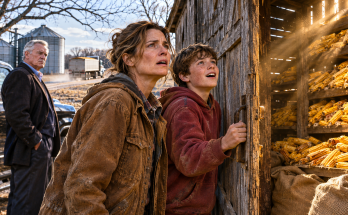
I locked the barn that evening and remained outside.
Normally, after finishing the work, I went directly back to the farmhouse.
There was often something waiting for me there.
Paperwork.
An order that needed checking.
Some ordinary household responsibility I hadn't attended to earlier.
That evening, I didn't particularly want to sit down at the kitchen table.
Not yet.
The light was beginning to fade across the property.
The maples on the ridge had taken on the deeper colors of autumn.
I could see patches of orange and red among the trees that remained after the harvest.
I started walking toward the creek.
The ground looked very different from the way it had when the logging trucks left.
There had been disturbed soil.
There had been tracks from heavy equipment.
There had been pieces of wood scattered in places that made moving across the clearing difficult.
I remembered standing there in the rain, wondering how much damage the moisture might be causing to the burls.
I remembered the chains.
I remembered Tom bringing his trailer and winch.
I remembered how exhausted I had been at the end of those first days.
Now grass covered much of the ground the equipment had disturbed.
Young trees had established themselves in places where there had previously been little room for them.
The changes had happened gradually.
I hadn't noticed every stage.
I had been busy inside the equipment shed, learning how to preserve wood that had already stopped growing.
Meanwhile, other trees were growing outside.
I found something reassuring in that.
The property hadn't remained fixed at the moment when the logging crew departed.
Neither had I.
I walked more slowly as I approached the creek.
This part of the farm always made me think about Matthew.
There were memories attached to ordinary features of the place.
A particular maple.
The direction of the ridge.
The way the light reached certain trees late in the day.
They weren't extraordinary memories.
We hadn't needed special occasions to spend time there.
Sometimes we had simply been looking at the property together.
Sometimes there was something practical we wanted to discuss.
Sometimes Matthew noticed a change in the trees and pointed it out.
I hadn't understood how precious those unremarkable occasions would eventually become.
After he died, I found it difficult to walk toward the creek without feeling overwhelmed by everything that was missing.
There was nobody beside me.
There was nobody pointing toward a tree or commenting on something that needed attention.
There was nobody with whom I could share the small observations I once considered too ordinary to remember.
For a long time, the familiar surroundings had made his absence more noticeable.
I occasionally avoided them when I was particularly tired.
I already had enough difficulty getting through certain evenings.
I didn't always want to make myself remember things that would leave me sitting at the kitchen table feeling worse.
That evening was different.
I stopped beside the creek.
I could still picture Matthew standing nearby.
I could still remember the sound of his voice.
The fact that he was gone still hurt.
But the memory didn't make everything else around me disappear.
I could remember him and also hear the water.
I could notice the leaves.
I could think about the customers who had visited the workshop.
I could consider the work waiting for the following week.
All those things could exist together.
There had been a time when I felt guilty for allowing them to.
I hadn't spoken much about that.
It seemed difficult to explain.
People generally wanted me to feel better.
They were pleased when I laughed or appeared interested in something.
I understood their intentions.
But sometimes having a good day made me uncomfortable afterward.
I would remember that Matthew hadn't been there to share it.
Then I would feel as though I had temporarily forgotten something important.
That feeling had accompanied some of the earliest successes of the business.
When I received twelve thousand dollars for B38, I had been relieved beyond anything I expected.
Later, alone in the farmhouse, I had wanted Matthew to know about it.
The tractor could be repaired.
There was money for important obligations.
There was an opportunity I hadn't anticipated.
He should have been there.
It took time for me to stop feeling that his absence made my happiness inappropriate.
I understood the matter differently now.
Matthew had been part of my life.
He remained part of my memories.
But I was still responsible for living the years that followed his death.
I couldn't return to the ones we had shared.
And refusing to enjoy anything new wouldn't restore them.
Standing beside the creek, I allowed myself to appreciate the evening.
The leaves were beautiful.
The farm was quiet.
I had finished a weekend that once would have seemed entirely beyond my abilities.
I was tired from working rather than exhausted from worrying.
That distinction felt important.
I turned and looked back toward the farmhouse.
From where I stood, I could see the buildings against the changing evening light.
The roof was in good condition.
The tractor stood beneath its shelter.
There were lights visible in the workshop.
Caleb had left several prepared blanks on the drying racks, ready for the next stage of work.
They would be waiting when we returned on Monday.
There were orders that still needed to be packed.
There were records to update.
There were pieces that required further inspection.
I didn't mind knowing those responsibilities were waiting.
They gave shape to the coming days.
For a while after Matthew died, looking ahead had meant imagining another series of difficulties.
I would wake up and think about what might go wrong.
The tractor could fail.
An unexpected bill could arrive.
Another part of the roof might need attention.
Something I couldn't afford might become impossible to postpone.
Those possibilities had occupied much of my mind.
I had been living as though the future were a collection of expenses moving toward me.
Now I could look at the coming week and imagine something different.
There might be another interesting piece of maple to examine.
There might be a customer returning for material.
There might be a call from someone who had found an unusual growth and wanted me to look at it.
There might be another discovery inside something that appeared ordinary from the outside.
I liked having those possibilities.
They didn't guarantee an easy week.
But they gave me a reason to be interested in it.
I hadn't become a millionaire.
I wanted to be honest about that.
There were still months when sales were less encouraging than I wanted.
There were still pieces of wood that disappointed me.
There were still costs associated with keeping the equipment functioning.
The business required ongoing work, and some of that work didn't produce the result I hoped for.
A successful open-house weekend didn't remove those realities.
Nor did I expect it to.
I had learned enough about the material to understand that uncertainty was part of the business.
I remembered the split slab.
I remembered the insect damage in B143.
I remembered standing over the decay inside B129.
Those pieces hadn't been erased from my memory by the successful sales.
They remained reminders that good judgment didn't eliminate every risk.
I could still lose money.
I could still make a decision that turned out badly.
I could still discover that something I considered promising was unsuitable for what I intended to do.
But those possibilities no longer seemed capable of destroying my entire life.
I had a business that didn't depend on a single piece of wood.
I had customers with different needs.
I had relationships with people who could provide additional material.
I had learned to assess the overall results rather than become overwhelmed by every individual disappointment.
Most importantly, I trusted myself more than I once had.
That didn't mean I believed every decision I made would be correct.
It meant I believed I could respond when a decision didn't work out.
There was a considerable difference.
I thought about the first visit from Mark Ellison.
The fear I had felt that morning had been almost physical.
I had stood holding his letter and imagined all the progress disappearing.
I had been frightened that I had misunderstood something essential and would be left responsible for money I couldn't afford to return.
At the time, I hadn't known how to proceed.
Then I had called Earl.
I had met Samuel Price.
I had gathered the paperwork and consulted my attorney.
I had stopped the sales while the ownership question remained unresolved.
I had refused an arrangement that would have given the company a quarter of future revenue.
None of those decisions had been easy.
But I had made them.
I had been able to examine the situation rather than surrender to the first frightening interpretation of it.
I had been able to learn what I needed to know.
That experience had changed me in ways I was still discovering.
The timber dispute hadn't simply ended when the company stopped pursuing its demand.
It had also taught me that somebody else's confidence wasn't necessarily proof that they understood a situation better than I did.
I could ask questions.
I could request evidence.
I could obtain help from people with appropriate experience.
I didn't have to accept an unfavorable arrangement simply because I was afraid of what might happen if I refused.
That knowledge belonged to me now.
It would remain useful even if I never encountered another dispute like the one over the burls.
I stood beside the creek, listening to the water.
The farm was peaceful that evening.
I was grateful for the quiet.
I no longer needed every silent moment to be filled with work because I was afraid of what I might think about otherwise.
I could stand there and remember Matthew.
I could miss him without feeling that the rest of my life had become meaningless.
There were still difficult nights.
I knew there would be more.
Sometimes I sat in his old chair at the kitchen table.
I couldn't completely explain why.
Perhaps it changed the familiar arrangement of the room enough to make his absence less noticeable.
Perhaps I simply wanted to occupy a place associated with him.
Whatever the reason, I continued doing it occasionally.
I hadn't tried to turn grief into something I could finish and mark as completed.
It didn't work that way.
There was no final measurement I could record.
There was no date when I could declare that particular responsibility resolved.
I had simply learned to carry it differently.
That was enough.
I looked toward the maple Matthew had once pointed out near the creek.
The leaves had changed as he would have expected.
I smiled.
There was something lovely about being able to remember that without immediately feeling devastated.
I allowed myself to stand there a little longer.
Then I began walking back toward the farmhouse.
The sky had become darker.
The lights from the workshop were more noticeable.
I could picture the drying racks inside.
I could picture Earl's bowl near the entrance.
I could picture B193 against the rear wall.
The final numbered piece still hadn't been opened.
For years, I had kept it because of the connection it provided to the beginning of the business.
I didn't regret that decision.
Having it there had reminded me of what I had nearly overlooked.
It had also reminded me that I didn't need to extract every possible dollar from everything I owned.
Some things could remain untouched because I wanted them to.
But I found myself thinking about the burl differently as I walked.
I didn't know how much longer I wanted to preserve it in that condition.
The memory associated with it wouldn't disappear merely because I eventually opened it.
The first bowl had demonstrated that.
The original growth had been transformed, yet holding the bowl had brought back the memory more clearly than looking at another rough piece might have done.
Perhaps B193 didn't need to remain unchanged forever.
I didn't decide anything immediately.
There was no particular reason to.
I simply noticed that the thought of opening it no longer made me uncomfortable.
I reached the farmhouse and stopped near the doorway.
Behind me, the workshop remained quiet.
The vehicles had gone.
The visitors had returned to their own lives and their own projects.
The open-house weekend had finished.
But I still had the ordinary work of maintaining Bennett Figured Maple.
That was what mattered most.
A successful weekend was pleasant.
A business capable of continuing through ordinary weeks was something more substantial.
I thought about the telephone calls that had brought new stock onto the property.
The suppliers who remembered my interest.
The customers who trusted the measurements and photographs I provided.
The people who helped keep the work manageable.
I didn't know exactly what the next year would bring.
There could be difficulties I hadn't anticipated.
There could be decisions that frightened me.
There could be months when I questioned whether I was doing enough to keep everything functioning.
I didn't need to pretend otherwise.
But the fear I felt now was different from the fear that had occupied my life after Matthew died.
Back then, I had been afraid there was nothing left for me except the gradual loss of everything we had built.
Now I worried because I had something I wanted to continue building.
There was hope inside that worry.
I understood the distinction as I stood outside the farmhouse.
I preferred these concerns.
They belonged to a life that was moving forward.
Inside, I looked at Matthew's chair.
Then I sat down at the table.
There were no alarming envelopes waiting to be opened.
There were ordinary responsibilities that could wait until morning.
I rested my hands on the table and allowed myself to enjoy the quiet.
I hadn't escaped every difficulty.
I hadn't become fearless.
I hadn't stopped missing my husband.
But I was no longer measuring the future entirely by what it might take away from me.
There were still things I could discover.
Things I could learn.
Things I could make possible through the work of my own hands.
I had found that future without leaving the place where I once believed my life had stopped.
And that evening, sitting alone at the kitchen table, I felt grateful that I hadn't mistaken the worst period of my life for the rest of it.