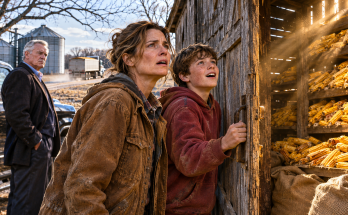
Nearly half the old seed failed to come up.
I had been prepared for disappointing germination.
Knowing something might happen and standing in a field looking at the result were two different experiences.
There were gaps where I had hoped to see young plants.
I walked the rows with Owen.
He was looking at every little patch of green as though the field contained an important message.
I was looking at the empty spaces.
"That's a lot missing," I said.
He nodded.
"There's still quite a bit growing."
I looked farther down the row.
He was right.
Some of the seed had survived decades of storage and was now growing on the ground where its earlier generations had been selected.
That was remarkable.
It just wasn't the sort of remarkable that produced a particularly impressive-looking field.
As the plants developed, the differences between them became more obvious.
Some stalks grew tall.
Others remained considerably shorter.
The timing of their development varied.
The ears weren't the large, consistently shaped ears people expected from commercial corn.
There were days when I looked across those three acres and wondered what other farmers thought when they passed.
Owen didn't seem concerned.
He found the differences interesting.
I found some of them inconvenient.
He stopped beside a section of the field one afternoon and grinned.
"Look at this mess."
I laughed.
"It certainly doesn't look like the pictures in a seed catalog."
"Do you like it?"
"I'm waiting until harvest to decide."
He looked pleased with that answer.
I think he knew I had already become attached to the little experimental field.
I had spent enough time examining Harold's ledger to appreciate what we were attempting.
The old population hadn't been maintained for its appearance.
My grandfather had cared about what happened when the weather was difficult and the ground wasn't particularly generous.
He had selected plants individually.
He had saved ears based on how their parent plants performed.
That was work we could continue.
We watched how the surviving plants developed.
We paid attention to the ones that remained healthy.
When the time came, we selected ears worth saving.
Those ears weren't destined for the cattle.
They represented the beginning of another planting.
Owen liked that part of the work.
He wanted to understand why one plant might be worth selecting when another wasn't.
I told him that one attractive ear didn't necessarily tell us everything we needed to know.
We had to pay attention to the entire plant.
We had to pay attention to where it had grown.
We had to consider the conditions it had experienced.
I was learning alongside him.
Some of the answers came from what my grandfather had recorded.
Others came from our own observations.
There was something satisfying about making a decision that wasn't dictated by a bill or a lender.
We could decide what we wanted to preserve.
We could examine the results the following year.
And if something didn't work, we could change our approach.
The next season, we planted descendants of the surviving seed again.
I didn't expect the second planting to turn the farm into something people drove miles to see.
It was still an agricultural experiment taking place on a working farm.
We had ordinary work to do around it.
The cattle needed feeding.
Other fields needed attention.
The tractor didn't become any less capable of breaking down just because it had survived a difficult December.
During hay season, a hydraulic line failed.
I stood beside the machine looking at the problem and thought about the equipment installment Owen had helped me make.
For a moment, I felt the old fear.
Another repair.
Another expense.
Another amount I would have to find somewhere.
Then I started considering what the repair actually required.
The tractor wasn't about to disappear because I needed a new hydraulic line.
Calvin wasn't standing in the driveway with a purchase offer.
There was nobody telling me that a broken piece of equipment demonstrated my inability to operate a farm.
It was simply a problem with a tractor.
I dealt with it.
That distinction took some time to become natural to me again.
For so long, I had treated every financial difficulty as the first step toward losing everything.
Even after the hearing and the settlement, it was difficult to stop thinking that way.
A calf developed pneumonia one January.
I worried about the animal.
I worried about the expense.
I didn't spend the entire time wondering whether the farm's future depended on the outcome.
When the farmhouse roof began leaking above Lucy's bedroom, I had another unwanted repair to arrange.
She showed me the problem with the seriousness of someone reporting a major structural emergency.
"Mom, there's water coming in."
I went upstairs.
She pointed toward the ceiling.
I looked at the damp area.
"Well, that's not supposed to happen."
She gave me a look.
"I know that."
I couldn't help smiling.
Years earlier, she had cried because she was afraid somebody else might end up sleeping in that room.
Now she was complaining because the room needed repairs.
I was strangely grateful for the complaint.
It was her bedroom.
It needed attention.
We would give it attention.
There was no discussion about leaving the house.
By the third summer after the hearing, Owen had grown so much that I sometimes mistook him for an adult when I saw him from a distance.
He was fifteen.
He was approaching six feet tall.
The red sweatshirt he had worn beside the cattle gate on the afternoon Calvin took our corn would no longer have fit him properly.
His interest in the old seed had grown with him.
I liked watching him examine a field.
He noticed things.
He had always noticed things.
The blue jays near the abandoned orchard.
The markings on the seed sacks.
The loose board.
The iron bolt that didn't match the wooden pegs.
Now that same habit was becoming useful in his approach to farming.
He paid attention to differences other people might overlook.
That summer, those differences began to matter more than they had before.
The rain stopped in June.
At first, we treated the lack of rainfall as something temporary.
A few hot days.
A dry stretch.
Something that might be corrected by the next weather system.
I checked the sky.
I checked the fields.
I checked them again the following morning.
The ground continued drying out.
By July, the ponds around Millstone were noticeably lower.
Pastures that had been green earlier in the season were turning brittle.
The grass broke beneath our boots.
The cattle spent more time dealing with the heat, and keeping their water supplies dependable became particularly important.
I thought about Miller Spring frequently.
Its water had always seemed plentiful when I was growing up.
After the dispute with Calvin, I had become much more conscious of how easily something dependable could become the center of a serious conflict.
During a drought, nobody needed to explain why water mattered.
You could look across the fields and see the reason.
August brought little improvement.
The heat was oppressive.
Soybean leaves curled during the day, sometimes before noon.
Corn leaves began showing the effects of prolonged stress.
Lower leaves dried and discolored.
I walked through our fields and tried not to calculate the possible losses every time I saw another plant struggling.
There were problems everywhere.
Calvin's irrigated acreage generally held up better than much of the surrounding farmland.
That wasn't surprising.
He had spent considerable money installing equipment that allowed him to supply water during conditions like these.
But irrigation equipment was only useful when water remained available for pumping.
As the creek levels dropped, restrictions began to affect how much water could be taken.
Some of his newer acreage suffered.
I knew about those difficulties because people in Millstone discussed little else.
Farmers who ordinarily talked about machinery prices or markets were discussing water levels.
Everybody was watching the sky.
Everybody was wondering how much damage had already been done.
Our own farm wasn't spared.
There were sections where the plants looked terrible.
We had no special protection from a Missouri drought.
But when Owen and I examined the descendants of Harold's corn, we noticed something worth paying attention to.
Some of those plants remained green longer than others growing nearby.
Not every one.
There were plants from the old population that performed poorly.
Some had suffered severely.
But enough were holding up better that the difference was difficult to dismiss.
We walked through the rows one evening.
The air was still warm, although the worst of the day's heat had passed.
Owen stopped beside a stalk.
He examined its leaves.
Then he looked toward another section of the field.
"That one's doing better."
I nodded.
"It is."
"And that one."
We kept walking.
The variation that had made the earlier plantings look untidy was now one of the more interesting features of the field.
The plants weren't all responding to the drought in the same way.
Some appeared better suited to getting through it.
Some seemed to mature at different rates.
Their differences gave us something to observe and potentially preserve.
I thought about my grandfather working through earlier Missouri summers.
He hadn't had access to the tools and information farmers had by then.
But he had paid attention to what survived.
He had chosen ears.
He had recorded his observations.
He had planted again.
Some of the characteristics that had been passed down through those selections were still present in the corn Owen and I were examining.
I didn't want to exaggerate what that meant.
One drought couldn't establish everything about a seed population.
A healthier-looking plant didn't automatically produce a better yield.
We still needed to see what happened by harvest.
But the plants were giving us reasons to continue the work.
Owen stood beside me and looked down the rows.
"Do you think he expected this?"
"Who?"
"Great-Grandpa."
I pulled a dried leaf away from one stalk.
"Expected what?"
"That we'd have a summer like this and need his corn."
I thought about the question.
Harold hadn't known Owen.
He hadn't known Nathan.
He hadn't known that Calvin would one day remove the entire harvest from our grain bins.
He couldn't have imagined a university preservation group examining seed he had stored decades earlier.
But he had known difficult summers.
He had known what it meant to wait for rain that didn't arrive.
And he had understood that farming didn't give people permanent relief from those problems.
"I don't think he was saving it specifically for us," I said.
Owen looked at me.
"But I think he understood another farmer would face the same conditions eventually."
He nodded.
We continued walking.
There was nothing particularly dramatic about the field.
No miraculous green oasis surrounded by completely dead crops.
No evidence that we had discovered a variety capable of defeating every drought.
There were simply individual plants that had endured more successfully than others.
Enough to make the difference meaningful.
Enough to give us useful selections for the future.
I liked that the answer was modest.
By then, I had grown suspicious of people promising perfect solutions.
Calvin's purchase offer had once been presented to me as a way to end every uncertainty.
It would have ended certain financial problems.
It would also have ended our ownership of the farm.
The old corn wasn't offering that kind of bargain.
It required us to keep working.
To keep observing.
To accept that some experiments would fail.
And to save what might help the following year.
Owen pointed toward another ear he wanted to examine when the time was right.
I listened while he explained what he had noticed.
I was proud of the person he was becoming.
Not simply because he was interested in farming.
I would have loved him just as much if he had wanted nothing to do with agriculture.
I was proud because he understood that useful things could exist in places people had stopped paying attention to.
He was willing to look.
He was willing to ask.
And he wasn't embarrassed by finding something imperfect.
We finished walking the field as the daylight began to fade.
Across the surrounding farmland, the drought was still taking its toll.
I could see discolored crops in the distance.
I knew families were going home to difficult calculations.
I had been one of those people many times.
I would be one of them again.
There was no satisfaction in seeing somebody else's field struggle simply because some of our own plants had performed better.
I wanted rain for everybody.
Even Calvin.
That surprised me when I first acknowledged it.
But it was true.
I didn't want the drought to become another chapter in the fight over Miller Spring.
I wanted the ground to receive the water it needed.
I wanted our cattle fed.
I wanted farmers to have something to sell when harvest arrived.
As Owen and I headed toward the house, I looked back at Harold's corn.
The plants weren't all the same height.
Their ears weren't all the same size.
Some of their leaves had dried.
Others were still green.
We would save what performed well.
We would learn what we could from what hadn't.
Then we would plant again.