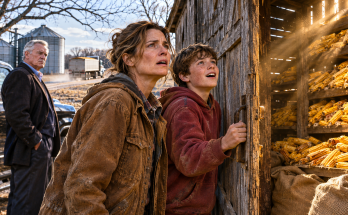
Owen repaired the roof of the corn crib before he left for agricultural college.
I watched him work on the building that had once been almost completely concealed by vines.
The sagging section that had bothered me for years was finally being put right.
He approached the repairs with the same attention he had given the old seed.
He wanted to preserve what still served a purpose.
He wanted to replace what could no longer do its job.
He didn't see any reason to turn the crib into something entirely different merely because it was old.
I appreciated that.
The narrow spaces between the wall boards remained.
The stone supports remained.
The building could still perform the task for which it had originally been constructed.
And we intended to keep using it.
Lucy decided it needed a sign.
She painted one herself.
When she showed it to me, I read the lettering.
HARPER SEED HOUSE
EST. 1964
I smiled.
"Where'd you get the date?"
"Great-Grandpa's book."
"That's when his records begin."
"Exactly."
"That doesn't necessarily mean this building was established then."
She looked at me.
"Mom."
"What?"
"Nobody's going to investigate the sign."
I laughed.
She had a point.
The date represented the beginning of the work we could document.
Whether the crib itself was older or whether Harold had started saving seed somewhere else wasn't terribly important to her.
She wanted something on the door acknowledging what the place meant.
And the sign did that.
We put it up.
It looked almost too clean against the weathered wood.
I stood back and examined it.
Years earlier, the only markings Owen had noticed near that building were faded black numbers on old burlap sacks.
Now there was a sign announcing that the seed belonged to the Harper family.
We no longer had any reason to hide that fact.
The university helped document and catalog the old seed population.
Other farmers around Millstone became interested in trying small plantings.
Some experimented with incorporating characteristics from Harold's corn into newer populations.
The work developed gradually.
There were successful experiments.
There were disappointing ones.
There were questions that required more than a single growing season to answer.
Nobody sensible treated our seed as a perfect solution to agricultural problems.
I discouraged that idea whenever I encountered it.
The old corn had useful characteristics.
It also had limitations.
A farmer interested in growing it needed to understand both.
I had spent enough time around people selling certainty to know how dangerous exaggerated promises could become.
I preferred to tell people what we had observed.
If they wanted to learn more, they could plant some and observe it themselves.
Harold's ledger eventually found a permanent place inside the farmhouse.
I kept it in a cabinet with a glass front.
The old book wasn't especially attractive.
Its pages had aged.
The writing varied depending on how carefully my grandfather had been working when he made a particular entry.
But I loved having it where I could see it.
I didn't look at it because I wanted to live the way my grandfather had lived.
There were plenty of things about earlier farming practices I had no desire to recreate.
I looked at it because I understood the importance of what he had chosen to preserve.
He hadn't simply kept a record of the good years.
He had documented the difficult ones.
He had recorded the plants that failed as well as the ones that survived.
He had preserved information concerning a dispute that might otherwise have disappeared from our family's understanding altogether.
The book reminded me that remembering the past could be useful without requiring me to remain there.
That was something I had needed to learn in another part of my life too.
Nathan's boots stayed beside the mudroom door for six years after he died.
I had cleaned around them.
I had stepped over them.
I had seen my children pass them every morning on their way outside.
There were occasions when I considered moving them.
Usually, I found a reason not to.
They weren't bothering anybody.
There was enough room.
I had other things to do.
But the truth was that I wasn't ready.
Those boots had been waiting beside the door when Nathan was alive.
He had put them there because he would need them the following morning.
After his death, their presence seemed to preserve something about that expectation.
As long as they remained there, a familiar part of our household hadn't changed.
One October morning, I stood in the mudroom and looked at them.
I couldn't have explained why that particular morning was different.
There wasn't a special anniversary.
Nobody had suggested it was time.
I simply knew I was ready to move them.
I bent down.
I picked them up.
They felt lighter than I remembered.
I carried them toward the barn.
For a while, I stood inside without deciding exactly where they should go.
Then I noticed the old bucket Owen had used when he bottle-fed Buttercup.
I set Nathan's boots beside it.
The two objects looked right together.
They belonged to different memories, but those memories belonged to the same family.
I thought about Owen asking what we were going to feed Buttercup after Calvin emptied the grain bins.
I thought about him standing in Nathan's coat beneath the barn overhang during the freezing rain.
I thought about him admitting that he couldn't clearly remember his father's voice.
I could still hear that voice in my mind.
I could still remember the four notes Nathan whistled when something troubled him.
I smiled at the memory.
Then I cried.
I didn't try to stop myself.
There was nobody there whose feelings I needed to protect.
I stood beside the boots until I was ready to leave.
Then I went outside and continued with the day's work.
That evening, the space beside the mudroom door looked unfamiliar.
I noticed it every time I walked past.
Gradually, I became accustomed to it.
Moving Nathan's boots hadn't removed him from the house.
It hadn't changed the years we had spent together.
It hadn't made our children any less his children.
I understood that I could keep loving him without maintaining every object exactly where he had left it.
That realization helped me accept the other changes taking place in our family.
Owen went away to agricultural college.
I missed him.
The farm felt different without him appearing beside the cattle lot or walking into the kitchen with something he had noticed.
I was proud that he was learning things I couldn't have taught him myself.
But I missed having him nearby.
When he eventually returned after college, he brought plenty of opinions.
He wanted to discuss soil health.
Water retention.
Cover crops.
He had ideas about how we could improve the ground rather than concentrating entirely on what the next crop might produce.
I listened.
Sometimes I agreed immediately.
Sometimes I wanted him to explain why a different approach was worth the expense.
Sometimes I reminded him that understanding something in a classroom didn't automatically make it easy to carry out on a working farm.
He didn't seem offended.
He had grown up watching me question every major expense.
He knew where that habit came from.
I liked that he wasn't interested in simply repeating what Nathan and I had done.
He respected the work that came before him.
But he also understood that respect didn't require him to reject everything new.
That was especially important when it came to our seed.
Harold had developed his population by selecting and improving what earlier generations had grown.
Owen wanted to continue that process.
Preserving the seed didn't mean refusing to allow it to change.
It meant retaining useful characteristics while looking for ways to make the next generation of plants perform better.
I thought my grandfather would have understood that.
Lucy, meanwhile, had developed interests that pointed in an entirely different direction.
She wanted to study architecture in Chicago.
When she talked about buildings, she noticed things that reminded me of Owen examining a field.
The arrangement of materials.
The way a structure had been designed for a particular purpose.
The decisions made by people who expected a building to remain useful for years.
I loved hearing her talk.
I also understood what her plans might mean.
She might spend much of her adult life somewhere other than Missouri.
There was a time when I would have found that thought difficult to accept.
After everything we had done to preserve our home, I wanted my children to remain close to it.
But the more I considered what that desire meant, the more careful I became.
I hadn't fought to keep the farm so I could make Owen and Lucy feel obligated to spend their lives there.
They didn't owe me their futures because I had worked hard to protect their childhoods.
Owen could choose farming.
Lucy could choose something entirely different.
Both choices were legitimate.
I wanted the farmhouse to remain somewhere they knew they were welcome.
A place they could return to because they loved it.
Not because they believed leaving would disappoint me.
Nearly ten years after Calvin emptied the grain bins, Lucy came home for an autumn weekend.
The fields had turned gold.
The air had the familiar coolness that arrived when summer was finally over.
Owen was bringing selected ears toward the restored corn crib.
Lucy had brought her camera.
She was interested in photographing the old building for a preservation project.
I watched her examine the slatted walls.
She moved around the structure, looking for angles that showed how it was constructed.
Occasionally, she stepped back and studied the roof.
I was reminded of the afternoon Owen first led me through the overgrown orchard.
I had been carrying a wrench when he called me.
I had assumed something was wrong with one of the animals.
Instead, he had brought me to a building filled with corn nobody had expected to find.
Now he was a grown man unloading another generation of ears into the same building.
And the little girl who had once been afraid of losing her bedroom was examining our family property through the lens of a camera.
"Mom?"
I turned toward Lucy.
"What?"
"Could you stand beside the door?"
"Why?"
"I want something in the picture to show how big it is."
I pointed toward Owen.
"Use him."
She looked at her brother.
"He's filthy."
I looked down at my own clothes.
"So am I."
She smiled.
"Yes, but you look appropriately old-fashioned."
Owen started laughing.
I stared at her.
"That's a lovely thing to say to your mother."
"You know what I mean."
"I certainly hope I don't."
She laughed.
I went to stand beside the door.
Owen was still grinning as he continued unloading the wagon.
I rested my hand against the weathered boards.
Sunlight passed through the narrow openings between them.
Inside, it fell across the racks in thin, bright lines.
The light looked almost exactly as it had the afternoon we first entered.
I remembered the dust.
The dried ears.
The little tobacco tin concealed behind the loose board.
I remembered how frightened I had been when I realized the originals were missing.
The sheriff had never established who removed them.
I had never received a satisfying answer about the disappearance of Charlie's uncle's file either.
But those missing papers no longer controlled what happened to our property.
Harold had left another copy with the bank.
His ledger had survived.
The agreement had been recovered.
The old boundary had been recognized.
There was no longer anything uncertain about the spring belonging to the Harper farm.
I looked toward the pasture.
For decades, people had assumed the old crib was empty.
My father had told Walter Bell as much.
I had grown up nearby without ever investigating it.
Eventually, the vines had nearly concealed it.
If Owen hadn't noticed the birds, I might have gone on believing there was nothing worth preserving inside.
That thought stayed with me.
I understood how easily people could make the same mistake about one another.
Calvin had looked at me and seen somebody whose financial problems would eventually force her to surrender.
People around Millstone had looked at me and questioned whether I could manage work they had associated with Nathan.
And I had looked at myself and begun believing their assessment.
I hadn't secretly known how to solve everything.
I hadn't been fearless.
I had made mistakes.
I had accepted help from people I hadn't expected to need.
My twelve-year-old son had contributed his savings because I couldn't find another hundred eighty-six dollars.
There was nothing glamorous about any of that.
But needing assistance hadn't meant I was incapable.
Having a difficult season hadn't meant every future season would be difficult in the same way.
And being frightened hadn't meant I was finished.
Owen carried a basket of selected ears into the crib.
He placed it where I could examine them.
"What should we call this group?" he asked.
I looked through the ears.
They came from descendants of Harold's corn that Owen had been crossing with a newer line he was testing.
The plants had grown in one of our lower fields.
That ground presented a different challenge from the dry conditions we had been studying earlier.
Water had collected there.
Many plants hadn't managed well.
These had survived.
"Twelve good ones from that low section," Owen said.
I looked at him.
"All twelve made it through?"
He nodded.
"These are the ones I want to keep working with."
I examined another ear.
I thought about the old numbered sacks.
H-1 through H-22.
The missing numbers.
The little wooden fragment marked H-23 that Owen had pulled from his sweatshirt pocket.
It had been years since I first held that piece of wood at the kitchen table.
Harold's numbering had stopped there.
Not because twenty-three represented some perfect number.
Not because there was nothing further to investigate.
His life had ended.
The next decision belonged to somebody else.
I looked at the basket.
"H-24," I said.
Owen smiled.
"Really?"
"Why not?"
"You sure?"
I shook my head.
"No."
He laughed.
"Fair enough."
He wrote the number on a tag.
I watched him.
It was such a small thing.
A few characters identifying some ears of corn.
But I understood why seeing the new number affected me.
For years, our work had centered on recovering what Harold had left.
Now we were adding something.
Something he hadn't selected.
Something he hadn't observed.
Something that belonged to another generation of the same effort.
Owen handed me the tag.
I placed it with the seed.
H-24.
I stood there for another moment.
Then Lucy called from outside.
"The light's changing!"
Owen went to retrieve another basket.
I opened both doors of the corn crib.
The autumn air moved through the building.
Beyond the orchard, Miller Spring continued running beneath the sycamores.
The tractor had finally been paid off.
The cattle were fed.
There were still repairs the farmhouse needed.
I knew there would be other expensive problems.
Another dry summer.
Another damaged fence.
Another piece of machinery that chose the least convenient moment to stop working.
I wasn't expecting an easy life.
I hadn't expected one when Nathan was alive either.
What I wanted was the opportunity to face those difficulties without somebody treating each one as evidence that my home should belong to him.
Harold's corn hadn't permanently solved every agricultural problem we would encounter.
His agreement hadn't guaranteed that nobody would ever challenge another part of our property.
His ledger hadn't made our future predictable.
What he had given us was something more practical.
We had records to consult.
Seed to work with.
Experience to build upon.
And the knowledge that other people in our family had encountered difficulties before we arrived.
We didn't have to repeat every mistake.
We didn't have to forget every success.
We didn't have to begin each new season pretending nobody had ever survived a difficult one.
I stepped outside.
Owen closed the wagon gate.
Lucy lifted her camera.
"Mom, look over here."
I turned.
She took the photograph.
Behind me stood the old corn crib with its repaired roof and the sign my daughter had painted.
Inside, our newest selection rested beneath a tag marked H-24.
Ahead of me, my son was preparing for another harvest.
I could hear him moving around the wagon.
I could hear Lucy asking me to stand still for another picture.
I could hear the autumn wind moving through the dry plants.
For a moment, I thought about Nathan.
I wished he could have been standing beside us.
I wished he could have seen the children he had loved become the people they were.
Then I looked at Owen and Lucy.
There were pieces of Nathan in both of them.
Not because they had remained exactly as he remembered them.
Because they had continued growing.
The farm had done the same.
It wasn't the operation my grandfather had known.
It wasn't exactly the farm Nathan and I had worked together.
It had changed with every person who cared for it.
And it would change again.
Lucy lowered her camera.
Owen picked up another basket.
I turned toward the pasture one last time.
Beneath the sycamores, water continued emerging from the limestone and flowing into the old stone trough.
I couldn't see all of it from where I stood.
But I knew the path it followed.
I had known it since childhood.
It ran through our ground, toward our creek, on the Harper side of the boundary my grandfather had defended.
Exactly where it belonged.
I went back inside the crib to help Owen.
There was more seed to put away.
The End
Read more original stories on lastestdrama.com.