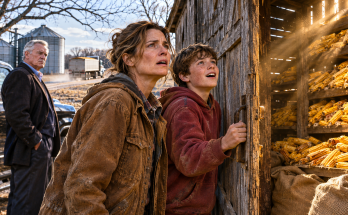
Thursday morning was bitterly cold.
I wore the black pants I had kept since Nathan's funeral and the cream sweater Lucy had chosen.
I felt uncomfortable in clothes that weren't meant for farm work.
There was something strange about preparing to defend the land I worked every day by putting on things I would never ordinarily wear while working it.
Lucy looked at me before we left the house.
"You look nice, Mom."
"Thank you."
Owen appeared more interested in making sure we had all the paperwork.
He watched me gather everything.
I had Harold's ledger.
The copied survey.
The bank documents were with Jenna Vale, along with the other evidence she intended to submit.
There wasn't anything more to collect.
There wasn't another hiding place we needed to search.
For once, I wasn't leaving the farm because something was missing.
I was leaving because we had found what we needed.
The hearing was held in the county administration building.
When we arrived, I immediately noticed how many people were there.
By nine o'clock, there must have been close to forty.
Some had reasons to be in the building unrelated to our dispute.
Others had clearly come because they knew Calvin Rusk and Evelyn Harper were finally going to sit in the same room and discuss the boundary.
I recognized almost everyone.
That made me more nervous than a room full of strangers would have.
These were people I encountered at the feed store.
At church.
At livestock auctions.
They knew things about my family.
Some of those things were true.
Others had traveled around Millstone so many times that I doubted anyone remembered where they originated.
Walter Bell was there.
Owen and Lucy sat behind him.
Charlie Ames stood near a wall rather than making himself comfortable in one of the chairs.
Marie Temple had come too.
I was particularly surprised to see Pete Danner.
He gave me a small nod when our eyes met.
Even our pastor was present.
I wondered whether he was there to support somebody or simply to discourage people from behaving badly.
Calvin was already seated with two attorneys.
He wore a charcoal suit.
His silver hair was neatly arranged, and the papers in front of him looked professionally organized.
He appeared comfortable.
I envied that.
My hands were cold despite the warmth inside the building.
I sat beside Jenna and tried not to look at the people gathering behind us.
She quietly reviewed the order in which she intended to present our material.
I listened.
I trusted her to handle the legal questions.
What I wasn't sure about was how I would handle sitting across from Calvin while his attorney explained why part of my farm belonged to him.
The chairman called the matter.
Calvin's side presented its case first.
His attorney spoke clearly and without unnecessary emotion.
He explained the nature of the disputed parcel.
He referred to the current survey.
He described measurements and property descriptions.
He made the disagreement sound like an unfortunate technical matter that responsible landowners occasionally needed to resolve.
Listening to him, I almost understood how a stranger might accept Calvin's version.
There was a professional survey.
There was a clearly marked line.
There was a wealthy landowner asking the county to recognize what his documents appeared to establish.
Everything sounded straightforward.
The corn crib was mentioned as a structure located partly within the disputed section.
There was little discussion of what it contained.
And there was no discussion of why Calvin had become so interested in the area immediately after Owen opened the door.
One board member asked whether the boundary determination could affect access to water.
I looked up.
Calvin's attorney paused.
"It could have implications in that regard."
That was all.
I looked toward Calvin.
He remained perfectly composed.
I thought about the two irrigation pivots on his adjoining ground.
I thought about the fields he wanted to supply with additional water.
I thought about Walter Rusk acquiring those neighboring farms in 1978.
Water had been important enough for two generations of that family to pursue the same piece of Harper property.
Now it was being described as a possible implication.
I kept my mouth shut.
When Calvin's attorney finished, Jenna stood.
She began by identifying the historical boundary agreement.
She explained that both of the previous landowners had formally accepted the survey completed in April 1979.
Then she handed copies of the signed agreement to the board.
I watched Calvin.
He didn't immediately react.
His attorney, however, turned toward him.
It was a quick movement.
The kind somebody made when unexpected information suddenly required an explanation.
Jenna continued.
The agreement identified Harold Harper and Walter Rusk.
It acknowledged the old survey and the stone monument.
It established the permanent boundary.
It also provided for a temporary access arrangement that had expired years earlier.
She submitted the matching survey.
The blue line was there.
Exactly where I remembered it.
Next came the certification associated with the bank's historical records.
Then the relevant pages from my grandfather's ledger.
Jenna explained how the entry concerning the agreement had identified another place where a copy could be found.
I thought about Owen standing on the wooden rack.
The iron bolt.
The short board.
The bundle wrapped in waxed canvas.
If he hadn't noticed one detail that looked out of place, I wouldn't have known to request the bank records.
It was remarkable how small the beginning of something could be.
Charlie Ames was called to explain his knowledge of his uncle's surveying work.
He identified the signature.
He described the historical dispute and the importance of the stone monument near Miller Spring.
He spoke in the same plain manner he had used in his living room.
He didn't try to make himself sound particularly important.
He simply explained what he knew.
I appreciated that about him.
When the chairman turned toward Calvin, the room became very quiet.
"Mr. Rusk, did you know about this agreement?"
One of Calvin's attorneys rose.
He explained that his client had not personally participated in the original negotiations and had been young when those events took place.
The chairman looked at him.
"That's not what I'm asking."
Calvin leaned toward his attorney.
They exchanged a few quiet words.
Then Calvin stood.
"I knew there'd been some disagreement between the previous owners."
"Did you know it had been settled through a signed agreement?"
Calvin adjusted his jacket.
"I'd heard references to historical documents."
I looked at Jenna.
She waited until he finished.
Then she introduced the archival request Denise Carter had brought from Springfield.
She explained that Rusk Agricultural Holdings had requested the relevant file six years earlier.
I heard people shifting in their seats.
There was a low murmur behind me.
Calvin's attorney stood and objected.
The chairman asked everyone to remain quiet.
Jenna explained the significance of the additional record.
The company had requested the historical material as part of due diligence relating to an attempted acquisition of neighboring water rights.
I watched Calvin's face.
His jaw had tightened.
The chairman looked directly at him.
"Can you explain this?"
Calvin didn't answer immediately.
His attorney leaned toward him again.
Eventually, Calvin spoke.
"There are thousands of documents handled by the various businesses I'm involved with."
The chairman waited.
"I don't personally examine everything that comes through our offices."
It was a reasonable statement on its own.
A man managing substantial agricultural and financial interests couldn't be expected to read every document connected to every transaction.
But I noticed what Calvin hadn't said.
He hadn't said the company never requested the agreement.
He hadn't said the archive information was incorrect.
He hadn't produced another signed agreement establishing a different boundary.
He had simply placed some distance between himself and the record.
From near the wall, Charlie spoke.
"Is that how you handle everything people tell you, too?"
The chairman frowned.
"Mr. Ames, please wait until you're asked to speak."
Charlie nodded.
"Understood."
I looked down at the table because I didn't want Calvin to see my expression.
Charlie had never been especially good at pretending not to have an opinion.
Calvin looked distinctly annoyed.
I thought the hearing might proceed directly toward a decision.
We had presented the agreement.
We had established that the old survey wasn't merely a drawing my grandfather had kept for sentimental reasons.
We had shown why it mattered.
That should have been sufficient.
But as I sat there listening to the explanations Calvin's attorney continued offering, something began bothering me.
Even if the board recognized the old boundary, Calvin could still walk out of that room claiming the dispute had resulted from incomplete information.
He could blame the survey.
He could blame the difficulty of working with older land records.
He could blame somebody within one of his companies for not bringing a particular document to his attention.
And people around Millstone might accept those explanations.
The widow had gotten lucky.
The businessman had made an understandable mistake.
Everybody could go home believing nothing particularly serious had happened.
I thought about the empty grain bin.
I thought about Lucy coming home from school crying.
I thought about Owen putting his savings on the kitchen table.
I raised my hand.
Jenna turned toward me.
"What is it?"
"I'd like to say something."
She lowered her voice.
"You don't need to do that."
"I know."
She studied me for a moment.
Then the chairman acknowledged me.
I stood.
My knees felt unsteady.
I placed one hand against the table.
I looked at the people behind us.
Some had known Nathan since he was a boy.
Some had known me since I was a little girl.
Some had apparently decided I wasn't capable of keeping the farm without ever asking how I had managed to keep it for four years.
I turned back toward the board.
"This began with my harvest."
My voice sounded quieter than I expected.
I cleared my throat.
I explained that Nathan had borrowed money after the flood.
I acknowledged that the agreement gave Calvin a financial claim.
I wasn't there to pretend the debt didn't exist.
There were separate questions concerning the amount claimed and the way the harvest had been credited.
Those questions would have to be addressed separately.
But Calvin had taken every bushel.
Then he had offered to purchase the farm.
Not for the first time.
I looked at him.
"Whenever I had trouble making ends meet, there seemed to be another offer."
He watched me without speaking.
"For a long time, I thought he just wanted more land."
I looked down at the copied survey.
"I understand now that forty-three acres weren't the important part."
I pointed toward the boundary.
"It was Miller Spring."
Nobody interrupted.
I explained what had happened between Harold Harper and Walter Rusk.
The attempted acquisition.
The disputed boundary.
The survey.
The agreement establishing ownership of the spring.
Then I referred to the archive request.
Calvin's attorney stood.
He objected to any conclusion concerning his client's personal intentions that wasn't directly established by the documents.
I looked at him.
"That's fair."
He appeared surprised.
I continued.
"I can't tell you what another person was thinking."
I paused.
"But I can tell you what I was thinking."
I looked toward Owen and Lucy.
"I thought I'd turned out to be a terrible farmer."
The words were difficult to say.
They were also true.
I explained how every breakdown had become another reason to question myself.
Every overdue bill.
Every evening I needed Owen to help with work his father would once have done.
Every time Lucy asked whether we would have to move.
I had interpreted those things as evidence that I couldn't manage the life Nathan and I had built.
And when other people began suggesting I should sell, I had listened.
I glanced toward Pete.
He was looking down.
"I assumed people with more experience and more money could see something I couldn't."
I rested my hand on Harold's ledger.
"What I didn't know was how long this particular fight had been going on."
I turned toward Calvin.
"My grandfather had already stood where I'm standing."
Not literally.
But he had been a Harper trying to defend the same water against a Rusk who wanted it.
He had understood the importance of keeping records.
He had made sure copies of the agreement were placed in different locations.
He had done that because obtaining a signature wasn't necessarily enough to make a powerful man stop wanting something.
I thought about the short board in the crib.
The rusted tobacco tin.
Charlie's empty drawer.
"My grandfather went to considerable trouble to make sure the truth didn't disappear when he did."
I looked directly at Calvin.
"Your father wanted that spring."
Calvin remained silent.
"That wasn't your decision."
I waited.
"But bringing this claim against me was."
For once, I didn't feel the need to say anything more.
I sat down.
My hands were shaking.
Jenna remained beside me while the chairman announced a recess.
People began speaking quietly.
I stayed in my chair.
I didn't want to interpret every expression around the room.
I didn't want to know whether the people who had been talking about me at church were embarrassed.
I wanted to know whether the boundary I had spent my whole life accepting would still be recognized when the board returned.
Owen came close enough to touch my shoulder.
"Good job, Mom."
I looked at him.
"Thanks, honey."
He smiled.
Lucy stayed near Walter.
Twenty-three minutes passed.
I knew because I kept looking at the clock.
Eventually, the board returned.
The room settled.
The chairman explained the determination.
The agreement executed in 1979 remained controlling.
The accepted boundary would stand.
The current survey could not supersede the signed stipulation by disregarding its terms.
The corn crib was on Harper property.
Miller Spring remained within our parcel.
Calvin's petition was denied.
I sat perfectly still.
I had imagined hearing those words so many times that I almost didn't recognize what was happening when somebody finally said them.
Then Owen reached me.
He wrapped his arms around my shoulders so tightly that it hurt.
I laughed.
I was crying at the same time.
Lucy squeezed herself between us.
"We keep it?"
I held her.
"The spring belongs to us, sweetheart. So does the crib."
Walter rubbed his eyes and complained about dust.
Nobody challenged him.
Charlie came over and shook my hand.
"Harold would've enjoyed that."
I wiped my face.
"The decision?"
"The way you handled yourself."
I shook my head.
"I nearly lost my temper."
Charlie smiled.
"So did he, most of the time."
Outside the building, reporters from two regional newspapers were waiting.
I saw Calvin walk past them without stopping.
His attorneys accompanied him.
He didn't look in my direction.
I watched him go.
Then I turned toward my children.
The debt dispute hadn't vanished.
There were still financial questions to settle.
We still had cattle to feed and a farm to operate.
But I wouldn't have to leave my grandfather's corn untouched because Calvin claimed the ground underneath it belonged to him.
The old fence had been recognized.
The spring was ours.
And when I drove home with Owen and Lucy, I knew exactly where our property began and ended.
The line was where it had always been.