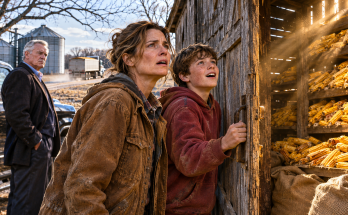
The first thing I did after returning home was walk behind the orchard.
I hadn't changed out of my good clothes.
The black pants I had worn to the hearing caught on a piece of thorny brush, and I nearly tore them trying to get through.
I didn't care.
Owen followed me.
Lucy stayed close behind him.
When we reached the corn crib, I stopped outside the doorway.
The building looked exactly as it had the previous afternoon.
Weathered boards.
A sagging section of roof.
An old chain hanging from a damaged iron fitting.
Nothing about its appearance suggested that anything important had happened.
But I was standing in front of it without somebody else's attorney telling me I couldn't touch what was inside.
I placed my hand against the doorframe.
"Well," Owen said.
I looked at him.
"Well what?"
"It's ours."
I nodded.
"It always was."
He smiled.
"Yeah, but now everybody knows."
There was a difference.
I hadn't appreciated how much of a difference until that moment.
Lucy wandered toward the fence.
"Where does our land stop?"
Owen pointed toward the old boundary.
"Over there."
"Where Grandpa put the fence?"
"That's right," I said.
She looked between the posts and the corn crib.
Then she seemed to lose interest in the legal question altogether.
"Can we go home now?"
I laughed.
"We are home."
"I mean inside."
She was cold.
Of course she was.
She had spent much of the morning sitting in a county building listening to adults discuss things she barely understood.
She didn't need another lesson about property ownership.
She wanted to change her clothes and get warm.
We headed back toward the farmhouse.
I glanced over my shoulder once.
The corn crib was still standing.
For the first time since Owen opened it, looking at the building didn't immediately remind me of something Calvin was trying to prevent.
That evening, I returned to the kitchen table.
There were still bills in the folder.
The machinery installment had been paid, but another one would eventually become due.
Pete Danner had given me ninety days of credit, not ninety days of free feed.
Calvin's remaining claim hadn't disappeared.
Eleven thousand three hundred dollars.
That was the amount I had been carrying around in my head since he took the harvest.
I looked at it differently now.
Before the hearing, I had treated the amount as something I needed to find a way to pay.
Now I wanted somebody qualified to establish whether it was actually correct.
Jenna Vale began examining the original agreement Nathan had signed after the flood.
An agricultural accountant examined the financial records as well.
I brought out everything I had.
Statements.
Receipts.
Payment records.
The documentation concerning the seized corn.
I had spent so many evenings looking at those papers by myself that I had almost forgotten there were people who knew how to ask better questions about them.
The accountant wanted to know exactly how the elevator had credited the grain against our debt.
He examined the price.
He examined the deductions.
He asked about storage charges and other fees.
I explained what I knew.
When he asked whether I had ever received a satisfactory explanation for certain amounts, I shook my head.
"I questioned some of them."
"What were you told?"
"Usually that the figures were correct."
He looked back at the statement.
"That's not much of an explanation."
No.
It wasn't.
But for years, it had been the explanation I received.
Calvin's companies handled substantial amounts of money.
I was a woman working through farm expenses at a kitchen table.
When our calculations differed, people generally assumed the mistake belonged to me.
Sometimes I assumed it too.
The accountant wasn't prepared to make that assumption.
He wanted to understand how every significant figure had been calculated.
Jenna approached the agreement in much the same way.
She examined what Nathan had actually accepted.
Not what Calvin said he had accepted.
Not what I feared he might have accepted.
What was written there.
I found the process uncomfortable at times.
There were things I should have challenged earlier.
Charges I should have asked more questions about.
Documents I had accepted because I was too tired to spend another afternoon arguing over them.
I admitted that to Jenna.
She looked at me.
"That's why we're looking at them now."
I nodded.
There wasn't much value in spending another four years criticizing myself for the previous four.
I had enough work ahead of me.
Outside our financial discussions, life on the farm went on.
The cattle still needed attention every morning.
Water had to be checked.
Equipment had to be maintained.
The weather continued being cold regardless of how pleased I was with the county board's decision.
But the atmosphere around the farm had changed.
When I walked behind the orchard, I was free to examine the corn without worrying that Calvin might accuse me of interfering with property he claimed belonged to him.
Walter Bell helped me understand the testing results.
Some of the old grain could be used as livestock feed.
Not all of it.
Age, storage conditions, and the quality of individual portions mattered.
We weren't going to treat every ear in the crib as equally suitable.
I had cattle depending on me to make sensible decisions.
The last thing I wanted was to create an animal health problem while trying to solve a financial one.
Once we knew which portions were suitable, I was able to sell some of the bulk corn for livestock feed.
The amount wasn't spectacular.
Nobody arrived offering a fortune for a wagonload of forty-year-old ears.
But the grain had value.
Real value.
And I could finally use that value instead of standing outside the crib wondering whether I would ever be permitted to.
Owen helped distinguish the ordinary stored corn from the separately marked seed.
We were particularly careful with the burlap sacks.
The faded black lettering had become familiar to both of us.
H-7.
H-8.
H-9.
I remembered asking what the H meant.
I still didn't know precisely how my grandfather had intended every label to be interpreted.
But his ledger provided information that made those markings much more useful than they had initially appeared.
Dr. Leah Givens and the university preservation group could now examine the seed alongside records of the conditions under which it had been selected.
That was something they hadn't possessed when Leah first visited the farm.
She had looked at the old ears and wondered whether detailed records survived.
Now there were pages beginning in 1964.
Rainfall.
Planting dates.
Disease observations.
Yield information.
Records of plants that endured heat when others didn't.
I began to understand why scientists became excited about things that seemed ordinary to farmers.
My grandfather had written down observations that would have disappeared with him if he hadn't preserved them.
The seed mattered.
The information mattered too.
Together, they explained considerably more than either could have explained alone.
The conservation arrangement brought additional money to the farm.
The six-thousand-dollar offer Walter had mentioned hadn't been a promise of instant wealth.
It was a modest opportunity connected to preserving material that might prove useful.
I was grateful for it.
I was also grateful that we weren't being asked to surrender every ear my grandfather had saved.
I wanted the numbered sacks to remain part of our family's work.
I didn't know exactly what that work would become.
But I wanted the opportunity to find out.
Over the next few months, Jenna and the accountant continued challenging Calvin's financial calculations.
The elevator's grain valuation received particular attention.
So did fees, storage deductions, and interest.
None of those matters had been decided during the boundary hearing.
Calvin still had the right to defend his financial claim.
I still had the right to question it.
The difference was that people no longer seemed quite so willing to accept his figures without examining them.
The hearing had changed something beyond the ownership of a few acres.
It had demonstrated that records presented with confidence could still be contradicted by other records.
And people had seen that happen.
I noticed the difference in ordinary conversations around Millstone.
Questions about whether I intended to sell became less frequent.
People seemed more interested in what I was going to plant.
Occasionally, somebody asked about the corn.
I explained that it was old seed with potentially useful characteristics.
I was careful not to encourage the stories about extraordinary wealth.
There was nothing extraordinary about my financial situation.
I still needed to count money.
I still needed Pete's credit arrangement.
And I still went outside whenever something broke.
But I no longer felt that every conversation about my farm began with the assumption that somebody else would eventually own it.
Three months after the hearing, the financial dispute reached a settlement.
Calvin's claimed remaining balance was reduced substantially.
I studied the final figures.
They were much more manageable than the amount he had insisted I owed after taking the harvest.
It wasn't a declaration that Nathan had never borrowed money.
It wasn't a return of the entire crop.
It didn't erase the months of fear we had experienced.
But it brought the outstanding financial obligation back into a range I could deal with.
I put the relevant papers into the folder.
Then I sat there for a little while.
I had expected a settlement to feel like another dramatic victory.
It didn't.
There were no people gathered around me.
No county chairman reading a decision.
No reporters outside.
There was just a quieter kitchen and one less enormous uncertainty.
Owen came in from the cattle lot.
He noticed the papers.
"Something about Calvin?"
"Yes."
"What happened?"
"We've settled the remaining debt dispute."
He looked at me.
"Is that good?"
"Very good."
"Does he still get the farm if we can't pay?"
I shook my head.
"He's not getting the farm."
Owen nodded.
He went toward the sink to wash his hands.
That was all.
He didn't need a lengthy explanation.
He didn't ask me to describe every deduction the accountant had challenged.
He wanted to know whether his home was still in danger.
For once, I could answer without immediately adding another warning.
"No."
I said it again after he had turned away.
I think I needed to hear it myself.
As winter gave way to spring, our attention shifted toward planting.
The old seed presented questions none of us could answer merely by examining the ears.
We needed to know what would happen when some of it returned to the ground.
There was no guarantee that enough would germinate.
There was no guarantee that the surviving plants would perform well.
Decades of careful storage couldn't make time irrelevant.
Still, we had a chance.
Owen was particularly interested in giving the old population a proper opportunity to grow.
We decided to plant three acres with seed from Harold's stored line.
Three acres wasn't a huge commitment compared with the amount of land Calvin farmed.
For us, it was meaningful.
Every piece of ground needed to justify the work and expense we put into it.
I wasn't prepared to pretend that growing an old variety would automatically be profitable.
But I was prepared to try.
I went through my grandfather's ledger again before planting.
I read the entries concerning difficult fields and dry summers.
I looked at the notes he had made about selecting individual ears.
Some of his observations were wonderfully straightforward.
A particular row hadn't done well.
Another had managed better than expected.
He had saved seed from the plants he considered promising and left the others behind.
He hadn't written like a man attempting to create something famous.
He had written like someone trying to make next year's crop a little better.
I understood that.
I found myself relating to Harold in ways I hadn't anticipated.
He had experienced financial trouble.
He had dealt with difficult weather.
He had faced a wealthy neighbor who wanted something he wasn't prepared to surrender.
And after all of that, he had apparently continued making ordinary decisions about his fields.
I wanted to do the same.
The corn had already helped us financially in ways I couldn't have imagined when Owen found it.
Now it was going to become part of the farm again.
Not grain hidden away behind an orchard.
Not evidence connected to a boundary dispute.
Seed going into the soil.
I looked at the three acres we had set aside.
For years, I had been planting crops while wondering whether I would still own the farm when the next season arrived.
That spring, I was thinking about what we might save from the healthiest plants for the year afterward.
It was a small change in how I looked at the future.
It felt enormous.