By lunchtime, people around Millstone were discussing my confrontation with Calvin.
By evening, they were discussing a confrontation I barely recognized.
According to one version, I had publicly accused him of stealing documents.
Another version suggested that I had manufactured an old survey to strengthen my claim to the disputed land.
Someone apparently believed I was preparing to take several people to court.
And then there was the story about the corn.
People were saying that I had discovered seed worth a million dollars.
A million.
I couldn't have afforded the retainer for a property attorney, yet somewhere in Millstone, people were probably imagining me sitting on a fortune.
I wondered how those rumors began.
I wondered why people found it easier to invent numbers than ask the person involved.
Eventually, I stopped wondering.
There were too many actual problems requiring my attention.
The following Sunday, I stayed home from church.
I couldn't face another morning of sympathetic questions followed by whispered conversations.
I didn't feel like carrying paper cups of lemonade past people discussing my financial circumstances.
I didn't want Lucy hearing another prediction about where she would be living next year.
For that one morning, I wanted our problems to remain inside our own household.
On Monday, the sheriff contacted me.
There hadn't been much progress concerning the missing documents.
The tire tracks hadn't provided information sufficient to identify a particular vehicle.
There were no useful fingerprints.
Nobody had produced camera footage.
There was nothing definite linking any person to the crib that night.
I listened to the explanation.
Then I thanked him.
After hanging up, I remained beside the telephone.
I hadn't expected a miracle.
But I had hoped there might be something.
A tire impression.
A witness.
Some small detail that would tell me who had gone through my grandfather's hiding place.
Instead, I was left with suspicions.
And suspicions didn't restore missing paperwork.
Tuesday brought another setback.
Calvin had formally petitioned the county to resolve the disputed property boundary.
Until the matter was decided, moving material from the corn crib could put me in serious legal trouble.
I read the information carefully.
The consequences were more substantial now than they had been when his attorney sent the original letter.
The grain remained where it was.
The marked sacks remained where they were.
Even if laboratory results established that some of the corn could be used safely, I couldn't simply begin taking it out of the structure.
I looked toward the cattle lot.
Finding the crib had originally given me hope that I could reduce my winter feed expenses.
Now every practical use for its contents seemed to require permission from somebody else.
On Friday, the machinery lender sent its final notice.
I knew what it would say before I finished opening the envelope.
December 19.
Seven thousand eight hundred dollars.
There wouldn't be another extension.
I placed the notice beside Calvin's purchase offer.
The two documents looked remarkably ordinary.
Plain paper.
Printed numbers.
Spaces where signatures belonged.
But between them sat the entire future of my farm.
I spent a long time at the kitchen table that day.
I went over what money was available.
I considered what I might still sell.
I tried to determine whether there was any realistic way of covering the machinery installment and continuing to operate.
I kept arriving at the same conclusion.
I didn't have enough.
There were possibilities concerning my grandfather's seed, but possibilities couldn't be deposited into a bank account.
There was evidence concerning the boundary, but the originals had disappeared.
There were attorneys who might help me, provided I could pay them.
Every direction seemed blocked by another requirement.
I pulled Calvin's offer closer.
His price was still too low.
That hadn't changed.
But I was becoming less concerned about whether the sale represented the true value of the farm.
I was becoming concerned about whether I could avoid a complete financial disaster.
I picked up a pen.
I read the offer again.
If I accepted, I could clear the machinery debt.
I could resolve the outstanding financial claims.
There would be enough left to establish a household somewhere else.
Lucy wouldn't like moving.
Owen would be devastated.
But perhaps they would eventually adjust.
Children adjusted to difficult things all the time.
They had already survived losing Nathan.
I stopped at that thought.
It seemed terribly unfair to use the greatest loss of their childhood as evidence that they could endure another.
I put the pen down.
Then I picked it up again.
I thought about the night Owen and I had repaired the fence in freezing rain.
He had stood beneath the barn overhang wearing a coat that belonged to a man he could barely remember hearing.
I thought about Lucy crying against my shoulder.
I thought about the machinery payment and the look on Pete Danner's face when he told me he could only offer thirty days of credit.
I was tired.
There wasn't a more complicated explanation for it.
I was tired of being frightened.
Tired of calculating.
Tired of going to bed with a problem and waking up to discover that the problem had multiplied.
For a few minutes, selling the farm seemed less like surrendering something precious and more like purchasing the right to sleep.
Calvin would get what he wanted.
I would get some money.
The children and I would start over.
I tried telling myself that a home was simply wherever we were together.
There was truth in that.
But I also knew I was using it to make something painful easier to accept.
I looked at the signature line.
The pen hovered just above the paper.
Nathan's notebook lay among the other records.
I thought about his little entry concerning the crib.
One word.
A question.
Two lines drawn underneath.
I wondered how differently things might have turned out if he had found what Owen had discovered.
Then I heard a sharp tapping against the kitchen window.
I looked up.
Owen was standing outside.
He waved urgently.
I frowned.
He pointed toward the yard.
I set the pen down and went to the door.
"What is it?"
He looked excited.
"You have to come with me."
I nearly laughed.
He had said much the same thing the afternoon he found the corn crib.
"Owen, I'm in the middle of something."
"This is important."
"What happened?"
"Nothing happened."
"Then what is it?"
"I found something else."
I looked back toward the kitchen table.
The purchase offer remained open.
The pen lay across the bottom of the page.
I didn't know whether Owen had any idea how close I had come to signing it.
I doubted it.
I pulled on my coat.
He was already heading toward the orchard before I finished fastening it.
I followed him.
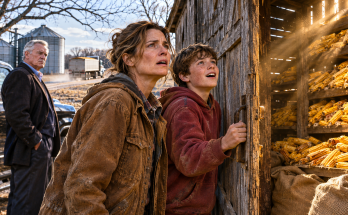
When we reached the crib, he went directly inside.
He appeared to know exactly where he wanted to take me.
I looked at the loose board near the rear wall.
The sight of the empty cavity still made me angry.
I assumed Owen had noticed another detail relating to the missing tin.
Instead, he started climbing onto one of the upper wooden racks.
"Be careful," I said.
He continued upward.
"What are you doing?"
"Look up here."
He pointed toward the roof framing.
I tilted my head.
The old rafters were dark with age.
There were wooden pegs at the joints.
I had seen similar construction in other older farm buildings without thinking much about it.
"See those?" he asked.
"The pegs?"
"Yeah."
He moved his hand along one beam.
"They're all made of wood."
I followed his finger.
Most of the connections appeared to have been constructed in the same way.
Then he pointed toward the northern rafter.
A short piece of wood had been secured against it.
Unlike the other parts of the framing, this piece was held in position by a dark iron bolt.
I looked more carefully.
"What is that board for?"
"I don't think it's holding anything up."
Owen touched the nut.
The short board didn't appear to be performing an ordinary structural function.
It looked more like something that had been attached after the rest of the building was assembled.
"How did you notice it?" I asked.
"I was looking for anything that was different."
"Different?"
"Like the board with the tin behind it."
I looked at my son.
He hadn't accepted that the theft of the tobacco tin meant the search was over.
He had gone back through the building and started examining how things were put together.
The answer he had arrived at was simple.
If something had been hidden behind one unusual board, perhaps another unusual board deserved attention.
He worked at the nut.
Eventually, he got it loose.
I watched him remove it carefully.
Then he shifted the short board away from the rafter.
Behind it was a narrow space.
Owen leaned closer.
"There's something inside."
I stepped forward.
"What?"
He reached into the opening.
A moment later, he pulled out an object wrapped in waxed canvas.
It was considerably larger than the tobacco tin.
Flat.
Rectangular.
He passed it down to me.
I held it with both hands.
I didn't know what I expected to find.
More land papers would have been welcome.
Another original survey would have been wonderful.
But when I unfolded the canvas, I discovered something different.
A ledger.
Its pages had aged, but the wrapping had protected much of the book.
I opened it.
My grandfather's name was written near the beginning.
Harold J. Harper.
Below his name, he had identified the book as his seed and field record.
The first year indicated was 1964.
I stared at the writing.
This wasn't the brief inventory we had found in the tobacco tin.
It was something my grandfather had maintained over a substantial period of time.
I turned a page.
There were entries concerning rainfall.
Dates when particular fields were planted.
Information about yields and hot weather.
Observations about plant disease.
He had written about the performance of different seed selections.
Some rows had done poorly.
Others had survived conditions he considered unusually difficult.
He had recorded which plants and ears he chose to preserve for the following season.
I thought about Dr. Leah Givens.
She had asked me whether anything like this existed.
I had told her I hadn't found any notes about my grandfather's seed development.
Now I was holding the record of his work.
Page after page.
Year after year.
Owen climbed down.
"What is it?"
"His planting records."
"Like Dad's notebook?"
"Something like that."
I moved closer to the available light.
The ledger was extraordinary to me for reasons that had nothing to do with its possible scientific importance.
I had remembered my grandfather as a brown hat, a pair of large hands, and peppermints in a shirt pocket.
Here was another part of him.
A man who carefully observed what happened in his fields.
A man who kept track of failure as well as success.
A man who had apparently spent years trying to develop corn that could withstand the conditions of the ground he farmed.
I turned farther through the book.
The nature of the entries began to change.
There were financial records.
Payments connected with Walter Rusk.
Surveying expenses.
References to legal advice.
I stopped.
Then I went back a page.
Owen leaned toward me.
"What?"
"There's something about the boundary."
He moved closer.
I found an entry dated April 4, 1979.
The day after the survey in the stolen tobacco tin.
My grandfather had recorded that the agreement had been signed the previous day.
Walter Rusk had accepted the Harper property line.
He had also accepted the old stone monument as the reference point for that boundary.
I read the entry again.
My hands had started trembling.
There was more.
Harold had written down where copies of the agreement had been placed.
One had been entrusted to Dale, my father.
Another had been concealed beneath the H-23 seed area.
I remembered Owen's painted fragment.
I remembered reaching into the wall.
I remembered the rusted tobacco tin and the survey containing the blue line.
Then I read the final reference.
A copy had been left with the bank.
I stopped turning pages.
Owen pointed to the entry.
"Which bank?"
I looked at him.
There had been a bank in Millstone when my grandfather was farming.
Millstone Farmers Bank.
It had closed in 1992.
Its business and records had passed through acquisitions over the following years.
The institution that eventually succeeded it was still operating.
Heartland Community Bank.
I knew its name.
I also knew the name of the man who served as its chairman.
Calvin Rusk.
I lowered the ledger.
For a moment, the discovery felt almost cruel.
We had finally located evidence that another copy of the signed agreement might exist.
And the institution most likely to possess it was connected to the very man disputing our boundary.
Owen looked at my face.
"Is that bad?"
I considered the question.
Then I looked at the record again.
"Not necessarily."
"Can we ask them for it?"
"We can try."
I wrapped the ledger carefully in its waxed canvas.
I wasn't leaving it behind another loose board.
I wasn't going to assume that a hiding place which had remained undisturbed for decades would necessarily remain safe now.
We walked back toward the farmhouse together.
When I entered the kitchen, Calvin's purchase offer was exactly where I had left it.
The pen still rested near the signature line.
Owen went toward the table.
He glanced at the papers.
I picked up the offer before he could study it.
Then I put it back into its folder.
I hadn't found enough money to make the machinery payment.
I hadn't recovered the stolen documents.
I still had no certainty that the old bank records had survived.
But my grandfather had written down something I hadn't known when I picked up that pen.
There was another place to search.
Another possible copy.
Another way of establishing what Walter Rusk had agreed to in 1979.
I set Harold's ledger on the kitchen table.
Beside it, I placed Nathan's spiral notebook.
I looked at the two books.
My grandfather had preserved a record of the fight.
My husband had tried to recover it.
And my son had found something both of them had left behind.
I closed Calvin's folder.
I wasn't going to sign it that afternoon.