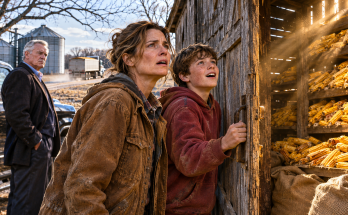
I recognized Calvin's pickup before it reached the house.
It was September, and the drought had left pale dust along the driveway.
The black truck moved slowly toward the porch.
I stood at the kitchen window and watched it.
There had been a time when the sight of that vehicle made me immediately begin searching my mind for an outstanding payment.
Had I missed something?
Had another letter arrived?
Was there some provision in Nathan's agreement I hadn't understood?
That afternoon, I didn't have those thoughts.
I simply wondered what Calvin wanted.
He parked and stepped out.
He looked thinner than I remembered.
His hair was still silver, and he was still dressed more neatly than most men who spent their working lives around farms.
But he seemed older.
Perhaps that was simply because he was.
Three years had passed since the hearing.
Three years of ordinary farm seasons, repairs, payments, and decisions.
I had changed during those years.
There was no reason he wouldn't have changed too.
I went outside.
Calvin stood near the porch.
He didn't have any documents in his hands.
That was the first thing I noticed.
No rolled survey.
No envelope.
No purchase proposal.
Owen came from the barn when he saw the truck.
He stopped beside me.
Calvin looked toward the field.
"That the old Harper corn?"
I followed his gaze.
"Part of it."
He nodded.
"How's it doing?"
"Some plants have handled the weather better than others."
"What are you expecting for yield?"
I looked at him.
"We'll know more when we've finished harvesting."
He nodded again.
Then he stood there without speaking.
It was an uncomfortable little silence.
In the past, Calvin had usually arrived knowing exactly how he wanted the conversation to proceed.
He would explain a problem.
Then he would present an arrangement that benefited him.
And I would be expected to make a decision based on the circumstances he had described.
This time, he appeared less certain about how to begin.
I waited.
Owen looked from Calvin to me.
Finally, Calvin spoke.
"I'd be interested in purchasing some of your seed."
For a moment, I thought I had misunderstood him.
Not because his words were difficult to understand.
Because they were coming from Calvin Rusk.
I looked toward the field again.
"What amount are you thinking about?"
"Enough to plant twenty acres."
Owen turned his head sharply.
I kept my expression as neutral as I could.
"Why?"
Calvin gave me a look.
"I imagine you've got a pretty good idea."
I did.
The drought had affected the entire area.
Pumping restrictions had made it more difficult for him to maintain some of his irrigated ground.
He had seen or heard how portions of Harold's corn had performed.
Now he wanted to investigate whether some of those characteristics might be useful on his own land.
Twenty acres was a small experiment for a man operating thousands.
But it was a meaningful request.
Especially coming from him.
"There are commercial varieties selected for drought conditions," I said.
"I know."
"Have you tried them?"
"Yes."
I waited.
"I'd like to see what this one does," he continued.
I studied his face.
He wasn't asking to buy the marked sacks from the original crib.
He wasn't asking for ownership of our seed collection.
He wanted enough of the descendants we had been growing to conduct a trial planting.
It was a straightforward agricultural request.
The difficulty was that the person making it had once taken every bushel of my harvest.
I remembered the empty east bin.
The yellow dust.
The truck disappearing between the cottonwoods.
I remembered asking him to leave something for the cattle.
He had refused.
I remembered standing at Pete's counter while an old family acquaintance explained why offering me credit might interfere with his relationship with Calvin.
I remembered Lucy crying because another child had told her we were leaving our home.
And I remembered Owen's jar of money.
The sound of the coins against the glass.
Calvin probably didn't know about that jar.
He knew the machinery payment had been made.
He didn't know how close we had come to missing it.
He didn't know exactly what my son had offered to make sure Nathan's tractor remained on our farm.
Standing beside the porch, I felt all those memories return.
I had imagined conversations like this one during the worst months of the dispute.
I had imagined Calvin eventually needing something from me.
I had imagined being able to refuse him as easily as he had refused me.
There had been evenings when that thought gave me considerable satisfaction.
I wouldn't have admitted it to anyone.
But I had entertained the idea of seeing him experience a fraction of the helplessness he had imposed on us.
Now he was actually standing there.
And I discovered that the opportunity didn't feel the way I had expected.
There was no crowd.
Nobody from church had gathered in the driveway to witness the occasion.
There were no attorneys.
No chairman.
No newspaper reporters.
There was a man asking to buy seed.
There was another farmer standing in front of him.
That farmer happened to be me.
"What would you charge?" Calvin asked.
I considered the amount.
Two other farmers had already inquired about purchasing seed.
I had quoted them a price based on what we were offering.
I gave Calvin the same figure.
He looked surprised.
"That's what you want?"
"That's the price."
He studied me.
I could see him considering the answer.
Perhaps he had expected me to refuse.
Perhaps he had expected me to name an excessive price and explain that doing business with him carried a special cost.
He knew enough about our history to understand that either response was possible.
"You're not asking for more?" he said.
"No."
"You could."
"I suppose I could."
Owen remained quiet beside me.
I could feel his attention shifting toward my face.
He understood what Calvin was asking.
He understood there was something more important than the price being discussed.
Calvin folded his arms.
"Why wouldn't you?"
I looked at him.
It was a fair question.
There were reasons I could have given.
He had never shown me comparable consideration when I was struggling.
He had attempted to acquire land he knew was important to my family.
His company had requested the historical agreement before he presented a survey contradicting it.
I had ample reason not to feel particularly generous toward him.
But generosity wasn't what I was offering.
I was selling seed.
I was establishing a price for something my family had spent time and effort growing.
That price was supposed to reflect the product.
Not the character of the customer.
If I charged Calvin considerably more because I disliked him, I would be making a business decision based on my desire to punish him.
I had spent enough time on the receiving end of business decisions driven by something other than the actual transaction.
I wasn't interested in continuing that practice from the other side.
"I've already told other people what the seed costs," I said.
He waited.
"It doesn't become more valuable because you're the person buying it."
Calvin looked toward the field.
Then he looked back at me.
"You think that makes you better than me?"
The question caught me by surprise.
I hadn't been thinking about who was better.
At least, I hadn't been thinking about it until he asked.
I thought about the possibility of telling him exactly what I believed he had done wrong.
I thought about reminding him of every conversation that had taken place during the boundary dispute.
But we had already dealt with the boundary.
We had settled the financial disagreement.
There was nothing left for me to establish by repeating those things in the driveway.
"No," I said.
He looked at me.
"I don't need to compare myself with you anymore."
I glanced toward the sycamores.
Miller Spring continued flowing beneath the limestone.
Even in a difficult summer, the water moved through the old stone trough and toward the creek.
That water had been the center of a disagreement long before I understood its importance.
Walter Rusk had wanted it.
Harold Harper had refused to surrender it.
Calvin had continued pursuing it.
And I had spent a considerable part of my life reacting to the pressure that pursuit created.
I didn't want to spend the remainder of my life defining myself by how differently I could treat Calvin whenever an opportunity arose.
"I've had enough of letting our dealings determine the kind of person I'm going to be," I told him.
He didn't answer.
For a little while, the three of us stood there.
Then Calvin returned to the practical matter.
He wanted enough seed for twenty acres.
I was willing to sell it.
We agreed on the amount.
He paid in cash.
I wrote him a receipt.
It was an ordinary receipt.
Nothing on it mentioned his father.
Nothing referred to the 1979 survey.
Nothing explained that he had once argued that the building where the original seed was found stood partly on his land.
It recorded a sale.
A quantity.
A price.
A payment.
I handed it to him.
He looked at it briefly.
Then he folded it.
I watched him return to his truck.
He didn't apologize.
He didn't acknowledge that I had been right about his reasons for wanting Miller Spring.
He didn't offer an explanation for the things he had done when our circumstances were considerably more difficult.
There was no grand reconciliation.
I hadn't expected one.
I wasn't interested in inventing one merely because he had come to buy corn.
His purchase didn't change our history.
It was simply a new transaction.
When his truck disappeared down the driveway, Owen looked at me.
He appeared to be thinking about something.
I waited.
Finally, he looked toward the field.
"Twenty acres."
"That's what he wants."
He shook his head slightly.
It was obvious that he found the situation remarkable.
I did too.
A few years earlier, Calvin had questioned why we should have access to anything inside the old crib.
Now he was preparing to plant descendants of that seed on his own land.
I thought about the question Owen had asked beside Calvin's pickup during the first boundary confrontation.
Why would anybody care about corn that old?
At the time, Calvin had insisted the matter concerned property.
Now the corn itself was the reason he had come.
I smiled at the thought.
Then Owen and I returned to what we had been doing.
There was still work to finish.
The following spring, Calvin planted twenty acres with descendants of Harold's old corn.
Naturally, people around Millstone noticed.
Agricultural experiments didn't usually generate that much conversation unless they involved unusually large investments or something remarkably unfamiliar.
This particular planting interested people for a different reason.
They knew where the seed had come from.
They remembered the dispute between our families.
They remembered Calvin arriving at the hearing with two attorneys and leaving without the property determination he wanted.
Now there was Harper seed growing on Rusk ground.
Some people found that funny.
Others treated it as evidence that Calvin had finally admitted I had beaten him.
Whenever somebody mentioned that interpretation to me, I corrected it.
"He purchased some seed."
That was usually enough to make them look disappointed.
They wanted a more satisfying ending to the argument.
They wanted Calvin to be humiliated.
They wanted me to have the last word.
I understood the appeal.
I had once wanted those things myself.
But what would it have accomplished?
The boundary had been recognized.
The spring was ours.
The debt had been resolved.
I could continue working my own land.
Calvin was planting corn that might or might not prove useful under his conditions.
He would have to see what happened.
He would have to examine the results.
He would have to make decisions about whether to continue experimenting.
Those were the same things Owen and I had been doing.
They belonged to farming, not to our personal disagreement.
I didn't need his experiment to fail.
I didn't need it to succeed either.
I had our own fields to think about.
I had our own seed to select.
I had cattle that didn't care about what Calvin Rusk was growing twenty acres at a time.
That was the freedom I hadn't understood I was seeking.
Not the ability to make Calvin feel powerless.
The ability to stop arranging my life around him.
One afternoon, I walked down toward Miller Spring.
I stood beside the stone trough and watched the water.
I thought about my father bringing cattle there.
I thought about Nathan leaving our anniversary champagne in the cold water until December.
For years, those memories had become tangled up with surveys, legal notices, and financial pressure.
Now I could stand there and remember Nathan doing something foolish without immediately thinking about Calvin.
I smiled.
I wished Nathan could have seen what Owen was doing with Harold's seed.
I wished my grandfather could have known that farmers were becoming interested in the work he had done so quietly.
But there was no way to arrange those things.
There was only the opportunity to continue.
I left the spring and headed back toward the house.
The old corn crib stood behind the orchard.
Its roof still needed attention.
Its boards still carried the marks of decades of weather.
The building had done an extraordinary amount for us without ever becoming particularly impressive to look at.
I decided that whenever we could manage it, we would make sure it remained standing.
It deserved more than being forgotten again.