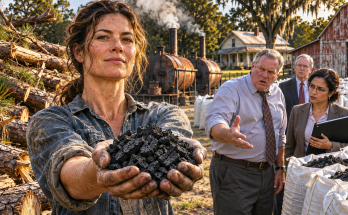
Dale Rucker looked at my proposal as though I had accidentally handed him the wrong piece of paper.
He read the amount at the top.
Then he looked at me.
“Twelve thousand?”
“Yes.”
“For everything behind the road department?”
“Everything identified in the agreement.”
He returned his attention to the page.
I sat across from him and waited.
His office was where the county's expensive debris problem had become a collection of estimates, quantities, and deadlines.
I understood why my offer surprised him.
The conventional disposal estimates were much higher.
He probably expected anyone offering to do the work for less to have misunderstood the scale of it.
“Have you actually been over there?”
“I have.”
“You've seen how much is piled up?”
“Yes, sir.”
He leaned back in his chair.
“What exactly do you think you're going to do with all that?”
“I'll sell whatever is still useful as timber and process the rest.”
He gave a short laugh.
“Planning to go into the firewood business?”
“Not really.”
He looked at me for another moment.
I could tell he expected me to explain further.
But I hadn't come to ask him to invest in my business.
I was offering to remove material the county needed removed.
What happened to that material afterward was the risk I was prepared to take.
He tapped the proposal with his finger.
“You know there's stuff in that pile nobody's going to pay you for.”
“I understand that.”
“Some of those trees aren't worth loading.”
“I've worked with damaged timber before.”
He smiled in a way that suggested he wasn't especially interested in my experience.
I could almost hear the story he would tell someone after I left.
A woman had walked into his office offering to remove thousands of ruined trees for practically nothing.
He probably thought I'd discover my mistake somewhere between the county yard and my grandmother's farm.
I wasn't offended enough to argue.
I needed an agreement.
Not his admiration.
He read the remaining provisions.
When he reached the ownership clause, he stopped.
“You want this to say that whatever you make from the wood belongs to you?”
“That's right.”
He looked amused.
“Is that really necessary?”
“It is to me.”
He lifted the page slightly.
I kept my expression neutral.
That sentence was the reason I had prepared my proposal rather than simply offering to haul the debris away.
I couldn't afford to spend months processing material that somebody else might later claim.
Dale shook his head.
“As far as I'm concerned, you can keep every rotten branch in there.”
“Then we're in agreement.”
He picked up his pen.
He confirmed the amount and the removal deadline.
Twelve thousand dollars.
Before spring.
Then he signed.
I indicated the ownership provision.
“Would you initial that section as well?”
He gave me another amused look.
But he did it.
Two small marks beside the sentence.
I thanked him.
He handed the signed paper back to me.
The meeting was over.
I walked out of the county office without making any attempt to explain why I felt relieved.
Once I reached my pickup, I closed the door and looked at the document.
I read the ownership provision again.
The material belonged to me once transferred under the agreement.
Whatever I produced from it belonged to me as well.
I allowed myself a smile.
It didn't last particularly long.
The agreement had secured a supply of raw material.
It hadn't secured a customer.
It hadn't given me additional equipment.
And it certainly hadn't guaranteed that I would be able to move all that wood for the amount Dale had agreed to pay.
I folded the document carefully.
I had just accepted responsibility for nearly three thousand damaged trees.
Now I needed to get them home.
The first Monday in October, the hauling began.
Amos agreed to lend me his flatbed trailer.
Without that help, the transportation costs would have been even more difficult to manage.
He didn't pretend to understand everything I intended to do.
But he trusted me enough to let me use his equipment.
I also hired Tucker Boone.
Tucker was seventeen and lived on a neighboring farm.
He wanted some work that could fit around his school schedule.
He was friendly, energetic, and interested in almost everything except standing around waiting.
When he first saw the timber, he grinned.
“We're going to make some serious firewood.”
I shook my head.
“Not much of it.”
He glanced toward the pile.
“Mulch, then?”
“Maybe some.”
He waited for a better explanation.
“What are we making?”
“Something you'll recognize once you've seen it.”
He looked disappointed.
I couldn't blame him.
It was difficult to explain the value of biochar to someone looking at enormous pine trunks scattered around a debris yard.
Getting the material home was our immediate concern.
That work demanded attention.
Storm-damaged timber didn't always behave predictably.
Some trunks had broken irregularly.
Some pieces were unstable because of attached branches.
Moving one section could cause another to shift.
On our first day, a log moved unexpectedly while we were working around the load.
I saw it shift and immediately stopped the operation.
Tucker stepped back.
We waited until everything was stable.
Then I insisted that we check the arrangement before proceeding.
It took time.
Tucker looked toward the remaining wood.
“We'll be here forever if we do that every time.”
I looked at him.
“Come over here a second.”
I showed him the weight and position of the log.
I explained what could happen if it shifted on the trailer while we were traveling down the road.
He stopped smiling.
A passing vehicle wouldn't have much protection against a large piece of timber falling into its path.
Neither would the person operating our equipment.
Saving a few minutes wasn't worth that possibility.
“We don't move a load until it's secure.”
He nodded.
After that, I frequently saw him checking the chains again without being asked.
That was when I began to appreciate having him around.
He was young.
He was inexperienced.
But he was willing to learn.
We settled into a routine.
I traveled between the county yard and the farm, gradually moving the material.
Tucker helped when his school schedule allowed.
The flatbed carried load after load.
The space in front of the farmhouse began changing.
I organized the timber into separate sections.
Relatively straight trunks that could still interest a sawmill went in one area.
Twisted pieces and broken tops went elsewhere.
Branches and smaller woody material were separated when practical.
The work was slow.
There were mornings when I looked at the growing rows on the farm and felt encouraged.
Then I would return to the county yard and see how much remained.
That usually cured my optimism.
I kept going.
The possibility of recovering some commercially useful timber was important.
I couldn't treat every log as though it were worth more after processing.
Some of the better trunks still had value in their existing form.
A sawmill owner in Baxley eventually agreed to purchase a portion of that material.
The money helped cover fuel and other immediate expenses.
It wasn't a fortune.
But it gave me some breathing room.
I was beginning to understand how carefully every dollar would need to be managed.
Fuel alone added up quickly.
There were operating expenses.
There were equipment concerns.
There were the farm's existing needs, which hadn't disappeared simply because I had taken on another project.
And every month, there was the bank.
The loan documents remained in the kitchen shoebox.
I didn't need to open it to remember the amount.
While I worked, people around the county developed their own explanations for what I was doing.
Some thought I had entered the firewood business.
Others assumed I was selling mulch.
At the feed store, I heard jokes about the amount of wood accumulating on my property.
One man suggested I could keep everybody in the Southeast warm for years.
I smiled politely.
There wasn't much reason to correct him.
At church, someone wondered whether I intended to sell pine straw.
I didn't even know how that particular idea had started.
The stories became more entertaining as they traveled.
Meanwhile, Dale was telling people that he had arranged an unusually inexpensive solution to the county's debris problem.
Considering the alternative estimates, I could understand why he was pleased with himself.
He had secured a low-cost removal agreement.
What irritated me was the suggestion that he had achieved it by finding someone foolish enough to take the timber.
I heard that version too.
For a while, it bothered me more than I wanted to admit.
I'd spent seven years learning about forest management.
I'd worked around timber under difficult conditions.
I understood that storm debris contained materials of different qualities and potential uses.
Yet because I wasn't explaining my entire business plan to everyone who asked, people assumed I hadn't thought it through.
Looking back, I know I wasn't entirely confident either.
There was a difference between knowing how to produce biochar and knowing how to build a profitable business around it.
I had experience with the first.
The second was something I would have to learn.
Some of the doubts expressed around town were reasonable.
The quantities were enormous.
The schedule was demanding.
My financial situation was precarious.
I knew all of that.
I simply didn't see how explaining my worries to strangers would improve the outcome.
So I worked.
The flatbed returned to the farm again and again.
The rows of timber extended farther across the field.
The county pile gradually changed shape as material was removed.
Some days, the work seemed endless.
My hands were sore by evening.
The cab of my pickup collected dust and pieces of bark.
I would come home, wash up, and look through my expenses at the kitchen table.
The difference between a promising idea and a successful operation was becoming painfully clear.
A promising idea could be explained in a few sentences.
A successful operation required someone to perform the same necessary tasks over and over.
Even when they were tired.
Even when nobody was impressed.
Even when the money wasn't coming in fast enough.
One evening, I stood beside the barn and looked toward the stacked logs.
The last daylight was fading behind them.
I tried to remember what the field had looked like when I first arrived in August.
Bare patches.
Pale soil.
Weeds.
Now it looked like a timber storage yard.
I wondered what my grandmother would have thought.
She would probably have questioned the quantity before anything else.
Amos certainly had.
But I liked to believe she would have understood why I was trying.
The farm needed something other than another desperate growing season.
And the trees needed somewhere to go.
I had managed to bring those two problems together.
By November, I had enough suitable material organized to begin processing.
The two steel kilns I had brought from Oregon were still waiting behind the barn.
I examined them carefully.
They represented twenty-six hundred dollars I had spent before knowing precisely how I would use them.
At the time, buying them had felt like a gamble.
Now they were the foundation of my plan.
I thought about Martin Keller showing me that first piece of porous black material in Oregon.
I remembered the production records.
The soil trials.
The importance of understanding what the finished material could and couldn't do.
I would need to apply those same lessons here.
Only this time, I wouldn't be working on somebody else's restoration project.
The equipment was mine.
The timber was mine.
The risks were mine.
And whatever I managed to produce would belong to me.
I went inside and retrieved a spiral notebook.
I wanted a dedicated record of the work from the beginning.
The county agreement went into a folder where I could find it easily.
The notebook would remain close to the processing area.
I wasn't interested in producing a large quantity of something without knowing how I had made it.
If a batch turned out particularly well, I wanted to understand why.
If something went wrong, I wanted to know that too.
The next morning was unusually cold for the work we had been doing.
Tucker arrived and found me beside the kilns.
He looked from the equipment to the prepared pine wood.
Then he looked at me.
“Are we finally going to find out what this is all about?”
I opened the notebook.
“Yes.”
For the first time since signing Dale Rucker's agreement, we were ready to do something other than move his unwanted trees from one place to another.