I checked the account twice before I believed what I was seeing.
It was the second Friday in July.
The county's payment had cleared.
One hundred and ninety thousand dollars.
I sat at the kitchen table with my hands resting beside the paperwork, staring at the amount.
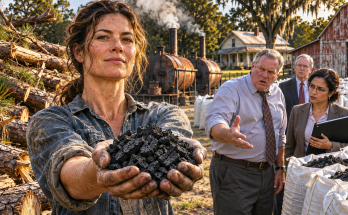
For six weeks, I had concentrated on producing and delivering material.
Before that, I had spent months trying to establish whether anybody would buy enough of it to make a meaningful difference to my financial situation.
Now the transaction was complete.
The money was actually there.
I didn't shout.
I didn't get up and dance around the kitchen.
I simply sat there.
The refrigerator made its usual humming sound.
Through the window, I could see the barn and the remaining timber along the edge of the field.
Everything looked ordinary.
That was probably what made the moment so difficult to understand.
I had imagined it so many times that I expected something about the world around me to feel different.
Instead, the farmhouse was quiet.
The table still had its familiar scratches.
The window frames still needed painting.
And my grandmother's old shoebox was sitting within reach.
I pulled it toward me.
Inside were the documents relating to the loan she had left behind.
I removed them carefully.
Then I looked at the yellow sticky note.
Sorry.
I had spent nearly two years living with that little word.
There had been evenings when it made me angry.
Not with my grandmother.
With the circumstances that had made her believe she needed to write it.
She had worked that land for decades.
She had raised peanuts, maintained her garden, and stayed in the farmhouse long after it became difficult to manage everything alone.
When growing conditions became worse, she hadn't simply abandoned the property.
She had done what she could.
And somehow, at the end of her life, she had decided that what remained wasn't enough.
I had never been able to tell her otherwise.
That was what hurt.
I placed the note beside the original loan documents.
Then I reviewed my financial calculations again.
The county contract wasn't pure profit.
There were costs associated with the expanded production schedule.
The additional processing capacity had been expensive.
There were workers to pay and transportation arrangements to account for.
I had spent considerable time making sure I understood those obligations.
But after allowing for the business expenses, there was enough money to settle the farm loan.
All of it.
Not another interest payment.
Not another temporary arrangement.
The entire outstanding obligation.
I picked up the shoebox.
Then I reached for my truck keys.
I wasn't going to spend the morning finding other things to do.
The barn could wait.
The remaining timber could wait.
For once, the bank was going to receive my attention for a reason that didn't make me miserable.
I carried the box outside and placed it on the passenger seat of my pickup.
The truck looked much the same as it had when I drove it across the country from Oregon.
It had accumulated more dust and wear.
There were traces of pine bark in places that were difficult to clean.
The interior had carried the smell of work for so long that I barely noticed it anymore.
I climbed behind the steering wheel.
Before starting the engine, I looked toward the farmhouse.
The porch sagged slightly.
The roof of the barn needed work.
There were weeds growing in places my grandmother would never have tolerated.
I smiled.
For the first time, looking at those things didn't immediately lead me to calculate whether repairing them made financial sense.
Soon they would be my problems to solve.
That was exactly what I wanted.
I started the truck and drove toward town.
The fields along the road were green in places and pale in others.
I noticed them automatically.
After nearly two years of working with the soil on my grandmother's property, I had become even more attentive to the condition of the surrounding land.
There were farms where the crops looked promising.
There were others where the difficulties were visible from the road.
I understood how much work was hidden behind those ordinary views.
I passed stretches of road where storm damage had once been extensive.
Most of the debris had long since disappeared.
The county had returned to its regular routines.
People drove along roads that had once been blocked by broken pine trees without giving those trees another thought.
I couldn't do that.
Some of those trees had become the foundation of my business.
Some of them were now part of a filtration project intended to protect the Satilla River.
Others had been incorporated into the soil on the farm I was trying to keep.
The hurricane had changed the direction of my life in a way I could never have predicted.
I glanced toward the shoebox.
It slid slightly on the passenger seat when I turned.
I reached over and steadied it.
When I arrived at the bank, I parked and sat in the truck for a moment.
I had been there before.
Ordinary banking matters had brought me through those doors numerous times since returning to Georgia.
But I had never walked in with enough money to make the farm's debt disappear.
I took the shoebox with me.
It probably looked strange carrying it into a bank.
I didn't care.
The important papers were inside it.
So was something considerably more important to me than the papers.
I approached the counter and explained that I wanted to discuss the full payoff of the loan associated with my property.
I was directed to a loan officer.
When I sat down, I placed the shoebox beside my chair.
Then I removed the relevant documents.
“I'd like the total amount necessary to satisfy this loan.”
The officer examined the information.
He confirmed the account details and began reviewing the balance.
I waited.
He explained that the final payoff amount included the remaining principal together with the applicable interest and fees.
I understood.
I hadn't come to pay part of it.
I hadn't come to negotiate another extension.
I wanted the entire obligation settled.
He finished checking the figures.
Then he turned the information toward me.
I looked at the amount.
It was a number that would have frightened me terribly when I first arrived home.
Now I could pay it.
There was something almost disappointing about how ordinary the transaction appeared.
The officer had paperwork to complete.
I had information to provide.
There were financial arrangements to confirm.
For him, it was another loan being satisfied.
For me, it represented the difference between keeping my grandmother's home and surrendering it.
I completed the necessary arrangements.
The officer continued processing the paperwork.
I watched his hands move across the desk.
At one point, he asked whether I had any questions.
“Once this is finished, there won't be anything else outstanding on the loan?”
“That's correct.”
I nodded.
I wanted to hear those words.
He returned to the documents.
I looked down at the shoebox beside my chair.
I remembered the night I first discovered the loan papers.
I had been alone in the farmhouse, trying to calculate how much money sixty acres of tired ground might produce.
Every calculation had seemed to lead toward the same conclusion.
Sell.
Pay the bank.
Leave.
I had been so close to accepting that conclusion.
There had been a perfectly reasonable argument for it.
Keeping the property had required taking risks that weren't guaranteed to produce anything useful.
I hadn't known whether the business would work.
I hadn't known whether the agricultural trials would succeed.
I certainly hadn't known that the county would eventually require filtration material.
I had simply been unwilling to sell before discovering whether I possessed another option.
Now I was sitting across from a loan officer while he prepared the documents confirming that the debt had been satisfied.
I watched him finish the paperwork.
Then he placed the release documents in front of me.
“There you are, Ms. Marsh.”
I looked at them.
He continued.
“The loan has been paid in full. There's no remaining balance against the property under this loan.”
I stared at the page.
I knew what the words meant.
I had spent nearly two years understanding exactly what they would mean.
But hearing them spoken made my throat tighten.
The officer waited.
I wanted to thank him.
For a moment, I couldn't get the words out.
I lowered my eyes and examined the document again.
The figures were there.
The release information was there.
The confirmation I had needed was there.
Forty-six thousand dollars of principal, together with the remaining required interest and fees, had been paid.
The bank no longer held the debt that had threatened my grandmother's farm.
I finally managed to speak.
“Thank you.”
He smiled politely.
I gathered the documents.
Then I opened the shoebox.
The yellow note was visible immediately.
I placed the release papers beside it.
For a few seconds, I looked at both.
One had been written by a woman who believed she was leaving me a problem.
The other confirmed that the problem was finished.
I closed the box carefully.
Then I stood.
Walking out of the bank felt different from walking inside.
I wasn't carrying a piece of property.
I wasn't carrying the farmhouse or the fields or the pecan trees.
They were all exactly where I'd left them.
But the documents inside that old cardboard box had changed what could happen to them.
I reached my pickup and placed the shoebox on the passenger seat again.
Then I sat behind the steering wheel.
I looked through the windshield.
People walked past.
Vehicles moved along the street.
Somebody was probably going into the bank to discuss a problem similar to the one I had just resolved.
Nobody knew what had happened to me.
Nobody needed to.
I put my hands on the steering wheel.
Then I lowered my head.
The tears came before I could stop them.
I hadn't cried when the county signed the contract.
I hadn't cried when the final delivery left the farm.
I had been too occupied with what needed to happen next.
Now there was nothing more I could do about the loan.
Nothing more I needed to do.
The debt was gone.
I thought about my grandmother.
I thought about how she would have reacted if I had been able to place the release documents on her kitchen table while she was still alive.
I wanted to see her read them.
I wanted to hear her say something practical about the farm.
She probably would have reminded me that the barn roof still needed repairing.
Then she would have made coffee.
I smiled through the tears.
I missed her terribly.
Eventually, I wiped my face and started the truck.
I drove home without making any unnecessary stops.
The shoebox remained beside me.
When I reached the driveway, I slowed down.
The farmhouse appeared between the trees.
I looked toward the place where the longleaf pine had fallen during the hurricane.
Less than fifteen feet had separated the house from serious damage that night.
I remembered standing on the porch afterward, wondering how many more problems the property could survive.
Now I pulled up beside that same porch knowing the farm was no longer in danger from the debt my grandmother had left behind.
I carried the shoebox into the kitchen.
The room was warm.
The afternoon light fell across the table.
I placed the box in the spot where it had spent so many evenings.
Then I opened it.
I removed the loan release.
After that, I lifted the yellow sticky note.
I stood beside the refrigerator for a while, holding both papers.
The note had become slightly worn.
Its corners weren't as sharp as they once were.
The handwriting remained clear.
I attached it to the refrigerator.
Then I secured the release document beside it.
I stepped back.
There they were.
The apology and the answer.
I looked at them until the afternoon light began changing.
I thought about everything my grandmother had left me.
The difficult ground.
The farmhouse.
The debt.
The memories.
For a long time, I had concentrated on the financial burden because it threatened everything else.
Now I could look at the inheritance differently.
She hadn't left me something worthless.
She had left me something that needed care.
I placed my hand against the refrigerator door.
“It's alright now, Grandma.”
My voice sounded small in the empty kitchen.
“We didn't lose it.”
I stood there for another moment.
Then I looked through the window toward the fields.
The property still needed work.
There would be expenses.
There would be poor growing seasons and difficult business decisions.
Paying the bank hadn't removed those realities.
It had simply given me the freedom to face them without the old deadline hanging over my head.
I opened the back door.
The evening air moved across the porch.
The pecan leaves stirred.
I walked toward the barn and stopped where I could look across the property.
Sixty acres.
The number had once frightened me because it represented more land than I knew how to restore financially.
Now it represented something else.
Room to work.
Room to learn.
Room to stay.
I had spent nearly two years trying to preserve my grandmother's home.
That evening, I finally stood on the farm without calculating how much time I had left before somebody else might own it.
The ground beneath my boots was mine.
Free of that debt.
And for the first time since I came home, I could begin thinking about its future without being afraid of losing it.