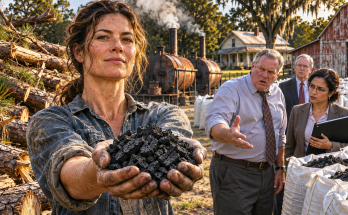
Priya arrived carrying a collection of engineering documents.
The county attorney came with her.
Dale arrived looking as though he would have preferred to conduct the meeting somewhere else.
I invited all three inside.
My grandmother's kitchen wasn't a particularly impressive place to negotiate a substantial commercial agreement.
The table had been there since my childhood.
The floor showed years of use.
The windows still needed attention.
There were repairs throughout the house that I had postponed because the business required whatever money I could spare.
But the kitchen was clean.
There was enough room for everybody to sit.
And the information we needed was arranged on the table.
That was sufficient.
Priya took the chair nearest the production binder.
The attorney sat beside her.
Dale sat across from me, facing the window that looked toward the barn.
From where he was sitting, he could see the rows of white bulk bags outside.
I noticed him looking at them before we began.
The county attorney opened his documents.
We started by discussing the proposed transaction and the county's purchasing obligations.
There were important details to establish.
The material wasn't being purchased for general landscaping.
It had to satisfy the specifications for the stormwater filtration project.
The county needed approximately one thousand cubic yards.
The delivery schedule had to fit the environmental compliance requirements.
There would be documentation and quality verification associated with the supply.
I listened carefully.
Priya explained the technical requirements.
I discussed the arrangements I had been making to increase production.
We reviewed the existing inventory and the additional work necessary to reach the required quantity.
The discussion was straightforward.
For a while, Dale said very little.
He occasionally looked at the documents in front of him.
More often, he looked toward the white bags outside.
When the conversation turned to the proposed price, he finally leaned forward.
“One hundred and ninety thousand dollars?”
“Yes.”
He stared at the figure.
“For the thousand yards?”
“For the complete qualifying supply under the proposed agreement.”
He looked at Priya.
She explained the comparison with the available alternative.
The original contractor's replacement material would cost considerably more and arrive later than the county required.
My proposed supply offered a local option supported by acceptable sample results and traceable production information.
The county would still need to verify compliance throughout the deliveries.
Dale looked back at me.
I could see that he was struggling to separate the proposed purchase from the removal agreement he had signed nearly two years earlier.
“You realize how this looks?”
I waited.
“We paid you twelve thousand dollars to get rid of those trees.”
“I remember.”
“And now we're talking about giving you another hundred and ninety thousand.”
“The first payment was for removing the debris.”
He gestured toward the window.
“That's the debris sitting out there.”
I looked where he was pointing.
“No. That's processed material.”
His expression tightened.
I understood why the comparison between the two amounts seemed extraordinary.
The proposed purchase was worth almost sixteen times the original removal payment.
But comparing the two numbers without considering the intervening work made very little sense.
The services and products involved were entirely different.
I hadn't earned the second amount merely by accepting ownership of the first.
Priya began explaining the engineering value of the material.
Dale interrupted with another glance toward the window.
“Those trees were ours.”
The room became quiet.
I reached for the folder beside me.
I had anticipated the possibility that the original agreement would come up during the meeting.
I removed the document and placed it in front of him.
“Before the transfer, yes.”
He didn't touch the paper immediately.
The attorney leaned slightly forward.
I indicated the relevant sentence.
The provision established that the trees and products made from them became my sole property under the arrangement.
Dale's initials remained beside it.
There was nothing complicated about the wording.
He had agreed to it.
I had fulfilled the removal obligation.
The county had no continuing ownership of the products I manufactured from the transferred timber.
Dale eventually picked up the document.
The attorney reviewed the relevant terms.
I sat quietly while they did.
I didn't enjoy the atmosphere around the table.
There had been a time when I imagined how satisfying it might feel if Dale ever discovered that the material he had dismissed was valuable.
The reality was considerably less entertaining.
I was trying to negotiate a contract that might save my grandmother's farm.
I couldn't afford to let personal satisfaction interfere with that.
I wanted the meeting to succeed.
I wanted the county to obtain what it needed.
I wanted to receive fair payment for the work I would perform.
Anything beyond that was unnecessary.
The attorney returned the document.
The ownership provision was clear.
We moved back to the proposed purchase.
Dale sat with his arms resting on the table.
His face had become noticeably red.
For a moment, I wondered whether he was feeling unwell.
He took a breath.
“So what exactly are we paying for?”
I opened the production binder.
I explained the distinction between existing raw biochar and the material required for the project.
I showed the information supporting the accepted samples.
I discussed the additional preparation and production necessary to meet the required volume.
Then I went through the practical obligations.
Qualified material.
Appropriate screening.
Batch identification.
Quality verification.
Delivery.
We weren't discussing a pile of wood that the county could take back whenever it wanted.
We were discussing the supply of one thousand cubic yards of material meeting particular performance requirements.
Dale listened.
The attorney occasionally asked a question.
Priya clarified the engineering details.
The conversation gradually became less personal.
That helped.
I had prepared carefully because I knew the price needed to be justified by the actual undertaking.
The county was spending public money.
Its representatives had a responsibility to evaluate the proposed transaction.
I respected that responsibility.
I wasn't asking them to purchase my product simply because I needed the money.
I was offering a solution to a problem their previous supplier hadn't resolved.
The price had to make sense in that context.
The delivery schedule was another major issue.
Six weeks.
That was the period we were working toward for completing the required supply.
Saying those words at the kitchen table was easier than imagining what the next six weeks would involve.
I thought about the existing inventory.
I thought about the additional processing arrangements.
I thought about the workers we would need and the equipment that would have to remain available.
There was very little room for wasted time.
I made sure the prospective schedule reflected the work we could reasonably perform.
I didn't promise something simply because I thought it would make the agreement more attractive.
Priya appreciated that.
She had already dealt with a supplier that couldn't provide acceptable material within the required schedule.
She needed a commitment supported by more than confidence.
We reviewed the arrangements again.
Some of the existing inventory could be prepared for delivery.
Additional material would come from continued production using the expanded capacity.
Every batch would need appropriate records.
The delivery schedule would have to remain coordinated with the project's requirements.
I answered questions about the production history and our quality-control practices.
The binder remained open between us.
There were pages documenting the earliest batches I had produced behind the barn.
There were laboratory findings from the first failed agricultural treatment.
There were records from the improved trial.
There were more recent documents concerning the material evaluated for filtration.
Not every section was directly relevant to the purchase.
Together, however, they demonstrated a consistent approach to identifying and evaluating what I produced.
I was grateful I hadn't stopped maintaining those records when it began to feel tedious.
Dale glanced at the thick binder.
“You've been keeping all this since the beginning?”
“Yes.”
He turned a few pages.
I remembered his expression during the first farm visit, when I had shown him my operating records.
He hadn't seemed particularly interested then.
Now he was examining information that supported the proposed supply arrangement.
He looked back at Priya.
She continued explaining the importance of product consistency and traceability.
The attorney reviewed the purchasing requirements.
I waited while the remaining terms were addressed.
There was no dramatic moment when everybody suddenly agreed that I had been right all along.
There was simply a practical decision to make.
The county needed suitable material within a defined period.
I had acceptable sample results, locally available raw material, existing inventory, and a plan for providing the additional volume.
The alternative was more expensive and couldn't meet the necessary schedule.
Eventually, the agreement came together.
One thousand cubic yards of qualifying filtration material.
Final delivery within six weeks.
A total contract value of $190,000.
I looked at the completed paperwork.
For a moment, I found it difficult to believe I was seeing my business associated with that amount.
I thought about the first gardening sales.
The small quantities customers had carried away from the farm.
I remembered sitting at the kitchen table afterward, subtracting expenses and realizing how little remained.
Now I was considering an agreement whose value was greater than anything I had previously handled on my own.
I reminded myself that contract value wasn't profit.
I would have considerable expenses.
There was production still to complete.
Labor to pay.
Equipment to arrange.
Material to prepare and deliver.
The amount on the paper belonged to the entire undertaking, not simply to me.
That distinction mattered.
Still, if I fulfilled the agreement and managed the expenses responsibly, I could finally address the loan.
The possibility made my hands feel unsteady.
I rested them on the table.
The attorney finished reviewing the relevant terms.
Priya made sure the necessary technical requirements were reflected in the arrangement.
Dale looked at the price again.
Then he picked up his pen.
I watched him sign.
He wasn't smiling.
I didn't expect him to be.
The circumstances had given him little reason to celebrate the county's expenditure.
But the agreement offered a workable resolution to the problem.
That was what mattered.
When it was my turn, I signed carefully.
I had signed plenty of documents since returning to Georgia.
Equipment paperwork.
Business arrangements.
The original debris removal proposal.
Various records related to the farm.
This signature felt different.
It represented an obligation considerably larger than anything I had undertaken before.
I put down the pen.
The documents were arranged and exchanged as required.
Priya gathered her engineering materials.
The attorney closed his folder.
Dale pushed his chair back.
Nobody offered a speech.
There was no reason for one.
We had reached an agreement.
Now it needed to be fulfilled.
I walked them outside.
Priya looked toward the processing area.
“We'll need to stay in close contact about the deliveries.”
“Absolutely.”
She nodded.
I appreciated her manner.
She hadn't treated the contract as the end of her problem.
She knew the next stage would determine whether the solution worked.
So did I.
Dale paused near the county vehicle.
He looked across the rows of logs and white bags.
For a moment, I thought he might say something about our original agreement.
Instead, he gave a brief nod.
Then he left.
I remained in the driveway until the vehicles were gone.
The farm looked exactly as it had before the meeting.
There were still logs waiting to be processed.
There were still covers to check.
There were repairs to the house that I couldn't yet afford to make.
The two original kilns remained behind the barn.
Nothing physical had changed.
But I now had a substantial customer.
And a deadline.
I returned to the kitchen.
The signed agreement lay on the table.
I sat down and looked at it.
Then I reached for the shoebox.
I removed my grandmother's loan documents.
The remaining principal was still $46,000.
The yellow sticky note rested beneath my fingers.
For nearly two years, those documents had dictated the limits of my decisions.
Now I had an opportunity to settle the debt.
I didn't permit myself to imagine the bank releasing the property just yet.
That would come only after the work was complete and the payment received.
I folded the loan documents and returned them to the box.
Then I opened the production notebook.
The words I had underlined after the first corn experiment were still there.
Do not rush the preparation.
I read them twice.
Six weeks was a tight schedule.
There would be pressure.
There would be moments when skipping a step might appear to save valuable time.
I knew better than to trust that temptation.
The first experiment had demonstrated what could happen when I allowed a deadline to influence decisions that should have been based on quality.
The county couldn't afford an unsuccessful product.
Neither could I.
I went outside to find Tucker.
He was near the barn, working around the inventory.
He straightened when he saw me.
“Did they sign?”
“Yes.”
His face brightened.
“Really?”
“Really.”
He smiled broadly.
I couldn't help smiling too.
Then I told him that the final supply had to be completed within six weeks.
He looked toward the timber rows.
“That doesn't sound like much time.”
“It isn't.”
“But we've got the extra equipment coming?”
“We've made the arrangements.”
He nodded.
For a few seconds, he looked as though he was trying to picture the quantity we would need to produce and prepare.
Then he turned back toward me.
“Guess we'd better get busy.”
I laughed.
“That would be a good idea.”
We walked toward the processing area.
I showed him how I wanted the existing inventory organized in preparation for the expanded work.
The identification system needed to remain consistent.
We would have more people working alongside us.
Everybody would need to understand how material moved through the operation and how batches were kept identifiable.
I didn't want the increase in production to create confusion.
Tucker listened carefully.
He had become a reliable part of the business.
The boy who had once complained about the time required to secure a load was now someone I trusted to help coordinate material handling.
That change mattered.
I couldn't manage every task personally during the coming weeks.
I needed people who understood why the procedures existed.
Not simply people willing to work quickly.
Later, I went to see Amos.
He was at home when I arrived.
I told him the county had agreed to purchase the filtration material.
He smiled.
Then he asked the amount.
“One hundred and ninety thousand.”
He lowered the coffee can he was holding.
“Dollars?”
I laughed.
“Yes, dollars.”
He stared at me for a moment.
“Well, I'll be.”
I explained that the contract involved substantial production and delivery expenses.
I told him about the six-week schedule.
He nodded slowly.
“Still sounds like enough to make things interesting.”
“It certainly will.”
He smiled again.
I didn't need to explain what the agreement could mean for my grandmother's farm.
He already knew.
As I left his porch, he called after me.
“Don't forget to eat while you're getting all that done.”
“I won't.”
That was a promise I would have trouble keeping.
Back at the farmhouse, I placed the signed purchase agreement in its folder.
I kept the original debris agreement with the other relevant business documents.
Then I prepared for the work scheduled to begin the following morning.
I checked what needed attention.
I reviewed the production plan.
I made sure the identification records were ready.
Outside, the evening air had begun cooling.
I stood beside the original steel kilns for a moment.
They had cost me twenty-six hundred dollars before I even arrived in Georgia.
At the time, purchasing them had seemed like a questionable decision made during an uncertain period of my life.
Now they stood at the center of a business that had earned a substantial contract.
I touched the edge of one of them.
Then I looked toward the remaining logs.
The county's signature had given me an opportunity.
It hadn't earned me the money.
It hadn't released my grandmother's property from the loan.
And it hadn't produced the additional material waiting on our schedule.
Those things would require six weeks of work.
I went inside and set the notebook beside the door.
We would begin before sunrise.