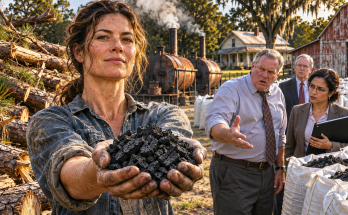
I had been back in Georgia for about three weeks when the hurricane came through.
It arrived after dark.
By then, I was becoming familiar with the sounds of my grandmother's house again.
The refrigerator.
The porch boards.
The wind around the corners of the barn.
That night, those familiar sounds disappeared beneath something much louder.
The rain struck the windows so hard that I couldn't see across the yard.
The trees bent in directions that made me uncomfortable watching them.
Every so often, there was a sharp cracking noise.
I knew what breaking timber sounded like.
I'd heard it plenty of times in Oregon.
But hearing it outside a house I was sitting inside was different.
I stayed away from the windows when the wind became particularly violent.
There was little else I could do.
I thought about the barn roof.
I thought about the house.
I thought about the money I didn't have for major storm repairs.
Eventually, those thoughts became exhausting.
I waited for morning.
When the worst of the weather had passed, I opened the front door and stepped outside.
The air smelled of wet bark and freshly broken wood.
Branches covered the yard.
Leaves were stuck against the porch.
I looked toward the driveway.
A longleaf pine had come down beside it.
It was enormous.
The trunk extended across the ground, and its branches had spread farther than I would have guessed from seeing the tree upright.
It had missed the house by less than fifteen feet.
I stood looking at that distance.
Fifteen feet.
I could have lost the farmhouse before I'd even figured out how to keep it.
I walked farther down the driveway.
The road beyond the property was covered in debris.
Some trees had snapped above the ground.
Others had come out with their roots attached.
The exposed root systems were packed with sand.
Utility crews were already working in the area.
Neighbors were clearing what they could from their entrances.
The sound of chainsaws carried across the wet landscape.
Nobody seemed to know the full extent of the damage yet.
As roads became accessible, the scale of it became clearer.
The county had lost thousands of pine trees.
They stood broken in fields.
They lay across roads and ditches.
Some had twisted so badly that there was little chance of recovering useful lumber from them.
Crews started moving the debris.
For weeks, trucks carried damaged timber away from roads and public areas.
A substantial amount of it ended up behind the county road department.
I had driven past that property before.
Usually, there was nothing remarkable about it.
Then one afternoon, I noticed an enormous pile rising behind the buildings.
I slowed down.
There were logs stacked upon other logs.
Broken limbs filled the gaps.
Tangled branches extended from the sides.
Some sections appeared to reach the height of a three-story building.
I pulled onto the shoulder.
For nearly an hour, I sat in my truck looking at those trees.
At first, I was simply trying to understand how much material was there.
My forestry background made it impossible for me to look at the pile as one uniform thing.
There were pieces suitable for milling.
There were damaged trunks that probably wouldn't be worth a sawmill's trouble.
There were branches and smaller pieces that could potentially be processed in other ways.
And there was an enormous amount of wood that nobody seemed particularly interested in owning.
I watched another truck approach the county yard.
It carried more storm debris.
The pile was still growing.
What I eventually learned was that the county had accumulated material from roughly three thousand trees.
The hauling records suggested around nine thousand cubic yards of mixed debris.
Disposing of it through conventional commercial methods was going to be expensive.
A contractor from Mobile had already provided an estimate.
Grinding and removing that quantity of material could cost the county hundreds of thousands of dollars.
Dale Rucker, one of the county commissioners, wanted the situation resolved before the next budget meeting.
Every day that the debris remained there, it represented another problem he needed to explain.
I didn't know all the details of those discussions while I sat beside the road.
But I knew the county would want the wood gone.
And I knew what some of that wood could become.
I thought about my two steel kilns.
They were sitting on the farm, waiting for a purpose.
I thought about the soil slipping through my fingers.
Then I thought about the shoebox in the kitchen.
Forty-six thousand dollars.
Two years.
The idea didn't immediately strike me as a brilliant business plan.
There were too many unanswered questions.
How much timber could I realistically move?
What would transportation cost?
How much material could I process?
Who would buy the finished product?
I couldn't answer those questions just by looking at a pile of hurricane debris.
But I could begin investigating.
When I finally drove away, I kept glancing toward the timber in my mirrors.
It was strange how quickly my opinion of the pile had changed.
A few weeks earlier, I had been worried about a fallen pine destroying my house.
Now thousands of fallen pines were making me wonder whether I might be able to save it.
Before I contacted the county, I went to see Amos Whitfield.
Amos lived on forty acres adjoining my grandmother's property.
He was eighty-one years old.
He had spent most of those years farming.
His tractor looked as though it belonged in a museum, although he would have been offended if anyone suggested replacing it.
He knew the land around us better than almost anybody.
When I arrived, he was sitting on his porch with an old coffee can.
It was filled with boiled peanuts.
He looked up when I approached.
“You've got that thinking look your grandmother used to get.”
I smiled.
“Is that a bad thing?”
“Depends what you're thinking about.”
He offered me some peanuts.
I took a few and sat down.
For a moment, we talked about the storm and the condition of the surrounding farms.
Then I asked the question I had come to ask.
“Did people around here ever make charcoal commercially?”
He looked at me with mild suspicion.
“Years ago, probably.”
“Do you know anywhere they did it?”
He stopped eating.
After considering the question, he stood up.
“Come on.”
We walked toward the back of his property.
The ground beneath the pecan trees was still scattered with small branches from the hurricane.
Beyond them, we followed the land toward a creek bed.
Amos stopped beside an unusual patch of ground.
“Right here.”
I looked down.
At first, I couldn't understand why he had brought me to that particular place.
Then I noticed the color of the soil.
Most of the surrounding ground was pale and sandy.
But within a roughly circular area, the earth was considerably darker.
The patch was nearly thirty feet across.
I stepped into it and crouched.
“What happened here?”
Amos looked around as if trying to remember a conversation from a very long time ago.
“My granddaddy used to talk about charcoal burners working this ground.”
He pointed toward the middle of the circle.
“Had pits somewhere around here, from what he told me.”
I picked up some soil.
It contained small dark particles.
I rubbed it between my fingers.
Then I squeezed it gently in my hand.
Unlike the sand in my grandmother's fields, this material held together for a moment.
I opened my palm.
Amos pointed toward the nearby planting rows.
“Corn's usually better through here.”
“Even in dry years?”
“Seems to be.”
He shrugged.
“Never spent much time wondering about it.”
I studied the ground again.
What I was looking at didn't constitute a scientific experiment.
I knew that.
I didn't know precisely what had been added to that soil over the years.
I didn't know whether differences in drainage, nutrient levels, or other conditions were affecting the crops.
I couldn't honestly claim that old charcoal alone explained the healthier corn.
But the dark circle was interesting.
Very interesting.
The material had apparently remained in the soil long after the people who produced it had disappeared.
And there was a noticeable difference between that ground and the surrounding sand.
I thought about the biochar trials I'd participated in during my years in Oregon.
Some of the results had been encouraging.
Not every treatment worked.
Not every soil responded in the same way.
But under certain conditions, properly prepared biochar had helped improve degraded ground.
I stood and brushed my palms together.
Amos was watching me.
“What are you fixing to do?”
I looked toward the neighboring property.
I couldn't see my farmhouse from where we stood, but I knew exactly which direction it was.
“I might have found something worth trying.”
He waited.
I told him about the hurricane debris behind the road department.
Then I explained what I had learned about biochar in Oregon.
He listened without interrupting.
When I finished, he glanced toward the dark circle again.
“You want to bring those trees to Evelyn's place?”
“Somehow.”
“How many?”
I hesitated.
“Possibly all of them.”
He stared at me.
Then he slowly shook his head.
“That's an awful lot of wood.”
“I know.”
“An awful lot of hauling, too.”
“I know that.”
He looked unconvinced.
I couldn't blame him.
I was standing in the middle of his field talking about transporting thousands of damaged trees while owing the bank more money than I knew how to earn.
It didn't sound particularly sensible.
But selling the farm would have been permanent.
Trying something else didn't have to be.
I looked at the soil beneath my boots.
“I need to find out whether I can make it work.”
Amos considered that.
“Well, finding out usually costs something.”
He was right.
When I returned to the farmhouse, I started putting numbers together.
I considered the value of timber that might still be suitable for milling.
I considered the cost of moving everything else.
I thought about the available space on the farm and how the debris could be organized without making the entire property unusable.
The quantities were intimidating.
My two kilns weren't designed to process an entire county's storm damage overnight.
I would have to work gradually.
I would have to preserve whatever material could be sold in its existing form.
And I would need money simply to move the wood.
That last problem gave me an idea.
The county was already prepared to pay someone to remove the debris.
I didn't need to purchase the trees if I could offer a disposal arrangement that made financial sense to the county.
What I needed was ownership of the material once I removed it.
I wrote down the figure I thought might cover a portion of the hauling expenses.
Twelve thousand dollars.
It was much less than commercial disposal was expected to cost.
It was also not nearly enough to make the work easy.
I knew that before I put the proposal together.
The potential value lay in what I could recover from the timber afterward.
I prepared a single page.
There was nothing elaborate about it.
The county would pay me $12,000 to remove the covered hurricane debris.
I would complete the removal before spring.
And the material, including anything subsequently produced from it, would belong to me.
That last provision mattered enough that I read it several times.
If I was going to invest my time, money, and labor into processing those trees, there could be no uncertainty about ownership.
I placed the proposal on the kitchen table.
Beside it sat the shoebox containing my grandmother's loan documents.
I opened the box and looked at her yellow note.
For several weeks, that little piece of paper had made me feel helpless.
That evening, it made me determined.
I wasn't expecting three thousand damaged pine trees to solve every problem I had.
I was expecting them to give me something I hadn't possessed when I first arrived home.
A chance to try.
The following Monday, I carried my proposal into the county offices.