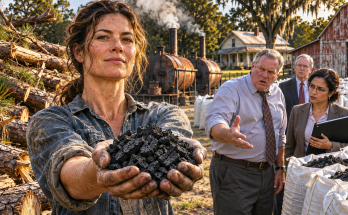
I was checking the identification tags on our first prepared bulk bags when I heard a vehicle coming up the driveway.
I recognized the county truck before it stopped.
Dale Rucker climbed out.
He stood beside the driver's door for a moment, looking across the field.
His attention moved from the remaining timber to the processing equipment behind the barn.
Then he noticed the white bags.
There were already several rows of them.
Each bag represented material that had been prepared for the potential filtration project.
We were organizing the inventory carefully while working through the arrangements necessary to increase production.
Dale walked toward me without his usual smile.
“Morning, Lena.”
“Morning.”
He looked past me.
“You've certainly been busy.”
“We have.”
He stepped closer to the bags.
I watched him examine one of the identification tags.
He didn't ask what the numbers meant.
Instead, he turned toward the remaining timber.
“All this came from the county yard?”
“Most of the material we're processing for this project did.”
He nodded slowly.
Then he pointed toward the bags again.
“That's our wood in there.”
I wasn't sure whether he was making an observation or attempting to establish something.
“The county transferred the wood to me.”
He looked at me.
“You know what I'm saying.”
I did.
And I didn't particularly like it.
For nearly two years, the county had shown little interest in what happened to the timber after I removed it.
The only time Dale had visited was when somebody complained about smoke.
Back then, he hadn't appeared especially concerned about the potential commercial value of what I was producing.
Now the county needed a product, and he was standing in my yard talking about the trees as though they had been temporarily stored on my property.
I wiped my hands.
“What did you need to discuss?”
He looked toward the equipment again.
“Priya tells me your material passed the tests.”
“The samples met the requirements.”
“And you've got enough to help us?”
“I'm arranging the additional capacity.”
He nodded.
For a moment, I thought we were going to have an ordinary conversation about the proposed purchase.
Then he returned to the subject of ownership.
“Seems a little peculiar that we're talking about buying something we already paid for.”
I studied his face.
“You paid me to remove the hurricane debris.”
“That's right.”
“And I removed it.”
“Well, yes.”
I waited.
He appeared to expect me to say something that would make his argument easier.
I didn't.
He looked toward the white bags.
“It's still the same wood, though.”
“No, Dale.”
He frowned.
I continued.
“It's a manufactured product made from wood that became my property under our agreement.”
He shook his head slightly.
“That's one way of looking at it.”
“It's the way we agreed to look at it when you signed the paperwork.”
There was a brief silence.
I remembered sitting across from him in his office with my one-page proposal.
He had been amused by my insistence on including the ownership provision.
He had acted as though I were asking him to clarify ownership of something nobody would ever want.
I hadn't argued with him then.
I wasn't particularly interested in arguing now.
“Come inside for a minute.”
He followed me toward the farmhouse.
I had established a small space for keeping the business records.
The original county agreement was in its folder.
I retrieved it and carried it to the kitchen table.
Dale remained standing.
I opened the folder and removed the document.
“Here's what we both agreed to.”
He accepted the paper.
His eyes moved over the terms.
I could tell when he reached the ownership provision because he stopped moving the page.
He read the sentence carefully.
Then he looked at the small initials beside it.
His initials.
I hadn't placed them there.
He had.
“Remember this?”
He didn't answer immediately.
He returned his attention to the document.
I stood beside the table.
The refrigerator made its familiar sound behind me.
It was strange how ordinary the kitchen felt during a conversation that could have enormous consequences for my business.
Dale finally looked up.
“That was just debris removal.”
“Exactly.”
“We weren't talking about this kind of operation.”
“You asked what I planned to do with the wood.”
He stared at me.
“I told you I would sell what was suitable as timber and process the remainder.”
He looked back at the paper.
I didn't remind him of every joke he'd made.
I didn't repeat what he had said about firewood.
There was no need.
The document established what mattered.
The county had paid for the removal of unwanted material.
Under the agreement, that material and anything subsequently made from it belonged to me.
There wasn't a provision requiring me to surrender the finished product if the county later discovered a use for it.
There wasn't a promise that I would sell anything back at a particular price.
Dale continued reading.
I let him take his time.
Eventually, he placed the paper on the table.
“Well, we'll have to work something out.”
“I expect we will.”
He didn't sound pleased.
I hadn't expected him to.
There were considerable financial consequences attached to the county's current situation.
Its original supplier had failed to provide acceptable filtration material.
The environmental deadline remained unchanged.
The available replacement would arrive too late.
And a woman Dale had once regarded as an unusually inexpensive solution to a disposal problem now possessed material his engineer needed.
I could understand why that situation made him uncomfortable.
Understanding it didn't require me to accept responsibility for it.
He glanced toward the window.
“Looks like you've got quite a bit ready.”
“Some.”
“How much more are you going to have to make?”
“We're working through those figures.”
He nodded.
Then he left the farmhouse.
I watched the county truck turn around in the driveway.
When it disappeared down the road, I returned to the kitchen table.
The agreement remained where he had placed it.
I looked at the signatures.
Nearly two years had passed since I first folded that paper inside my pickup.
At the time, the ownership clause had represented protection against a possibility I couldn't describe with any certainty.
I hadn't known what products would ultimately come from the trees.
I hadn't known whether the business would succeed.
I had simply understood that I needed to own the material before investing in it.
Now I was grateful I had insisted.
I returned the document to its folder.
Then I went back outside.
Tucker was near the bags when I approached.
“What'd he want?”
“To talk about the county project.”
He looked toward the driveway.
“Didn't look too happy.”
“No.”
“Is there a problem?”
“Nothing we can't discuss properly.”
He accepted that answer.
Then he handed me one of the identification tags he had been checking.
We returned to work.
I didn't want Dale's visit to distract me from the responsibilities already in front of us.
There was material to prepare.
There were production records to maintain.
There were arrangements concerning additional equipment and experienced workers.
The potential agreement couldn't be fulfilled by a piece of paper establishing ownership.
It could only be fulfilled through production.
Still, I thought about the conversation throughout the afternoon.
I wondered whether Dale genuinely believed the county retained some interest in the trees.
Perhaps he had forgotten the precise terms of the agreement.
Perhaps he was simply frustrated by the position in which the county now found itself.
I couldn't know exactly what was going through his mind.
What I did know was how quickly people could change their opinion of something once it became valuable.
When the trees lay behind the road department, they represented expense.
Nobody wanted to store them.
Nobody wanted to transport them.
Nobody wanted to explain the disposal estimates at a budget meeting.
When I took responsibility for them, people laughed.
Now that some of the same material had become a product capable of meeting engineering specifications, its origin suddenly seemed important.
That bothered me.
Not because I expected applause for what I'd done.
Because the original trees represented only one part of what the county was considering purchasing.
There had been countless hours of work between the debris pile and those white bags.
There had been fuel expenses.
Equipment expenses.
Labor costs.
Testing.
Storage.
Processing.
There had been mistakes that I had paid to correct.
The trees hadn't arrived at my farm as a finished filtration product.
They had arrived as damaged timber.
I thought about the first day Tucker and I worked around the logs.
I remembered stopping the operation when a piece shifted unexpectedly.
I remembered the chains on Amos's flatbed and the time it took to secure every load.
Then I remembered the first cold morning in November.
The two steel kilns.
The bucket of black material.
Tucker asking whether I intended to record every batch.
I had done exactly that.
The records had eventually brought Priya to my business.
Not the mere existence of the trees.
The work I had performed with them.
That evening, I sat down with the production figures again.
I wanted the proposed purchase price to reflect everything necessary to deliver acceptable material.
There was no sense agreeing to a price that looked impressive on paper but failed to cover the work required.
I accounted for the inventory already available.
I accounted for the remaining production.
I considered the additional processing capacity and experienced labor.
I considered quality checks, material handling, and delivery.
I also had to consider the financial risk.
If something delayed production, there would be expenses associated with resolving the problem.
If material failed to meet the requirements, I couldn't simply send it away and pretend everything was fine.
It would have to be corrected or replaced.
The county's experience with its previous supplier had made the consequences of poor performance particularly clear.
I needed an agreement that allowed me to do the work responsibly.
That was more important than producing the lowest possible number.
The original twelve-thousand-dollar removal agreement had given me access to raw material.
It hadn't made production free.
I wrote down the projected expenses.
Then I examined them again.
The total made me uncomfortable.
Not because it seemed unreasonable.
Because it represented the largest commercial undertaking I had ever attempted independently.
I had never managed a contract of this potential size.
The restoration projects in Oregon had involved considerable work, but somebody else had carried the ultimate financial responsibility.
Here, it belonged to me.
If I made a poor decision, the consequences would reach my own kitchen.
My own fields.
My grandmother's farm.
I looked at the shoebox.
There were occasions when I wished the property weren't connected to every decision I made.
It would have been easier to assess the business opportunity without imagining losing the land.
But that wasn't my situation.
I had to work within it.
The following day, I discussed the prospective arrangements with Priya.
Her questions remained focused on the project.
She needed to understand the production capacity, testing arrangements, and anticipated delivery schedule.
I appreciated that.
She wasn't asking whether the trees had once belonged to the county.
She was asking whether I could provide material that would satisfy the requirements.
That was the conversation we needed to have.
I explained what I could establish from my existing records.
I also explained where additional capacity was necessary.
We discussed the prospective schedule and the importance of maintaining consistent quality throughout the deliveries.
There were still contractual matters to resolve.
The county attorney would need to be involved.
So would Dale.
We arranged to continue the discussions.
When I told Amos about the commissioner's visit, he gave a small laugh.
“He wants those trees back now?”
“He's certainly interested in them.”
Amos shook his head.
“Funny how that happens.”
He didn't need to explain what he meant.
He had seen the original timber pile.
He had lent me the trailer when my entire plan consisted of removing the material and finding something useful to do with it.
He knew how different the operation looked now.
“Did you show him the agreement?”
“Yes.”
“And?”
“He read it.”
Amos smiled.
“Good.”
Then he asked the question that mattered considerably more.
“Think you can make what they're asking for?”
“I think it's possible.”
“Think or know?”
“Think. Until everything's arranged.”
He nodded.
I appreciated that he didn't confuse encouragement with certainty.
He wanted me to succeed.
He also wanted me to understand what I was taking on.
Before leaving his property, I glanced toward his old tractor.
I thought about the dark ground near the creek.
The entire business had begun with a combination of knowledge I'd brought from Oregon and something Amos had shown me on his farm.
Now it was becoming an operation neither of us could have fully imagined while standing in that circular patch of soil.
Back home, I reviewed the contract figures again.
The discussion with Dale had clarified something important.
I wasn't negotiating over the value of unwanted timber.
I was negotiating over the value and cost of a product that needed to meet defined requirements.
There was a difference.
A substantial one.
The county attorney, Priya, and Dale were expected at the farmhouse within a few days.
I began organizing the paperwork for that meeting.
The production binder went on the kitchen table.
Beside it, I placed the calculations concerning the expanded operation.
The engineering information would be available.
So would the original ownership agreement.
I didn't intend to surprise anybody with hidden terms.
I wanted the obligations understood before anyone picked up a pen.
As I arranged the papers, I noticed the shoebox sitting nearby.
I moved it away from the other documents.
The county representatives didn't need to know how often I'd looked at my grandmother's apology while trying to make the business work.
That belonged to me.
What they needed to know was whether I could supply their filtration project.
And what it would cost.
I sat down and checked the figures one final time.
The number was considerably larger than anything Dale had expected to discuss when he first paid me to remove the trees.
But I wasn't pricing the timber he remembered.
I was pricing the work that had transformed it.