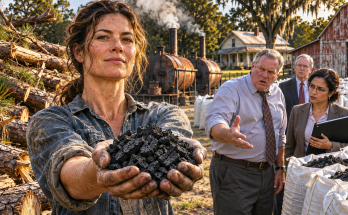
Tucker couldn't understand why I was preparing to burn wood we had worked so hard to collect.
He watched me beside one of the steel kilns.
Then he looked toward the rows of timber.
“All that hauling, and now we're setting it on fire?”
“Not quite.”
He folded his arms.
“Looks like fire to me.”
I laughed.
He had a point.
To someone unfamiliar with the process, what I was doing probably appeared to be an unnecessarily complicated way of disposing of wood.
We were standing behind the barn on a cold November morning.
The air smelled of pine.
The two kilns were positioned in the outdoor processing area.
I had made sure the necessary precautions and local approvals were in place.
Water was available.
The surrounding area was suitable for the work.
I wasn't going to let urgency about the farm make me careless about fire.
I'd spent too many years seeing what uncontrolled burning could do.
I explained to Tucker that our intention wasn't to reduce the wood to ash.
We wanted to convert part of it into a carbon-rich material.
Under controlled conditions, specially designed kilns could help accomplish that.
He listened while I described the difference between the finished product and ordinary burned debris.
Then he glanced at the remaining logs.
“And people buy this stuff?”
“Some people do.”
“What for?”
“There are different uses. I'm particularly interested in the soil.”
He looked down at the ground beneath his boots.
“You mean our dirt?”
“Exactly.”
I could tell he still wasn't convinced.
That was fine.
I hadn't hired him because of his knowledge of soil science.
We began processing the prepared material.
I paid careful attention to the operation throughout the day.
The conditions mattered.
I wanted the product to be reasonably consistent.
There was no point in making enormous quantities of something that might prove unsuitable for its intended use.
By the afternoon, we had finished processing our first batch.
After it had been properly extinguished and cooled, I collected some of the material in a bucket.
Tucker leaned forward.
The pieces were black.
Some were quite small.
Others retained the recognizable shape of the original wood.
I picked up a handful.
They weighed much less than he expected.
I let the pieces drop back into the bucket.
He reached for some.
“This is what you were talking about?”
“Yes.”
He turned a piece between his fingers.
“It's charcoal.”
“A particular kind of it, made for particular uses.”
I showed him the porous structure.
He examined it briefly.
Then he looked toward the enormous timber rows again.
“We're making that out of all this?”
“As much as makes sense.”
He shook his head.
I opened my spiral notebook.
The first page was still empty.
I wrote down the date.
Then I recorded the type of wood we had used and the relevant processing information.
I included the amount produced and my observations about the finished batch.
Tucker watched me writing.
“Are you going to do that every time?”
“Yes.”
“Even if it's all the same wood?”
“Even then.”
He smiled.
“You're going to need more notebooks.”
He was probably right.
But I wasn't willing to rely on memory.
During my years in Oregon, I had learned that small differences in production could matter.
Without records, it was difficult to investigate problems or reproduce good results.
Martin Keller had made that clear to me.
I wanted to carry that habit into my own work.
The first bucket of char didn't look particularly valuable sitting beside the kiln.
It didn't resemble a forty-six-thousand-dollar solution.
But it represented the beginning of something I had imagined while parked beside the county road department.
For the first time, I could hold that idea in my hands.
Over the following weeks, processing became part of our regular work.
The hauling continued.
The timber was sorted and prepared as required.
Finished material accumulated under protective covers.
I maintained the notebook.
Each new entry gave me information about what was working.
Some pieces of pine produced more consistent material than others.
Certain sections required additional preparation.
I tried to understand those differences instead of treating every disappointing batch as an inconvenience.
The work was physically demanding.
My clothes became stained with dark dust.
The material seemed to find its way into places I thought I had protected.
By evening, I often carried evidence of the day's work on my hands even after washing them.
I didn't mind.
What bothered me was how slowly the finished inventory accumulated compared with the amount of timber still waiting.
The kilns had limitations.
I couldn't change those limitations simply because I had a deadline.
I had to work within the equipment's capacity while continuing to manage the rest of the operation.
By December, our routines were becoming more efficient.
Tucker no longer needed me to explain every ordinary task.
He understood why we separated materials.
He understood why the records mattered.
At least, he understood that I wasn't going to stop maintaining them.
Sometimes he would remind me of an observation I hadn't yet written down.
I appreciated that.
As the operation continued, people began noticing what we were doing behind the barn.
There was a complaint about smoke.
It concerned me because I wanted to operate responsibly.
I also knew that complaints could quickly become a serious problem for a business trying to establish itself.
One day, Dale Rucker appeared at the farm.
His county vehicle came up the driveway while I was working near the processing area.
I recognized him when he stepped out.
He looked toward the kilns.
Then he looked at the surrounding timber.
“I've been hearing about smoke out here.”
I set aside what I was doing.
“What have you been told?”
“That you're burning those trees.”
“We're processing portions of them.”
He glanced toward the equipment.
I could tell the operation wasn't what he had expected.
He had probably imagined enormous piles of wood burning in the open.
Instead, there were the two steel kilns and an organized working area.
I explained what the equipment was intended to do.
I showed him the relevant approvals and our operating precautions.
Then I brought out the records.
He turned a few pages of the spiral notebook.
There were dates.
Observations.
Production entries.
He looked toward the kilns again.
I answered his questions without becoming defensive.
There was nothing to gain by treating an inspection as a personal insult.
Dale might have laughed at my original proposal, but the county still had responsibilities relating to fire and public safety.
I understood that.
He examined the site.
Eventually, he returned the notebook.
He left without issuing a violation.
I watched his vehicle disappear down the driveway.
Then I went back to work.
The complaint had been a useful reminder.
Producing something valuable from unwanted material didn't excuse me from considering the people around me.
If the operation created unacceptable problems for others, it wouldn't matter how good my intentions were.
I needed to continue paying attention.
There was another debris-burning operation elsewhere in the county.
Its approach was different from mine.
One evening, I drove past it and saw dark smoke spreading from enormous open piles.
The plume extended toward nearby residential areas.
I could smell it from the road.
I thought about the quantity of timber being consumed.
Some of that material might not have been suitable for better uses.
But I couldn't help wondering how much potentially useful wood was being lost.
The county had experienced a disaster.
It needed to clear the debris.
I didn't question that.
What interested me was whether certain parts of the cleanup could produce something beneficial afterward.
I returned home more determined to understand the possibilities of my own operation.
December passed.
Then January.
The piles of finished char grew.
The notebook filled with entries.
The remaining timber rows became smaller, although there was still plenty of work ahead.
By February, I had accumulated more than two hundred cubic yards of biochar.
Seeing that quantity gave me a certain satisfaction.
It was no longer an experiment involving a handful of black material in a bucket.
I had actual inventory.
But inventory wasn't income.
That distinction became more uncomfortable every time I received another bank statement.
I carried the latest one into the kitchen and sat down.
The loan hadn't disappeared.
The interest remained an obligation.
The deadline continued approaching.
I looked toward the barn through the kitchen window.
Somewhere out there was material I believed could have value.
I needed evidence.
Not just confidence.
Not just encouraging memories from my previous work in Oregon.
If I wanted other people to purchase biochar for improving their soil, I needed to understand how it performed in conditions like ours.
My grandmother's farm offered an opportunity to find out.
The sandy ground had been one of the first things that worried me when I came home.
It lost moisture quickly.
Its condition had contributed to disappointing growing seasons.
Improving that soil had been part of my motivation from the beginning.
I decided to establish experimental growing plots.
I wanted separate sections where I could observe different treatments.
There would be areas receiving biochar and areas that didn't.
I collected orange marking flags and went into the field.
The bright markers were easy to see against the pale ground.
Tucker helped with the work.
He looked at the flags and then toward the barn.
“So we're actually putting it in the dirt now?”
“Yes.”
He seemed pleased to be moving toward something he could understand.
Making black material had been interesting for the first few weeks.
After that, it had become another job.
Growing something would give him a visible result.
I felt much the same way.
I wanted to see green plants standing in soil that contained material we had made from unwanted trees.
I wanted the work to mean something beyond production quantities.
And I wanted it quickly.
That last desire would prove to be a problem.
At the time, however, I didn't recognize how much impatience was influencing my decisions.
I knew there were important differences between freshly produced biochar and material prepared specifically for agricultural application.
I had seen those differences during my work in Oregon.
I knew that combining biochar with suitable nutrient-rich organic materials could be an important part of preparing certain products for soil improvement.
I hadn't forgotten the principle.
I was simply under pressure.
I had spent months hauling, sorting, and processing.
I had more than two hundred cubic yards of finished char.
I still lacked a significant customer.
And the bank wasn't going to extend its deadline because I wanted more time to establish a business.
I looked at the experimental rows and began thinking about how soon I might see results.
That was the mistake in my thinking.
I was concentrating on the speed of the outcome rather than the quality of the preparation.
Some of the fresh material went into the experimental rows without being properly conditioned with compost first.
I incorporated it into the selected soil.
The comparison areas remained available for observation.
Then the growing trials began.
I recorded what I had done in the notebook.
I expected to learn something useful.
At first, there was nothing especially dramatic to observe.
The rows looked much like ordinary planting rows.
The orange flags moved slightly whenever the wind crossed the field.
I found myself checking the plots frequently.
Each time, I looked for some indication that the treated soil was behaving differently.
I thought about the old charcoal ground Amos had shown me near the creek.
I remembered the dark earth holding together briefly in my palm.
I wanted to see something resembling that in my own fields.
More importantly, I wanted to see healthy crops growing there.
The farm had been struggling long before the hurricane.
The timber project had given me a way to address that problem without purchasing all my raw materials.
If the soil trials produced convincing results, I could potentially improve the farm while developing a product to sell.
For someone in my financial position, that possibility was difficult to ignore.
I returned to the farmhouse one evening and placed the notebook on the kitchen table.
The shoebox was nearby.
I opened it and looked at my grandmother's yellow note.
I thought about how worried she must have been while arranging those financial papers.
She hadn't known whether I would be able to keep the land.
Neither did I.
But for the first time, I had done more than calculate what it might cost to save it.
I had brought material onto the property.
I had converted part of it into something potentially useful.
And I had begun testing that material in the very ground I wanted to preserve.
I closed the shoebox.
Outside, the orange flags marked the small sections of field that would provide my first real answers.
I had spent months making biochar.
Now I needed to find out whether I knew enough about using it.