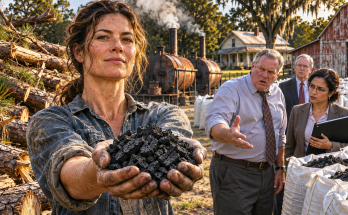
The following spring, another severe storm moved through Satilla County.
I heard the wind increasing around the farmhouse and immediately thought about the hurricane that had come through shortly after my grandmother's death.
There were certain sounds I had become particularly sensitive to.
Branches breaking.
Wood striking the ground.
Wind moving through trees with enough force to make them creak.
I knew what those sounds could mean.
When the weather cleared, I went outside and examined the property.
Across the county, other people were doing much the same thing.
There were damaged trees again.
There were roads and entrances that needed clearing.
There was work for utility crews and the people responsible for removing storm debris.
Gradually, another pile of damaged timber began accumulating behind the county road department.
I hadn't seen it yet when my telephone rang.
I was at the farmhouse, dealing with ordinary business matters.
When the caller introduced himself, I almost laughed.
It was Dale Rucker.
“Morning, Lena.”
“Morning, Dale.”
There was a brief pause.
“Got a fair amount of wood coming in from this storm.”
“I figured there might be.”
He continued.
“Wondered if you'd be interested in taking a look.”
I rested my hand on the kitchen table.
The conversation was so different from the one we'd had nearly three years earlier that I needed a moment to appreciate it.
Back then, I had walked into his office carrying a proposal he found amusing.
I had offered to remove roughly three thousand damaged trees before spring.
He had laughed when I insisted that the material and whatever I produced from it should belong to me.
Now he was calling me.
Not because the county needed to purchase filtration material.
Not because he wanted to question ownership of something standing outside my barn.
Because another storm had left damaged timber behind, and he thought I might know what to do with it.
“Have you got the debris information?”
“Getting it together.”
“I'll come over and see what's there.”
“Appreciate it.”
We ended the call.
I sat for a few seconds.
Then I looked toward the refrigerator.
My grandmother's apology was still there.
Beside it was the document confirming that the farm loan had been satisfied.
The old debt no longer influenced whether I could consider taking on additional storm material.
This time, I could evaluate the opportunity on its own merits.
I didn't need to accept everything simply because I was frightened of losing the property.
That was a considerable difference.
I could examine what was available.
I could determine which pieces might be useful.
I could consider the production capacity and likely demand before deciding what made sense.
The hurricane that had first brought me into contact with Dale had arrived during a period of desperation.
This storm had arrived during a period when I finally possessed choices.
I gathered what I needed and went outside.
Tucker was near the barn.
I told him about the call.
“More trees?”
“Looks that way.”
He smiled.
“Commissioner called you?”
“He did.”
Tucker laughed.
“That's different.”
“It certainly is.”
We prepared the flatbed and made our way toward the county road department.
The drive brought back memories I hadn't expected to feel so strongly.
I recognized the stretch of road where I had pulled onto the shoulder after seeing the original debris pile.
I remembered sitting in the pickup for nearly an hour.
At the time, I had been trying to calculate possibilities without knowing whether the county would agree to anything.
The farmhouse was threatened by a loan I couldn't repay through ordinary farming.
My two used kilns were waiting behind the barn.
I had no customers.
No established business.
No certainty that the material I imagined producing would ever have a significant market.
What I had possessed was knowledge I had acquired during seven years of restoration work.
And a willingness to investigate whether that knowledge could be useful somewhere else.
Now I drove past the same place with a functioning business behind me.
The loan was gone.
The records filled more than one binder.
The farm was beginning to improve through a longer-term effort.
And the county commissioner had asked me to come.
When we arrived, Dale was standing beside the debris.
He held some paperwork in his hand.
I parked and climbed out.
He greeted me without any of the amusement I remembered from our original meeting.
“Glad you could make it.”
I nodded.
“Let's see what you've got.”
He handed me the available debris records.
I looked through the information before examining the timber.
The pile wasn't simply a uniform supply of useful wood.
Storm debris never was.
There were pieces that had broken in ways that made them unsuitable for certain applications.
Some material would require careful consideration before being accepted for any particular use.
There were relatively sound trunks that might still have value as lumber.
There were smaller pieces and damaged sections that could potentially become suitable feedstock for biochar production.
I walked along the accessible portion of the pile, looking carefully.
Dale followed.
He didn't interrupt while I examined the timber.
Eventually, he asked a question.
“Think there's much you can do with it?”
I looked toward the broken trunks.
“There's some good material here.”
He nodded.
“Figured you'd know better than I would.”
I turned toward him.
It was a simple statement.
He probably hadn't considered how much it differed from the attitude he'd displayed during our original conversation.
But I noticed.
There had been a time when he seemed convinced that the only sensible thing to do with the timber was get rid of it.
He had regarded my interest as evidence that I didn't understand what I was taking on.
Now he was asking for my judgment about the material.
I appreciated that.
I returned my attention to the pile.
“Some of it could probably be recovered as timber.”
He nodded.
“And the rest?”
“Some might be useful for biochar. We'll have to be selective.”
He looked toward the debris.
“Whatever you think makes sense.”
I smiled slightly.
I didn't need to hear him admit that he had been wrong.
The conversation itself was enough.
He was treating the material as something that deserved examination rather than something to dispose of without considering its possibilities.
And he was treating me as someone whose experience could help.
That was a meaningful change.
We discussed the available information and what could reasonably be recovered.
I explained that the suitability of the wood depended on what we intended to produce.
We couldn't assume every damaged piece belonged in the same process.
There were considerations involving the condition of the material and its potential applications.
Dale listened.
The conversation was practical.
Nobody joked about heating the entire state with firewood.
Nobody suggested that I was collecting pine straw for tourists.
We were simply looking at timber and considering its possible uses.
I was grateful for the absence of anything else.
Tucker began preparing the flatbed for the first suitable load.
I walked over to review the arrangements.
We had developed considerable experience since the first hauling operation.
Tucker knew the importance of securing the material correctly.
He understood why we wouldn't allow a truck to leave until the load had been properly checked.
Dale came over while we were working.
He looked at what Tucker was doing.
Then he offered to help with the preparation.
I glanced toward Tucker.
He smiled.
Dale joined the ordinary work of getting the load ready.
He didn't stand at a distance making comments about how much time the operation required.
He helped.
There was something almost unbelievable about watching him beside that flatbed.
I remembered his signature on the original agreement.
His initials beside the ownership provision.
His expression when he discovered that the county needed to purchase a product made from the trees he had paid me to remove.
I remembered him standing in my kitchen, pointing toward the white bags.
Now he was helping us prepare another load of damaged timber.
Neither of us mentioned the earlier disagreement.
There was no need.
The work in front of us was different.
Our circumstances were different.
And the fact that he had called me himself said more than another conversation about the past could have accomplished.
Tucker checked the securing arrangements.
Then he checked them again.
I watched him without saying anything.
He had learned that habit after the first log shifted dangerously during our original hauling operation.
Years later, he still understood why it mattered.
Dale waited while the necessary checks were completed.
When everything was properly secured, we were ready to leave.
I thanked him for getting the debris information together.
He nodded.
“Glad somebody can make use of it.”
I smiled.
“So am I.”
He stepped away from the trailer.
Then Tucker and I climbed into the pickup.
As we pulled away from the county yard, I looked briefly toward the remaining timber.
There was still plenty of work to be done.
The new debris would need to be evaluated and managed appropriately.
Some of it might have commercial value without further processing.
Some could potentially become material for future biochar products.
Other pieces might not be suitable for the uses I had in mind.
I was comfortable making those distinctions.
I no longer needed to regard every log as a possible answer to a desperate financial problem.
I could decide what was genuinely worth recovering.
The loaded trailer moved steadily behind us.
I glanced toward Tucker.
He looked pleased.
“Back to hauling trees.”
I laughed.
“Seems that way.”
“Only this time they asked us.”
“Yes.”
He looked toward the road.
“That's pretty funny.”
I smiled.
It was.
But the thing I found most satisfying wasn't that Dale had changed his opinion of me.
It was that he had begun seeing potential in material that once represented nothing but expense.
The county still needed to manage its storm debris.
That responsibility hadn't changed.
What had changed was the way we could think about certain portions of it.
Disposal wasn't necessarily the only possibility.
Recovery could sometimes make sense.
Appropriate processing could produce useful material.
Those options needed careful evaluation.
They weren't universal answers.
But they deserved consideration.
I had wanted people to understand that from the beginning.
As we drove home, I looked toward the surrounding fields.
The view had become familiar again.
When I first returned from Oregon, I had been struck by how distant that part of Georgia felt from the life I had built in the mountains.
I had left a job I loved.
I had traveled across the country with my belongings and two steel kilns.
I had arrived at a farmhouse that seemed smaller than I remembered and fields that looked considerably worse.
For a while, I had wondered whether coming home had been the right decision.
I hadn't wanted to admit that.
My grandmother had left me the property.
I loved her.
I wanted to preserve what she had worked for.
But love didn't make the costs disappear.
There had been days when the business felt impossible.
There had been evenings when I sat at the kitchen table and considered the practical advantages of selling.
I had watched my savings become smaller.
I had seen crops struggle because of a decision I made while trying to save time.
I had heard people laugh at work I was taking seriously.
None of those experiences had felt particularly inspiring while they were happening.
They had been difficult.
Some had been humiliating.
Others had frightened me.
I hadn't known how the story would end.
That was important for me to remember.
It would have been easy, looking back from a safer financial position, to imagine that I had always been certain the trees would save the farm.
I hadn't.
There had been a possibility worth investigating.
I had investigated it.
When the first results disappointed me, I had needed to understand why.
When the later results encouraged me, I had needed to establish what they actually demonstrated.
When the county expressed interest, I had needed to prove that my material could meet its requirements.
The business had developed through those separate decisions.
There hadn't been one moment when belief alone was enough.
I thought about Martin Keller.
He had introduced me to biochar while we were working on forest restoration projects.
At the time, I had been fascinated by the appearance and properties of the finished material.
I hadn't known that what he taught me would eventually become part of the work that saved my grandmother's property.
I was grateful I had paid attention.
I was grateful that he had taught me to respect disappointing results as much as promising ones.
Without that lesson, I might have abandoned the entire project after watching the first corn turn yellow.
Or I might have ignored what the plants were telling me and continued making the same mistake.
Neither response would have helped.
Instead, I had contacted Dr. Okafor.
I had listened.
I had changed the preparation.
I had maintained the separate inventory.
The decisions had seemed relatively ordinary at the time.
They had eventually become important in ways I couldn't have predicted.
When we reached the farm, I slowed the pickup as we entered the driveway.
The farmhouse stood ahead.
The barn was visible beyond it.
The surrounding ground no longer looked like the enormous lumberyard it had become during the first autumn after the hurricane.
There was still material associated with the business.
There were still working areas and equipment.
But I could also see the fields.
I could see a property that was being cared for with the intention of keeping it.
Tucker and I completed the necessary arrangements for the new load.
Then I walked toward the farmhouse.
The afternoon sunlight fell across the porch.
I stopped before going inside and looked toward the field where Amos had examined the soil the previous autumn.
There were dark particles beneath portions of that ground.
They had come from trees that had been broken or uprooted by the hurricane.
I thought about how those trees might otherwise have been handled.
Some would have been ground into material for other purposes.
Some might have been burned away.
Some might have ended up somewhere their remaining value was never considered.
Instead, portions of the timber had become products that served different needs.
Some had helped support soil-improvement efforts.
Some had become part of an engineered filtration system protecting the river from particular contaminants.
The recoverable trunks sold to the sawmill had provided income when the business needed it most.
I hadn't found a single use for every tree.
I had found useful possibilities in different parts of the material.
That was what made the work worthwhile.
I went inside.
The kitchen was quiet.
I approached the refrigerator and looked at the papers attached to it.
The yellow sticky note had become increasingly familiar against the release document.
I no longer looked at the apology with the same sadness I had felt when I first discovered it.
I understood why my grandmother had written it.
I also understood that she had left me considerably more than the debt she regretted.
She had given me a place where I had learned to value patient work.
She had taught me to recognize that the land couldn't provide indefinitely without receiving care.
She had given me memories that were important enough to bring me back when selling would have been easier.
The farm had been worn down.
The financial circumstances had been difficult.
But what she had left behind hadn't been worthless.
I touched the edge of the yellow note.
Then I looked at the release.
I wasn't going to take either of them down.
They belonged together.
One reminded me of what she had feared.
The other reminded me that her fear hadn't determined the outcome.
I returned outside.
The air was pleasant.
Somewhere near the barn, Tucker was attending to the new material.
The pecan trees moved slightly in the breeze.
I walked toward the field.
There was still work waiting for me there.
The ground would need further improvement.
The business would need careful management.
Future storms would bring damage, and future growing seasons would bring conditions I couldn't control.
I had no expectation that life on the farm would become effortless.
But I had something I hadn't possessed when I first came home.
The freedom to keep trying.
I stopped beside a row and crouched.
The sandy earth contained the small black particles I had become accustomed to seeing.
I gathered a little soil in my hand.
It reminded me of the ground Amos had shown me beside his creek.
It reminded me of the first bucket Tucker and I had filled behind the barn.
It reminded me of the white bags that had left the property in June.
The same storm that had frightened me inside the farmhouse had provided material that became part of the farm's future.
I couldn't have imagined that while listening to the trees break in the darkness.
I could see it now.
I opened my fingers.
The soil rested briefly in my palm.
Then I let it fall back between the plants.
My grandmother had once explained that people couldn't expect the ground to keep giving them things unless they were willing to return something to it.
I had been a child when she told me that.
It had taken years of working in forests, coming home to a difficult inheritance, and finding a use for thousands of damaged trees before I fully appreciated her meaning.
I stood and looked across the sixty acres.
The farm wasn't perfect.
It wasn't supposed to be.
It was alive.
It was improving.
And it was still ours in the way that mattered most to me.
I turned toward the farmhouse.
The windows caught the afternoon light.
I imagined my grandmother watching from the porch, reminding me that there was more work to finish before supper.
I smiled.
Then I went back toward the barn.
There were new trees waiting to be examined.
There was another growing season ahead.
And beneath the familiar Georgia sand, some of the dark material from those first fallen pines remained where we had carefully incorporated it.
Helping the ground hold on to what it needed.
Helping support another generation of plants.
Giving something back.
The End
Read more original stories on lastestdrama.com.