On the eleventh day, I went back to the railroad.
The shed was gone from its old position, but work along the abandoned branch continued.
Men were removing spikes and lifting the timber that had once supported the rails.
I watched for a moment before approaching the foreman.
I didn't need anything that could still be used for an active railway.
I needed discarded ties.
Enough of them to create a strong foundation beneath the building Grant had moved.
I explained what I was trying to do.
The foreman listened.
When I finished, he looked toward the piles of old timber.
"How many?"
"Twenty-eight."
He considered the number.
"A dollar apiece."
I could manage that.
Not comfortably.
Not without reducing what remained of my savings to almost nothing.
But I could manage it.
I agreed before another possibility disappeared.
He also arranged to have the ties delivered to Leah's house.
I was grateful for that because buying twenty-eight railroad ties was one thing.
Getting twenty-eight railroad ties home without suitable transportation was another.
I returned to the house with the knowledge that I had finally found a way to get Grant's equipment out from beneath my building.
That alone was a relief.
When the timber arrived, the individual pieces looked even heavier than I remembered.
They were worn.
Darkened by age.
Marked by the years they had spent beneath railway tracks.
But they were capable of serving another purpose.
Grant and his nephew returned.
They built the supports carefully, arranging the timbers into stable cribbing that would distribute the shed's weight.
I didn't interfere with their work.
I had already demonstrated the limits of my knowledge when I suggested placing the building on the grass.
This time, I listened.
Grant checked the supports before beginning to lower the structure.
I watched the space between the timber and the underside of the building grow smaller.
Eventually, the shed settled into its new position.
Nothing shifted unexpectedly.
The equipment could be withdrawn.
Grant examined the finished arrangement.
I took out my tape measure.
At the old railroad site, the floor of the shed had stood forty-four inches above the ground.
That measurement had stayed in my mind throughout the move.
I wanted the building to stand at that height again.
I checked one corner.
Then the next.
Then the others.
Forty-four inches.
The floor was raised as it had been before.
Air could pass beneath the oak.
The building wasn't sitting in the damp earth.
It wasn't occupying Grant's equipment, either.
I stepped backward until I could see the entire structure.
It finally looked as though it belonged somewhere.
The railroad ties weren't beautiful, but they did what I needed them to do.
Twenty-eight dollars had purchased something more important than appearance.
They had purchased the chance to keep the building dry.
Grant looked at the result.
"Better than the grass."
I smiled.
"A lot better."
He didn't make a speech about my earlier suggestion.
He didn't have to.
The supports were the lesson.
After he left, I went inside and checked my money.
Seven dollars.
That was what remained in the coffee can.
I stared at the amount for a while.
Seven dollars wasn't much of a reserve for somebody who had just acquired a building full of unidentified freight.
It wasn't much of a reserve for anything.
I put the money away.
There was no point counting it a third time.
Outside, the shed was waiting.
Its main freight entrance remained sealed.
I had been careful not to disturb that part of the building.
There was, however, another entrance at the rear.
A narrow door led into the small office where the station agent had once worked.
Unlike the freight door, this one wasn't secured with the old wire seal.
Years of paint had effectively stuck it to its frame.
Leah came outside with me.
We examined the edges.
I could see where layers of paint had accumulated along the narrow seam.
There was no need to force the door.
There was no need to damage the surrounding wood.
We brought a putty knife and began working around the edges.
A little paint came away.
Then another small piece.
We continued until the seam became clearer.
I was tempted to pull harder.
Leah kept working patiently.
Watching her made me slow down.
Eventually, the door separated from its frame.
It opened into a room so small that I could take in most of its contents without stepping far inside.
There was a slanted wooden desk.
A tall stool stood nearby.
An old lamp remained where somebody had left it.
I looked at the walls.
Then I noticed the calendar.
1972\.
The year caught my attention immediately.
I thought about whoever had last worked in that office.
At some point, an ordinary working day had become the final day.
The stool hadn't been needed again.
The lamp hadn't been needed again.
The calendar hadn't been changed.
And now I was standing there, seventeen years old, looking at a room that had belonged to another man's working life.
Leah examined the desk.
I touched the edge of it gently.
The little office didn't feel like a treasure room.
It felt like a place where somebody had spent a great deal of time doing his job.
That difference mattered.
There was a drawer in the desk.
When I opened it, I found something wrapped in cloth.
I lifted the bundle carefully.
It had weight.
I unfolded the material.
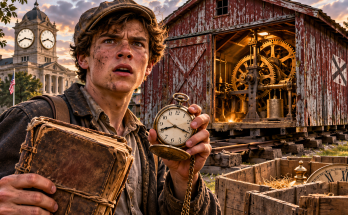
Inside was a pocket watch.
A Hamilton.
The sort of watch associated with railroad work, when keeping accurate time had been a serious responsibility.
I turned it over.
Two letters had been engraved on the back.
A.F.
I showed Leah.
"Look at this."
She took a closer look at the engraving.
"Those must be somebody's initials."
I nodded.
A.F.
Two letters weren't much information, but they were enough to establish that the watch had belonged to a particular person.
It wasn't simply an old object left in an abandoned building.
Somebody had carried it.
Somebody had wound it.
Somebody had decided to wrap it in cloth and put it inside that drawer.
I returned my attention to the desk.
There was a book resting on its slanted surface.
The cover was made of canvas.
It looked like the sort of thing that had been handled regularly rather than displayed.
Across the front was its title.
Record of Unclaimed and Refused Freight.
I read it twice.
Then I looked through the doorway toward the sealed section of the building.
Unclaimed freight.
Refused freight.
The six crates had been waiting inside this shed for reasons I didn't yet understand.
Now I had something that might explain those reasons.
I opened the book.
The handwriting was careful and consistent.
There were columns for dates and descriptions.
Names appeared beside shipments.
The entries belonged to a system that had once been ordinary to the person maintaining it.
I found the agent's name.
Albert Finch.
Ashford Prairie.
I turned toward the desk drawer.
"A.F."
Leah understood immediately.
"Albert Finch."
I looked down at the pocket watch.
The initials had become a name.
That was the first time the man who had worked in the building felt like a real person to me rather than an unknown station employee.
His desk was beneath my hands.
His watch was beside me.
His handwriting filled the pages I was turning.
I wondered how many times he had sat on that tall stool and written down the details of somebody else's property.
The ledger contained entries for all sorts of freight.
Agricultural equipment.
Hardware.
Even livestock.
Things that had once been important enough for people to order and arrange to have delivered by railroad.
For one reason or another, the shipments recorded in that particular book hadn't been collected normally.
Some had been refused.
Others had apparently remained unclaimed.
I moved through the entries slowly.
I wasn't looking for the most valuable object mentioned in the book.
I was looking for information that corresponded with what remained behind the freight door.
Six crates.
Six pieces.
A shipment that hadn't been released.
The dates went back much further than the calendar on the wall.
I turned another page.
Then another.
Leah stood beside me.
The light entering the little room wasn't particularly bright, but the writing was clear enough to read.
Eventually, I reached an entry from 1931.
I stopped.
"Wait."
Leah leaned closer.
I followed the line with my finger without pressing hard against the paper.
There were six pieces of machinery.
Six.
I read the name of the consignee.
Red Willow County Board of Supervisors.
For several seconds, I stared at those words.
County supervisors.
Machinery.
Six pieces.
I looked toward the freight section again.
The number matched.
That didn't prove the ledger was describing the same crates, but it was the strongest connection I had found.
The entry included several additional notes.
C.O.D.
The charges hadn't been paid.
The shipment had been refused.
It had been retained for its owner.
I pointed at the abbreviation.
Leah explained it.
"They were supposed to pay when the goods arrived."
I read the entry again.
"Before they could take them?"
"Exactly."
I thought about the crates.
I thought about the seal that remained across the main freight door.
I thought about the name of the county board.
Then I looked beyond the little garden.
The Red Willow County Courthouse wasn't far from our house.
Its tower rose above the surrounding buildings.
There were four clock faces on it.
Every one of them displayed the same time.
Eight seventeen.
They had displayed that time for as long as I had known them.
They didn't require winding.
They didn't require adjustment.
They were painted representations of clocks rather than functioning clocks.
People had become so accustomed to seeing them that nobody needed to explain why the time was always wrong.
I had passed the courthouse many times without thinking particularly hard about those faces.
Now I couldn't stop looking at them.
Leah followed my gaze.
I hadn't said anything.
Apparently, I didn't need to.
"Owen."
I turned back toward her.
"Be careful."
"About what?"
"Making the answer fit what you want to find."
I looked down at the ledger.
She pointed out that a county board could have ordered any number of large machines.
Road maintenance equipment.
Heating equipment.
Things required for public buildings.
Six pieces of machinery didn't automatically mean a courthouse clock.
I knew she was right.
I also knew I had already started imagining the opposite.
There was a difference between noticing a connection and establishing one.
I had crossed that difference in my head without realizing it.
I looked again at the entry.
There wasn't a single word identifying the machinery as a clock.
Nothing mentioned a tower.
Nothing mentioned four faces.
Nothing established that those six crates contained something that had been intended for the courthouse.
The ledger established only what had been written in it.
A shipment.
A date.
A recipient.
An unpaid charge.
And a refusal.
I closed the book carefully.
Leah glanced at the calendar.
The office had apparently been left behind in 1972.
The freight entry was from 1931.
Forty-one years separated those dates.
I couldn't stop thinking about that.
If the entry concerned the freight still inside the building, then Albert Finch might have spent an extraordinary portion of his working life looking after something that somebody else had refused to collect.
Why?
That was the question I wanted answered now.
Not simply what the crates contained.
Why had they remained there?
I picked up the ledger again.
The answer wasn't going to appear just because I stared at the same handwriting for another hour.
I needed other records.
Something from 1931 that could establish what the county had ordered.
There was a public library in town.
Old newspapers might contain reports of county decisions from that period.
If the supervisors had purchased machinery, refused a delivery, or abandoned an expensive public project, somebody might have written about it.
I glanced at the courthouse through the open doorway.
The four faces still read 8:17.
I wasn't ready to say I had found their missing mechanism.
But I finally knew where to begin looking.