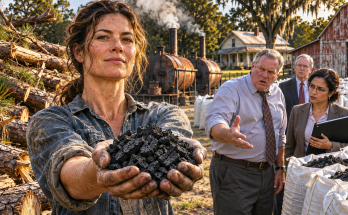
I never expected a man to get angry because I had done exactly what he paid me to do.
But there he was.
Dale Rucker was sitting at my grandmother's kitchen table with his face turning a disturbing shade of red.
His chair scraped against the floor.
He pointed through the window toward the white bags standing in rows outside my barn.
“That material belongs to the county.”
I looked at the bags.
Then I looked at him.
“No, Dale. It doesn't.”
The woman sitting beside him stopped turning the pages of her engineering report.
Her name was Priya Desai.
She worked for the county, and unlike Dale, she understood what was inside those bags.
She also understood why they needed them.
The county attorney adjusted his glasses and waited for me to finish.
I opened the folder in front of me.
There were several documents inside, but I only needed one.
I removed it carefully and turned it around so Dale could read it.
“Do you remember signing this?”
He glanced at the top of the page.
Then his eyes moved toward the bottom.
I watched him recognize his handwriting.
Two initials.
A signature.
A date from almost two years earlier.
He had put them there without a second thought.
Back then, he had been relieved to see me leave his office.
Now he was struggling to accept what that piece of paper meant.
“You can't possibly charge us that much for something we gave you.”
I rested my hands on the table.
“You didn't give me what you're buying today.”
Nobody spoke.
Outside, the wind moved through the pecan trees.
The kitchen smelled faintly of coffee.
I remembered sitting in that same room with a very different piece of paper in front of me.
A bank statement.
Forty-six thousand dollars.
At the time, I hadn't known how I would find even a fraction of that money.
Now the county was considering a contract worth $190,000.
And the man who needed to approve it was the same man who had once laughed at my plans.
My name was Lena Marsh.
I was thirty-eight when I learned that my grandmother had died.
I was living in Oregon then, working in forest restoration on the eastern side of the Cascades.
It wasn't the kind of work most people imagined doing for the rest of their lives.
My boots were usually dirty.
My clothes smelled of sweat and wood.
Most evenings, my shoulders hurt enough that taking off my work jacket required some effort.
I had been doing that work for seven years.
And I loved it.
There was something satisfying about looking at a crowded stretch of forest and understanding why it needed attention.
Not every tree belonged where it had grown.
Not every fallen branch needed to stay where it landed.
Sometimes removing material helped the remaining trees survive.
Sometimes leaving it alone was the better choice.
Learning the difference took patience.
My supervisor, Martin Keller, had spent years working in forests before I joined his crew.
He wasn't a particularly talkative man.
But when he explained something, I listened.
One day, during our restoration work, he showed me a piece of blackened wood.
It was surprisingly light.
The surface was full of tiny openings.
I turned it over in my hand.
“Isn't this just charcoal?”
“In a way.”
He took another piece from the container beside us.
“What matters is how it's made and where it ends up.”
That was my introduction to biochar.
Our crew regularly dealt with woody material that had little commercial value.
Branches.
Damaged trunks.
Small trees removed to reduce overcrowding.
Martin showed me how some of that material could be converted into a stable, carbon-rich product instead of being completely consumed by fire.
We used equipment designed for that purpose.
It wasn't simply a matter of lighting a pile of branches and waiting for something black to appear.
The quality of the finished material depended on how the work was done.
I began paying attention.
I learned how different pieces of wood behaved during processing.
I learned to examine finished batches.
I helped maintain records and participated in trials where prepared biochar was incorporated into soil.
The results weren't always impressive.
That mattered to Martin.
He didn't like exaggerated claims.
When something worked, he wanted to know why.
When it failed, he wanted to know that too.
I respected him for that.
Over time, I became interested in what happened beneath the ground.
How water moved.
How soil held nutrients.
How roots responded to changes people couldn't necessarily see from above.
There was something hopeful about taking wood that nobody wanted and finding a useful place for it.
I didn't know then how important that idea would become.
The telephone call from Georgia came while I was still employed with the crew.
The man on the other end introduced himself as a lawyer.
He asked whether I was Evelyn Marsh's granddaughter.
I said I was.
There was a brief silence before he continued.
I knew something was wrong before he told me.
My grandmother was gone.
I remember staring at my work boots while he spoke.
I had been planning to visit her at Christmas.
I had thought about the drive to her farmhouse, the pecan trees beside the yard, and the way she would complain that I looked too thin.
I'd imagined sitting across from her at the kitchen table.
I had not imagined a telephone call from a lawyer.
He explained that she had left me her farm in South Georgia.
Sixty acres.
The house.
The buildings.
The fields she had worked for most of her adult life.
Then his voice changed.
“There are financial matters we need to discuss.”
I asked what he meant.
He explained that the property wasn't free of debt.
There was an outstanding loan.
I listened, trying to understand numbers while still thinking about my grandmother.
The conversation felt wrong.
I wanted to ask about her.
Instead, we were discussing paperwork.
I thanked him when the call ended.
Then I sat quietly for a while.
My grandmother had been one of the few people who could make me feel at home without asking anything of me.
I had spent a great deal of my childhood on that farm.
She had taught me how to recognize when vegetables were ready to pick.
She had shown me how quickly sandy ground could dry out after a rain.
She had taught me to appreciate work that didn't produce immediate rewards.
I hadn't forgotten those things.
I'd simply allowed distance and employment to take up more of my life than I realized.
Christmas had always seemed close enough.
Until it wasn't.
I resigned from my job in Oregon.
Before leaving, I purchased two secondhand steel kilns suitable for producing biochar.
They cost me thirteen hundred dollars apiece.
It was a substantial expense for someone who was about to become unemployed.
Still, I wanted to bring something useful with me.
My belongings went into my old pickup.
I left the mountains behind and drove toward Georgia.
By the time I reached Satilla County, the August heat felt almost solid.
The air was heavy.
Even standing still made me sweat.
I recognized the road leading to the farmhouse.
Some of the trees seemed larger than I remembered.
The house seemed smaller.
I parked and sat behind the steering wheel for several minutes.
There was no one standing on the porch.
No movement behind the kitchen window.
No grandmother coming outside to tell me where to leave my truck.
I finally opened the door.
The porch boards sagged beneath my feet.
Several window frames needed painting.
The barn roof looked worse than I had expected.
Weeds had grown through the vegetable garden.
I could still recognize where my grandmother's tomato plants used to stand.
That was the part that hurt.
The places remained familiar even though the person who had given them meaning was gone.
I carried my belongings inside.
Then I went back outside to inspect the fields.
The land looked tired.
I knelt and pushed my fingers into the ground.
The soil came away easily.
It was mostly pale sand.
I closed my hand around it, then watched the grains escape between my fingers.
There was very little structure.
Very little of the dark organic material I would have liked to see.
I knew South Georgia farmland could be difficult.
But this was worse than I had hoped.
My grandmother's final peanut crop had not produced much.
The evidence was all around me.
Whatever she had been trying to do in those last growing seasons, the land hadn't been giving her enough in return.
I went inside as the daylight began fading.
Her kitchen looked almost unchanged.
The familiar refrigerator stood against the wall.
The table was where it had always been.
I could remember eating breakfast there before following her outside.
Among the financial papers she had left behind, I found a shoebox.
Inside were documents relating to the farm loan.
I sat down and began reading.
The outstanding principal was $46,000.
There were interest payments to maintain.
The remaining principal had to be repaid in two years.
I read the documents again.
The numbers stayed the same.
I started arranging the papers into separate piles so I could understand what I was dealing with.
That was when I noticed the yellow sticky note.
It had been tucked beneath the loan documents.
The handwriting was unmistakably hers.
One word.
Sorry.
I stared at it.
My grandmother's handwriting had become uneven toward the end of her life.
The letters leaned slightly.
I ran my finger over the edge of the note.
She had apologized to me.
For the debt.
For the condition of the farm.
For leaving something behind that she must have feared would become a burden.
I wished she were sitting across from me.
I would have told her that she had nothing to apologize for.
But there was nobody there to hear it.
I placed the note beside the shoebox and began making calculations.
I looked at possible peanut yields.
I considered seed costs, equipment expenses, fertilizer, fuel, and the repairs I couldn't postpone.
Then I added the loan interest.
The arithmetic was unforgiving.
Even if I managed a respectable harvest, I would struggle to keep the farm operating.
Producing enough additional money to repay the principal within two years was another matter entirely.
I tried changing some of my assumptions.
The outcome barely improved.
I sat back in the chair.
For the first time since coming home, I allowed myself to consider selling.
It was the financially reasonable option.
I could repay the bank.
I could walk away with whatever remained.
I could find another restoration job and rebuild the life I had left behind.
Real estate agents had already begun contacting me.
One suggested that an investor might purchase the property and divide it into residential lots.
I imagined the fields divided by new property lines.
I imagined the old farmhouse disappearing.
I imagined strangers living where my grandmother had spent decades growing food.
Then I remembered something she had told me when I was ten.
We had been walking through one of the fields.
I had asked why she spent so much time working on the ground before planting anything.
She had stopped and looked at me.
“You can't spend your whole life taking from a piece of land, Lena.”
I hadn't fully understood.
She continued walking.
“Sometimes you've got to put something back.”
I understood a little more now.
The farm needed more than another season of peanuts.
It needed time.
It needed improvement.
Unfortunately, the bank wasn't going to provide either simply because I loved the woman who had left it to me.
I folded the loan documents.
I returned them to the shoebox.
The yellow note went on top.
Then I stood beside the kitchen window and looked toward the fields.
I had two used steel kilns, seven years of forestry experience, an aging pickup, and a limited amount of money.
None of those things seemed equal to a forty-six-thousand-dollar problem.
But I wasn't ready to call the real estate agent.
Not yet.
I wanted to see whether the land and the experience I had brought home could give me another choice.