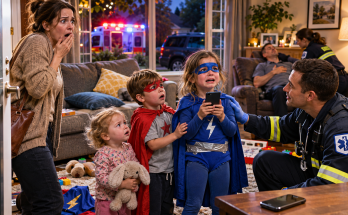
James rubbed his eyes and took a slow breath.
I waited for him to speak.
The conversation about his father had explained something important.
But it hadn't answered every question I had about the decisions he'd made during the previous month.
I still needed to understand why he'd gone to a clinic without mentioning it.
Why he'd delayed the recommended testing.
Why he'd continued looking after the children when he knew he was experiencing repeated dizziness.
And why he'd chosen to confide in Ben instead of me.
Those questions weren't going to disappear simply because I understood more about his childhood.
James looked at me.
“I wasn't trying to keep you out of things.”
I considered that.
“But that's what happened.”
He nodded.
“I know.”
I shifted slightly in the chair.
“Did you really think I wouldn't want to know?”
“No.”
“Then what were you afraid of?”
He looked toward his hands.
“I was embarrassed.”
The answer surprised me less than it would have two days earlier.
By then, I'd begun to understand how much shame was influencing his behavior.
He seemed ashamed that he'd been feeling unwell.
Ashamed that someone at work had noticed.
Ashamed that he couldn't continue doing everything he'd once managed without difficulty.
I hadn't considered those things failures.
Apparently, he had.
He continued.
“You were already working extra whenever you could.”
I nodded.
“And I knew you were tired.”
He paused.
“I didn't want you coming home and having to deal with another thing.”
I looked at him carefully.
“Another thing?”
He didn't answer immediately.
Then he said it more plainly.
“I didn't want to become something else you had to sort out.”
I felt an ache in my chest.
For years, I'd thought of us as partners.
We shared the work of raising the children.
We made decisions about expenses.
We adjusted when one of us had a particularly demanding week.
Sometimes I did more.
Sometimes he did more.
That was part of living together.
I hadn't understood that James had begun thinking about himself as another possible burden on me.
I looked at the blanket.
Then at his face.
“You're not another task on my list.”
He swallowed.
“I know you don't see it that way.”
“Then why do you?”
He shrugged slightly.
“I didn't want to make your life harder.”
I remembered Saturday morning.
The extra shift.
The breakfast he was preparing.
The way he'd insisted that I leave for work.
He'd probably considered himself helpful.
He was saving me from arranging childcare.
He was allowing me to earn extra money.
He was giving the children an enjoyable day.
All of those things would have been lovely under different circumstances.
But he hadn't been honest about his ability to manage them.
And that dishonesty had made everything considerably harder.
I leaned forward.
“Do you think Saturday was easier for me because you didn't tell me?”
He shook his head.
“No.”
“Do you think it was easier for the children?”
“No.”
I watched him.
“Do you think it was easier for you?”
He looked away.
“No.”
There wasn't anything triumphant about receiving those answers.
I didn't feel as though I'd won an argument.
I felt as though we'd finally arrived at the part of the conversation that should have happened weeks earlier.
James had been trying to protect us from knowing he was struggling.
But he hadn't protected himself.
And by failing to protect himself, he'd put the rest of us in a position where we couldn't protect one another.
I thought about the medical appointment.
“Tell me about the clinic.”
He looked at me.
“What about it?”
“What were you planning to do afterward?”
He took a moment to answer.
“I thought I'd arrange the tests when I had a chance.”
“What kind of chance?”
“When things weren't so busy at work.”
I nodded slowly.
“And when was that supposed to happen?”
He gave a small, defeated shrug.
“I didn't know.”
That was the problem.
He hadn't made a plan.
He'd made a vague promise to himself that he would deal with the situation when circumstances became more convenient.
Meanwhile, the symptoms had continued.
The warehouse shifts had continued.
The children had continued needing their father.
Nothing had paused simply because James wasn't ready to address what was happening.
He looked at me.
“I thought maybe I'd start feeling better.”
“And then?”
“Maybe I wouldn't need to worry about it.”
I shook my head.
I understood the temptation.
There were plenty of uncomfortable things in life that I wished would resolve themselves if I ignored them for long enough.
But repeated near-fainting wasn't something we could handle that way.
Especially after a medical professional had already recommended more investigation.
“Why didn't you tell me when you came home from that appointment?”
James looked down.
“I thought I'd wait until I knew something.”
“You knew you needed tests.”
He nodded.
“But I didn't know what was wrong.”
I waited.
He continued.
“I didn't want you getting frightened over something that might turn out to be nothing.”
I understood more clearly what he'd been doing.
He'd imagined that eventually there would be a definite answer.
Once he had that answer, he could decide whether the information was serious enough to share.
Until then, he'd treated his symptoms as something unfinished.
Something he didn't need to discuss.
But life hadn't waited for him to reach that conclusion.
The dizziness had continued.
And then he'd collapsed while caring for our children.
I looked at him.
“You didn't need to know what was causing it before you told me.”
He nodded.
“I could've helped you arrange things.”
“I know.”
“I could've known not to leave you with the children if you were having a particularly bad day.”
His face tightened.
“I know.”
I sat back.
I wanted him to understand the practical consequences of what he'd hidden.
This wasn't only about feeling excluded from a private matter.
Information about his condition would have changed the decisions I made.
It would have changed how we arranged our working hours.
It would have changed whether I accepted that Saturday shift.
It would have changed whether I left the house after seeing him hold on to the counter.
I had made those decisions using information that wasn't complete.
Because James had chosen not to tell me the rest.
He took another breath.
“After a while, I didn't know how to bring it up.”
I looked at him.
“What do you mean?”
“The longer I waited, the worse it seemed.”
I understood.
At first, he'd needed to admit that he'd visited a clinic.
Then he would have needed to explain why he hadn't mentioned the visit immediately.
Later, he would have needed to explain why the tests remained unscheduled.
Each day added another uncomfortable question.
Eventually, telling me meant admitting several different things at once.
He'd apparently decided that continuing to avoid the conversation was easier.
Until it wasn't possible anymore.
“Were you scared?” I asked.
He nodded.
“Yes.”
It was a quiet answer.
But there was something about hearing him say it plainly that affected me more than anything else he'd said that morning.
Not because I wanted him to be frightened.
Because he was finally admitting that he had been.
I thought of him preparing breakfast while trying to conceal his symptoms.
I thought of him standing outside with Ben at lunchtime, saying that he was feeling better.
I thought of him sitting on the couch during superhero school and telling the children that taking a break was part of the game.
He'd been managing his fear by pretending there was nothing to fear.
And I'd been accepting his reassurance because I didn't realize what it cost him to provide it.
I looked at him.
“You could've told me that.”
He wiped his face.
“I should have.”
“Even if you didn't have an explanation.”
He nodded.
“Even if the doctors couldn't tell you anything yet.”
Another nod.
“Even if all you could say was that something didn't feel right.”
He listened.
That was what I needed from him.
Not a complete medical report.
Not an explanation of every possible consequence.
Simply the truth about what he was experiencing.
I remembered how Ben had described James nearly falling while unloading a truck.
For weeks, another person had known enough to encourage him to seek medical attention.
Yet I'd continued watching my husband become increasingly tired without understanding why.
It wasn't Ben's knowledge that hurt me.
I was grateful somebody at work had noticed and cared.
What hurt was that James hadn't considered me someone he could turn to with the same concerns.
I told him that.
He looked distressed.
“It wasn't because I trusted Ben more.”
“I know.”
“He just happened to be there.”
“I understand that.”
I paused.
“But I should've known, too.”
He nodded.
I didn't need to compete with a coworker for my husband's confidence.
I needed James to recognize that his health wasn't a subject he could keep separate from our shared responsibilities.
Not when his symptoms affected the children.
Not when they affected his ability to drive.
Not when they affected whether he could safely continue doing the things our household depended on.
He looked down at the blanket.
“I kept thinking I'd fix it first.”
I sighed.
“You can't fix something by refusing to find out what it is.”
He gave a small nod.
I watched him.
He seemed exhausted again.
This time, though, I didn't interpret that exhaustion as something he needed to push through.
I let the conversation rest for a moment.
He adjusted his position beneath the blanket.
I glanced toward the monitoring equipment.
There was still an uncertainty about his health that neither of us could resolve that morning.
The physicians hadn't identified a clear cause.
Further investigation would be necessary.
And there were medical restrictions we would have to respect.
I didn't know how those restrictions would affect our finances.
I didn't know how long we would need additional childcare.
But I knew the situation wouldn't improve if James and I continued making separate decisions.
He needed to stop trying to spare me from difficult information.
I needed to know what was happening.
And both of us needed to accept that we couldn't control every outcome.
I looked at him.
“You aren't a problem I need to get rid of.”
His eyes moved toward mine.
“You're my husband.”
He nodded.
“And when something happens to you, it affects me.”
I reached toward the edge of the bed.
“Not because you're failing me. Because we're married.”
He looked at my hand.
For the first time since I'd arrived, he seemed willing to reach toward me without immediately offering another explanation.
He placed his hand near mine.
I watched him hesitate.
Then I moved my fingers toward his.
He held them gently.
There was no promise in that gesture that everything would return to normal.
There couldn't be.
Too much had happened.
But it was the first moment since Saturday when I felt we were beginning to look at the same problem together.
Not as something James needed to hide.
Not as something I needed to discover.
As something we both needed to face.
I sat there with his hand in mine.
I thought about Emma waiting for her father to open his eyes.
I thought about how easily she'd trusted him when he told her everything was alright.
And I understood that trust was going to require more from both of us than the words we'd been using.