Until that November afternoon, I still believed hard work would be enough.
I had spent four years getting out of bed before daylight, going outside when the temperature was below freezing, and putting money toward debts that seemed determined to outlive me.
Then I watched a grain truck leave my driveway with the last of my corn.
And I understood how little all that work had protected me.
The truck turned onto County Road 18, passing between the cottonwoods that had already lost their leaves for winter.
Dust rose behind its tires.
I stood beside the auger and waited for the engine noise to fade.
There was a little yellow powder around the bottom of the east bin.
That was all.
An entire growing season had been reduced to something I could have swept up with a kitchen broom.
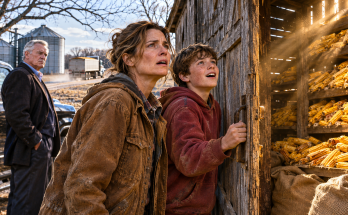
Calvin Rusk stood a few feet away.
He had a folded legal document in one hand and the expression of a man who had completed an unpleasant but necessary errand.
His jacket looked expensive.
There wasn't a spot of grease on either sleeve.
I had known Calvin long enough to remember when his hair was brown, but at sixty-one, almost all of it had turned silver.
People around Millstone, Missouri, treated him with a particular kind of respect.
The kind that came from knowing their livelihoods might depend on his good opinion.
He owned thousands of acres.
Through his various businesses, he had financial interests in thousands more.
I had forty-three acres of my own.
Standing there with an empty grain bin behind me, even those forty-three didn't feel entirely mine anymore.
"I wish we could have handled this differently," he said.
I looked at him.
"You were the one who decided how to handle it."
He adjusted the folded paper between his fingers.
"We discussed this, Evelyn."
"We certainly did."
He had spent three days explaining why he was entitled to take my corn.
Apparently, explaining something enough times was supposed to make it easier for me to accept.
The agreement went back five years.
My husband, Nathan, had borrowed money after a flood ruined much of our planting and damaged equipment we couldn't afford to replace.
We needed fertilizer.
We needed seed.
We needed a transmission for the combine.
Calvin had supplied the money when our other options were disappearing.
Nathan had worked out the figures and told me we could put the whole thing behind us after two good harvests.
I remembered the evening he said that.
We had been sitting at the kitchen table, and he had turned his calculator around so I could see the numbers.
He had looked relieved.
I had wanted to believe him.
Neither of us had included a fatal accident in our calculations.
A pickup crossed into Nathan's lane on Highway 7.
After that, I had a funeral to arrange, two children to raise, and a financial agreement I didn't fully understand.
Calvin had received payments from me for four years.
Some months, I could afford more.
Other months, getting anything to him meant postponing something equally important.
But I had kept paying.
The harvest he had just taken was supposed to give me some breathing room.
Instead, his attorney had determined that the agreement allowed him to claim my harvested grain until the debt was settled.
I had argued.
I had asked questions.
I had tried to get him to leave a reasonable portion behind.
None of it had mattered.
"You could at least have left enough for the cattle," I said.
Calvin put the document into his jacket.
"The collateral covers the whole crop."
"I've got sixteen head and two calves."
"I haven't forgotten."
"They need more than hay."
He glanced toward the cattle lot.
"I understand that."
"No, Calvin. I don't believe you do."
He looked back at me.
I pointed toward the bins.
"I also put aside grain for seed."
His expression barely changed.
"I'm sorry you're in that position."
I let out a little sound that wasn't quite a laugh.
He had emptied my bins, and now he was talking as though my circumstances had nothing to do with him.
It was an impressive skill.
I wondered how many years it had taken him to develop it.
"You're going to exhaust yourself trying to keep this operation going," he said.
"That's my concern."
"It doesn't have to be."
I knew where the conversation was headed.
We had been there before.
I folded my arms against the cold.
"Go on, then."
He took a moment before answering.
"You've done remarkably well considering everything."
Considering everything.
I had heard variations of that sentence from people since Nathan's funeral.
They were surprised when I got the planting finished.
Surprised when I brought healthy calves to auction.
Surprised when they saw me driving a loaded truck.
What they meant was that they hadn't expected much from me.
Sometimes I thought they would have been more comfortable if I had failed immediately.
Then they wouldn't have had to keep revising their expectations.
I hadn't grown up imagining myself as a widow responsible for an entire farming operation.
There were things Nathan knew how to do that I had barely understood.
The first time I tried welding a broken piece of equipment, I made such a terrible mess that I wanted to throw the whole thing into the creek.
Eventually, I got better.
I learned which noises from the machinery meant I could finish the field and which meant I needed to shut everything down.
I learned to repair fences without waiting for somebody to help.
I learned how to make a little money stretch across several large obligations.
Mostly, I learned how to keep moving when I was too tired to think clearly.
There were two reasons I couldn't simply give up.
One was named Owen.
The other was named Lucy.
Neither of them had asked for the life we had been handed.
They had lost their father.
I wasn't willing to make them lose their home without doing everything I could to prevent it.
Calvin looked toward the farmhouse.
"The purchase offer I gave you last summer is still available."
"I know."
"It would settle a great deal of this."
"It would certainly settle things for you."
He shook his head.
"I'm offering you a practical solution."
"You offered about seventy percent of what my property was worth."
"It's a small parcel. You've got the creek cutting through it."
"You didn't come after my property because you were interested in forty-three acres."
He waited.
I nodded toward the sycamores beyond the pasture.
"You wanted the spring."
For the first time that afternoon, he didn't have an immediate response.
Miller Spring was one of those things I had grown up taking for granted.
Cold water emerged beneath the limestone at the northern end of our land.
It collected in a stone trough before flowing into Harper Creek.
My father had watered livestock there.
My grandfather had used the trough to chill watermelons.
Nathan had once decided it would be a clever place to cool a bottle of champagne for our tenth wedding anniversary.
He forgot the bottle.
We didn't retrieve it until December.
I could still remember laughing at him.
Back then, the spring had seemed like a pleasant little feature of the farm.
Something permanent.
Something nobody would bother taking from us.
Then we had two exceptionally dry summers.
People who had never paid much attention to our water suddenly understood its usefulness.
Calvin had already installed two irrigation pivots on his adjoining land.
I knew he wanted another.
The fields to the northeast would be considerably more profitable if he could secure additional water.
He didn't have to tell me that.
I had been looking at those fields my whole life.
"You're a perceptive woman," he said eventually.
"I wish that was worth something at the bank."
He gave me a small, uncomfortable smile.
"I believe your next machinery installment is due in December."
I said nothing.
He knew the answer.
There was no point pretending otherwise.
"We could complete the sale before the holidays," he continued.
I stared at his truck.
"You wouldn't even have to move right away. I'd let you remain in the house until the school year ended."
How generous.
He would take possession of our home and allow my children to remain in their own bedrooms for a few additional months.
I wondered whether he expected me to thank him for that.
"Are we done?" I asked.
Calvin took a few steps toward his pickup.
Then he stopped beside the driver's door.
"You have responsibilities beyond keeping a piece of land, Evelyn."
"I'm aware."
"Don't let your stubbornness make life harder for those children."
He climbed into the truck.
I didn't answer.
I was afraid that whatever came out of my mouth would embarrass me later.
His engine started.
Within seconds, he was heading toward the same road the grain truck had taken.
I watched until he disappeared.
Then I looked down at my hands.
They were shaking.
I pushed them into my coat pockets and stood there for another minute.
I hadn't noticed Owen beside the cattle gate.
He was wearing a faded red sweatshirt, and his fingers were curled around the upper rail.
He was twelve.
Some days, the resemblance between him and Nathan caught me so unexpectedly that I had to look away.
That afternoon was one of those days.
"Mom?"
I turned toward him.
"Hey."
"There's none left?"
I knew what he meant.
"No, honey."
He looked toward the empty bins.
"Not even a little?"
"No."
His shoe moved through the loose dirt beneath the gate.
"Is he allowed to take it?"
I wanted to give him an answer that made the world sound reasonable.
Something reassuring.
Something about grown-ups having rules to follow and people not being permitted to behave unfairly.
Instead, I told him what I knew.
"His lawyer says he is."
Owen thought about that.
"What happens to Buttercup?"
Buttercup was his Hereford heifer.
Her mother had died during calving, and Owen had helped raise her with a bottle.
She weighed approximately seven hundred pounds by then, but he still spoke about her as though she were a little calf that needed him for everything.
"We'll make sure she's fed."
"With what?"
"I'll work something out."
He looked toward the other cattle.
"All of them?"
"Every one."
I tried to smile.
He didn't smile back.
That was the moment I realized my son no longer found comfort in hearing me promise to work something out.
He had heard it too many times.
He knew it usually meant there wasn't a plan yet.
I hated that he knew.
That evening, I went through our accounts.
Nathan's boots were still beside the mudroom entrance.
I saw them whenever I walked from the kitchen to the yard.
Nobody had suggested putting them away.
Not Owen.
Not Lucy.
Certainly not me.
I sat at the kitchen table with the account balances and a stack of bills.
There was $1,284 in our household checking account.
The farm account contained $3,106.
On December 19, I owed $7,800 on the machinery.
I wrote the numbers down.
Then I went through them again, as though I might have accidentally missed several thousand dollars.
I hadn't.
We had enough hay to manage most of the cattle for a while.
The steers I intended to finish and sell in February needed additional feed.
Buying that feed would cost money I didn't have.
Selling cattle prematurely would mean sacrificing income I had counted on later.
Every alternative seemed to take something away from the future.
I couldn't keep doing that indefinitely.
The corn had been my winter supplies, my spring planting, and my chance to put the farm's finances in better order.
I had spent months watching it grow.
I remembered checking the plants during the heat of summer and feeling grateful every time rain arrived.
I remembered thinking that perhaps this would finally be the year when I caught up.
Now I was sitting in the kitchen trying to decide what I could afford to lose next.
I put my pencil down.
From upstairs, I heard Lucy moving around in her bedroom.
Owen was somewhere near the mudroom.
The refrigerator clicked on.
Everything in the house sounded ordinary.
I looked at the empty space beneath the machinery payment on my piece of paper.
For the first time since Nathan died, I couldn't identify a sensible next step.
And the man who had created that problem was waiting for me to sell him the answer.