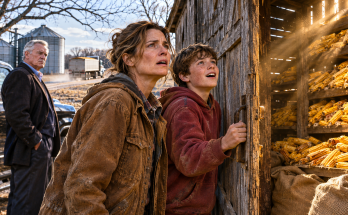
Four days passed before Michael Grant arrived.
He had driven from Tennessee specifically to examine B38.
Earl had helped bring the piece to the attention of someone who understood unusual maple better than either Tom or I did.
Michael had spent more than twenty years working with highly figured wood.
I tried not to make too much of that before meeting him.
Experience didn't guarantee that he would like my burl.
It certainly didn't guarantee that he would pay an amount that could make a difference to my circumstances.
Still, he had driven a considerable distance to see something that had almost become an addition to my burn pile.
That meant something.
I met him near the equipment shed.
By then, B38 had been placed in the rear portion, where I could protect it from the weather.
Michael walked inside.
He noticed the enormous piece almost immediately.
His pace changed.
I watched him carefully.
He didn't make an announcement about what he was seeing.
He didn't compliment me on the material.
He simply became quieter.
I had learned to recognize that behavior from Earl.
People who knew something about wood apparently had a way of becoming very restrained around pieces that interested them.
Michael walked around B38.
He bent down to inspect the lower portion.
He used a flashlight to look into openings that occurred naturally in the growth.
He examined the arrangement of the bark.
Then he took measurements.
I stood nearby, trying not to interrupt.
Every few seconds, I wanted to ask whether he had discovered something important.
I reminded myself that he hadn't driven from Tennessee to provide me with reassurance.
He was considering a purchase.
There was a difference.
"When was the tree felled?"
"Not even a month ago."
He examined another area.
"Have you kept it covered since bringing it in?"
"I have."
He nodded.
I thought about the hour Tom and I had spent pulling the piece free.
I thought about the rain falling against the farmhouse windows.
For once, I was grateful for how much work I had given myself.
Michael eventually straightened.
"Have you settled on a price?"
I shook my head.
There was no point pretending I had an established figure.
If I gave him a number, I would simply be guessing.
"Then we're both still figuring it out," he said.
He walked around the burl again.
I glanced toward Earl.
Earl appeared perfectly comfortable waiting.
I wished I could say the same about myself.
Then Michael stopped.
"I'd pay eight thousand dollars."
I stared at him.
I had prepared myself for the possibility of a few hundred.
I had allowed myself to hope for considerably more.
But eight thousand dollars was a number that belonged to the serious problems in my life.
I didn't immediately think about the wood.
I thought about the tractor transmission.
I thought about the roof.
I thought about the tax bill.
I thought about the remaining hospital balance and how much I wanted to stop seeing those notices.
Eight thousand dollars.
I could almost feel several months of financial pressure easing.
My first instinct was to say yes.
I opened my mouth.
Then I looked toward Earl.
He was standing near the entrance.
He didn't signal anything.
There was no encouraging smile.
There was no movement suggesting that I should refuse.
I couldn't read his expression at all.
Michael noticed my hesitation.
"I'm prepared to put down money today."
That made the offer feel even more immediate.
I wouldn't have to spend weeks trying to find a buyer.
I wouldn't have to figure out how to cut the material.
I wouldn't have to worry about losing value while learning to process it.
I could agree, let somebody more experienced take responsibility, and receive eight thousand dollars.
The simplicity of that arrangement was almost irresistible.
Earl finally spoke.
"Would you mind letting her consider it overnight?"
Michael looked at me.
I didn't contradict Earl.
Michael agreed to give me some time.
After he left, I turned toward Earl.
I was more upset than I had expected to be.
"Was there something wrong with that offer?"
"I didn't say there was."
"Then why did you ask him to wait?"
"Because we haven't established what a reasonable price is."
I looked at B38.
For nearly a month, it had existed on my property without paying a single bill.
Now somebody was willing to exchange eight thousand dollars for it, and I was being encouraged to hesitate.
I found that very difficult.
"You understand what that money would do for me, don't you?"
"Of course."
"No, Earl. I mean right now."
He waited.
"I wouldn't have to keep worrying about the tractor giving out while I'm using it."
He nodded.
"I could take care of the property taxes without moving money around."
"I understand."
I tried to continue speaking normally.
My voice didn't cooperate.
For two years, I had watched money leave my accounts.
Some of it went toward ordinary living expenses.
Some went toward repairs.
Some went toward obligations left over from a period of my life I desperately wanted to stop reliving.
I hadn't been careless with money.
I hadn't been spending it on things I didn't need.
I had simply been confronted with expense after expense while trying to maintain a property that required constant attention.
And now somebody wanted to give me eight thousand dollars for a single piece of wood.
I couldn't explain how extraordinary that felt.
"I finally have something somebody wants to pay me for."
Earl's expression changed.
He didn't argue.
He knew Matthew was gone.
He knew I was struggling to maintain the farm.
But knowing those things from the outside wasn't the same as sitting at my kitchen table and looking at the numbers every evening.
I wanted him to understand why I was afraid of losing the offer.
"I'm not asking you to turn it down," he said.
"Then what are you asking?"
"Find out if eight thousand is the right price before letting it go."
I looked away.
He continued.
"If that's what it's worth, sell it and be pleased. But suppose someone would willingly pay twice that amount?"
I didn't answer.
Because he was right.
That didn't make waiting any easier.
The same fear that had almost persuaded me to accept fifty dollars from Earl was working on me again.
The amount was different.
My circumstances weren't.
I had immediate needs, and somebody was offering immediate money.
I wanted the problems gone.
I didn't particularly want another lesson in patience.
But I also remembered the piece we had opened in Earl's shop.
The things I didn't know about this wood could be expensive.
I agreed to give it until the following day.
That evening, the photographs and measurements of B38 were circulated among a small group of professional woodworkers and specialized timber buyers.
I sat at the kitchen table with my computer open.
The same table.
The same empty chair.
But this time, instead of looking for ways to delay payments, I was waiting to discover whether somebody wanted to make one.
The first response arrived sooner than I expected.
Eight thousand five hundred dollars.
I read it twice.
Another buyer indicated that nine thousand two hundred might be possible, provided the wood was sound.
Then someone offered nine thousand five hundred and agreed to cover transportation.
I wrote the figures down.
There was no sensible reason to do that immediately because I could read them on the screen.
I needed to see them somewhere else.
I needed them to look like actual money rather than numbers appearing on my computer.
Another message came.
Ten thousand dollars.
I sat back.
I thought about Michael's first offer.
Had I accepted it, I would have gone to bed believing I had made the best financial decision available to me.
I would have been pleased.
I might never have discovered that other buyers were prepared to pay more.
The uncomfortable part was that eight thousand dollars hadn't suddenly become a bad offer.
It had simply stopped being the only offer.
That was something I needed to remember.
At fourteen minutes past nine, my phone rang.
It was Michael.
He told me he knew other buyers had expressed interest.
I waited.
There was no point attempting to sound like an experienced negotiator.
I wasn't one.
"I can make it twelve thousand," he said.
I held the telephone more tightly.
For a few seconds, I didn't know what to ask.
Then I remembered everything Earl had said about the uncertainty of unopened wood.
"You're offering that without cutting it first?"
"That's correct."
"And you would collect it?"
"I'll handle the transportation."
I looked toward the back window.
Somewhere beyond the dark yard sat an enormous wooden growth that a logging crew hadn't considered worth carrying away.
A man was offering twelve thousand dollars to carry it all the way to Tennessee.
I needed to understand why.
"What makes this particular piece worth taking that chance?"
Michael didn't answer immediately.
When he did, he explained that his work depended on finding exceptional natural material.
Ordinary wood was easy to acquire.
Standard dimensions could be produced repeatedly.
Colors could be altered.
Common surfaces could be made more attractive.
But the unusual character of a large burl was something nobody could reliably reproduce.
A manufacturer couldn't create another tree with precisely the same history of growth.
A buyer who missed an unusual piece couldn't necessarily find another next week.
That was why he was interested in buying B38 before somebody divided it into smaller sections.
He wanted control over what happened to the material.
I finally understood Earl's concern about the chalk.
I had been preparing to change the shape of something whose untouched condition was itself part of its appeal.
I asked Michael to confirm the arrangements.
He did.
Then I accepted the offer.
When the call ended, I remained seated.
I expected to feel an overwhelming rush of happiness.
Instead, I felt quiet.
I looked at my notes.
The first figure was eight thousand.
The final figure was twelve thousand.
One evening of waiting had made a difference of four thousand dollars.
For some people, that might not have been particularly impressive.
For me, it represented repairs, security, and obligations I could finally address.
I thought about how close I had come to saying yes before Michael finished presenting his first offer.
I wasn't ashamed of needing the money.
But I understood how easily that need could influence my judgment.
Three days later, Michael arranged for B38 to be collected.
I stood outside while the enormous piece was loaded.
Watching somebody else take responsibility for moving it reminded me how much trouble Tom and I had experienced freeing it from the ground.
I could still remember the winch straining.
I could remember wondering whether protecting the material was worth the trouble.
Now I was watching it leave my property.
This time, it hadn't been rejected.
Michael's trailer pulled onto the gravel driveway and headed away.
I stood holding the receipt.
Twelve thousand dollars.
Tom was beside me.
He watched the trailer disappear.
"That thing was lying out there like garbage a few weeks ago."
"I know."
He shook his head.
I looked at the receipt again.
Then, without any warning, I began crying.
Tom turned toward me.
"What's wrong?"
"Nothing."
He looked unconvinced.
I tried wiping my face.
That only made me more aware of how much I was crying.
"I'm all right, Tom."
I was.
For once, I genuinely was.
The tears weren't about becoming wealthy.
I understood perfectly well that twelve thousand dollars wouldn't solve every problem I faced.
There would still be taxes.
There would still be expenses.
The farm would still require work.
And Matthew wasn't coming home.
But for two years, opening an envelope or looking at a financial document had usually meant discovering something I needed to pay.
The receipt in my hand represented the opposite.
Somebody had recognized value in something I owned.
Somebody had paid me for it.
And I had made the decision myself.
Not perfectly.
Not without help.
But carefully enough to receive more than I initially would have accepted.
I folded the receipt.
I didn't know what the remaining burls would bring.
I didn't pretend they were all exceptional.
But I no longer felt that the timber sale had been followed by nothing except another expensive inconvenience.
That afternoon, I looked at the equipment shed with a feeling I hadn't experienced for a long time.
I had something to work with.
And for the moment, that was enough.