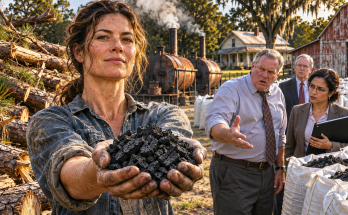
The first time I watched a loaded truck leave the farm for the bypass project, I felt an unexpected sadness.
Not because I wanted to keep the material.
I had spent nearly two years trying to find somebody who would purchase enough of it to make the business financially secure.
Seeing it leave was precisely what I had hoped for.
But I remembered where those bags had begun.
The county yard.
The roadside.
The hurricane.
I remembered Amos lending me his flatbed when I had very little more than an agreement and some secondhand equipment.
Now a commercial shipment was leaving the property.
It was carrying something made from trees that had once been regarded as an expensive inconvenience.
I stood beside the driveway until the truck disappeared.
Then I returned to the barn.
There was more work to do.
The deliveries were part of the schedule we had been coordinating with Priya.
The material had to reach the project with the appropriate identification and supporting information.
The work didn't end when a bag was filled.
Each shipment needed to correspond with the relevant records.
We checked quantities.
We verified the required information.
We maintained the distinctions between batches.
I wasn't willing to let the final stage become disorganized simply because we were exhausted.
Tucker understood that.
He moved around the loading area with the confidence of someone who had become familiar with the operation.
He checked the identification tags.
He helped coordinate the material.
He paid attention to the arrangements before a truck departed.
Occasionally, I watched him and thought about that first Monday in October.
He had been seventeen years old, eager for some work after school.
He had thought we were starting a firewood business.
Now he was helping organize deliveries associated with a substantial environmental engineering project.
I was proud of him.
I didn't tell him that every time I noticed something he did well.
But I hoped he knew.
The loading and delivery process continued.
Truck after truck carried the white bulk bags away.
The rows outside my barn gradually became shorter.
There was an odd pleasure in watching space reappear on the property.
For months, almost every available section of ground had seemed occupied by some stage of production.
Logs waiting to be prepared.
Raw material waiting to be screened.
Finished material waiting for testing or shipment.
Equipment.
Working areas.
Now a portion of that space was becoming available again.
I could see more of the field.
I could walk past sections of the barn without having to make my way around inventory.
The farm was beginning to look less like the enormous timber yard it had become after the hurricane.
I appreciated that.
I also appreciated what the change represented.
The material wasn't disappearing because I'd failed to find a use for it.
It was leaving because somebody needed it.
Priya remained closely involved in the verification process.
The county needed the records associated with the deliveries.
She reviewed the information to ensure the supplied material corresponded with the project's requirements.
I made myself available whenever clarification was needed.
There were no circumstances under which I wanted the paperwork to become an obstacle after all the work we had completed.
I kept the production binder close.
The newer records concerning the filtration material had added considerably to its thickness.
I frequently found myself working with documents spread across the kitchen table.
The original pages seemed almost insignificant compared with everything that had accumulated since.
Yet those early entries remained valuable.
They established how the operation had developed.
They connected the finished product to documented production practices.
They demonstrated a habit I had maintained before the county had expressed any interest.
I was grateful for every evening I had spent writing information I could easily have persuaded myself to leave until later.
One afternoon, while another delivery was being organized, a county vehicle appeared.
Dale was there.
He stood near the loading activity and looked toward the bags.
I recognized him immediately.
I had become accustomed to seeing him when something needed discussing.
This time, there was no disagreement over ownership.
No suggestion that the county was simply reclaiming its original property.
He watched the material being prepared for transportation.
The identification information was checked.
The load was handled appropriately.
The shipment was associated with the necessary documentation.
He looked at the operation for a while.
I greeted him.
“Afternoon.”
“Lena.”
He nodded.
“How's it coming?”
“We're on schedule.”
He looked toward the remaining inventory.
“All of that's going?”
“The material allocated to the project, yes.”
He nodded again.
There wasn't much else to say.
The agreement had been reached.
The work was being performed.
The material was leaving the farm according to the arrangements.
For the first time, Dale was seeing the actual volume of finished product associated with the contract he had signed.
I wondered whether he was thinking about the county's original debris pile.
I certainly was.
I remembered his jokes about having enough firewood to supply an enormous portion of Georgia.
I remembered him treating the ownership provision as something unnecessary.
Now he was standing beside his county vehicle watching the product go to a project the county urgently needed to complete.
Nobody laughed.
I hadn't imagined that particular silence would mean so much to me.
It wasn't an admission.
It wasn't an apology.
It was simply the absence of ridicule.
For nearly two years, I had been aware that people considered my decision foolish.
I had tried not to let their opinions influence my work.
Occasionally, I had failed.
I had allowed myself to become embarrassed by their jokes.
I had worried about what they would say when my first experiment went wrong.
There had been nights when I wondered whether they were seeing something I wasn't willing to admit.
Perhaps I had made a terrible decision.
Perhaps the farm couldn't be saved.
Perhaps I should have accepted the real estate agent's suggestion before investing my remaining resources.
Those doubts had been real.
I couldn't rewrite my experience into a story in which I had always been certain.
I hadn't been.
I had been frightened.
Frequently tired.
Sometimes discouraged.
But I had continued working because each stage provided enough information to justify trying the next one.
Standing beside the loading area while Dale watched another shipment leave, I realized that his opinion no longer occupied much space in my thoughts.
The work had become more important.
I wanted to complete the agreement.
I wanted the filtration material to perform as intended.
I wanted to repay the bank.
Those goals were enough.
Dale eventually returned to his vehicle.
He left without making any comments about the original trees.
I went back to checking the shipment information.
The remaining deliveries continued through June.
As we approached completion, I reviewed the cumulative quantities carefully.
The paperwork had to reflect what had actually been supplied.
There were records associated with each portion of the contract.
Priya verified the relevant information.
I made sure the supporting documents remained organized.
The last stages of production were particularly tiring because we could finally see the end of the schedule.
That created its own temptation.
Once the remaining workload became smaller, it was easy to start thinking about being finished.
I tried not to allow that.
The final portion of the material had exactly the same obligations attached to it as the first.
We maintained the quality checks.
We maintained the identification system.
We maintained the appropriate preparation procedures.
I remembered the single bag Tucker and I had removed from an earlier shipment.
That decision remained important.
Not because one correction demonstrated perfection.
Because it demonstrated that we were willing to acknowledge a problem even when doing so created additional work.
I wanted that attitude to remain part of the business after the county contract was complete.
The reputation of Satilla Black Earth would depend on more than the success of one project.
People would need to trust the material they purchased.
Whether they bought a few sacks for their garden or a large quantity for another purpose, I wanted them to receive what we had agreed to supply.
That was the kind of business I hoped to build.
The county project was giving me an opportunity to establish it on a considerably larger scale.
I didn't want to waste that opportunity.
One evening, Tucker and I stood near the remaining bulk bags.
The light was fading across the field.
He looked at the space around the barn.
“Feels strange without so much stuff sitting here.”
“It does.”
He glanced toward the driveway.
“Remember how many trips we made bringing those trees over?”
“Unfortunately.”
He laughed.
“Thought we'd never finish.”
I smiled.
There had been plenty of moments when I had thought exactly the same thing.
The original hauling operation had felt enormous.
The production operation had introduced a different kind of challenge.
The expanded schedule had tested both our endurance and our organization.
Now we were approaching the final deliveries.
Tucker looked toward the finished inventory.
“What happens after all this?”
“We keep working.”
He smiled.
“Figured you'd say that.”
I looked across the field.
There was still a farm to maintain.
There was still an agricultural amendment business.
There were other possibilities for properly produced and appropriately specified biochar that I could explore over time.
The county agreement didn't represent the end of everything.
It represented a chance to continue without the same immediate financial threat hanging over the property.
If the payment arrived as expected, the farm loan could finally be settled.
That was what I wanted most.
When the final shipments were organized, I went through the paperwork again.
I checked the identification and supporting information associated with the remaining material.
We completed the necessary loading arrangements.
The truck left the driveway.
I watched it go.
Then I stood outside for a while.
I didn't hear any particular change in the world around me.
The wind continued moving through the pecan trees.
There were ordinary sounds from neighboring properties.
The barn remained where it had always been.
But something important had changed.
We had completed the required deliveries.
One thousand cubic yards of qualifying material had been supplied for the bypass project.
The work had been finished within the agreed period.
I had spent six weeks concentrating on reaching that point.
Now I was standing in the driveway without another contract shipment to prepare.
Tucker came over.
“That's it?”
“For the deliveries.”
He grinned.
“We actually did it.”
I laughed.
“Yes. We did.”
He looked toward the barn.
Then he shook his head.
“Never would've guessed that's what those trees were going to turn into.”
Neither would most of the county.
I thought about telling him that.
Instead, I thanked him for his work.
He smiled.
There wasn't much ceremony associated with finishing.
We still needed to take care of ordinary responsibilities around the operation.
The records had to remain available.
The equipment and working areas needed appropriate attention.
There were continuing business matters to manage.
But the pressure of the six-week schedule was finally gone.
That evening, I carried the production binder into the farmhouse.
I placed it on the kitchen table.
Then I sat down.
For a while, I didn't open anything.
I simply enjoyed being in the kitchen without having an immediate production calculation demanding my attention.
The house was quiet.
I looked toward the window.
The fading light made it difficult to distinguish the remaining logs from the trees beyond them.
I remembered coming home after my grandmother died.
Back then, the field had seemed like evidence of a problem I couldn't solve.
The soil was poor.
The farm needed repairs.
The loan was substantial.
I had stood at that same window trying to imagine a way forward.
Now I had completed a contract whose value could allow me to repay what she owed.
I hadn't received the payment yet.
I reminded myself of that.
There were outstanding financial matters associated with the operation.
I needed the county's payment to clear before making the arrangements I'd spent nearly two years imagining.
Nevertheless, I allowed myself to feel relieved.
We had performed the work.
The material had been delivered.
The relevant records had been verified.
I wasn't waiting to discover whether my production plan could succeed.
That part had been established through actual results.
I opened the shoebox.
The yellow sticky note lay on top of the loan documents.
Sorry.
I lifted it carefully.
Its edges were no longer perfectly flat.
I'd handled it so many times since returning to Georgia that it had become one of the most familiar objects in the house.
I thought about my grandmother writing it.
She must have known how difficult the remaining debt could be for me.
She must have worried about what would happen to the property after she was gone.
I wished she hadn't spent any of her remaining time carrying that worry.
I couldn't change that now.
But I could still change what happened to the land she had left behind.
I returned the note to the shoebox.
Then I reviewed the remaining financial figures associated with the business.
The contract value was substantial.
The expenses were substantial too.
There were obligations arising from the expanded operation.
There were equipment and labor costs to account for.
I worked through them carefully.
Even after considering the costs, I could see a route toward settling the farm loan.
I sat back.
For the first time, the calculations didn't depend on an unusually good peanut harvest or a customer who might appear someday.
They were based on work we had already completed under an agreed purchase arrangement.
That difference was enormous.
The next morning, I went to see Amos.
He was sitting outside with his coffee can of boiled peanuts.
He looked up as I approached.
“You look like somebody finally got some sleep.”
“A little.”
“Finished?”
“The deliveries are complete.”
He smiled.
“All of them?”
“All of them.”
He reached into the coffee can and offered me some peanuts.
I accepted.
We sat together for a while.
I told him how the final stages had gone.
I explained that I was waiting for the county payment.
He listened.
Then he glanced in the direction of my grandmother's property.
“Getting close, aren't you?”
“Yes.”
He nodded.
I knew he meant more than the contract.
He had been there when I first tried to decide whether saving the farm was possible.
He had shown me the dark soil beside his creek.
He had provided the flatbed.
He had helped me obtain suitable material for the improved agricultural trial.
And during the expanded production schedule, he'd made sure I ate when I was too distracted to remember.
I thanked him.
He waved his hand.
“Didn't do anything that needed thanking.”
“You did plenty.”
He smiled faintly.
Then he returned his attention to the peanuts.
That was Amos.
He never seemed particularly interested in receiving credit for being useful.
I appreciated him all the more because of it.
Before returning home, I looked toward the back of his property.
Somewhere beyond the pecan trees was the old charcoal ground.
I thought about the generations that had passed since people worked there.
They couldn't have known that the material left behind would someday encourage a woman to attempt something unusual with thousands of hurricane-damaged trees.
I couldn't have known it either.
Not until Amos showed me the difference in that soil.
Back at the farm, I resumed the ordinary work that had been waiting for my attention.
The agricultural business still required care.
The remaining materials still needed appropriate management.
There were production records to maintain.
And there was a farmhouse that hadn't become younger during the months I had devoted to the business.
I looked at the peeling window frames.
I examined the porch.
The barn roof still needed attention.
For once, those problems didn't immediately make me feel helpless.
They were things I could address gradually if the land remained mine.
That was the important part.
As June ended, I kept the county contract paperwork organized with the relevant delivery records.
I also gathered the loan documents.
I wanted everything available when the payment arrived.
There was still a final payoff amount to establish with the bank.
The principal, interest, and any required fees would need to be settled properly.
I wasn't going to assume the original balance represented the exact amount necessary to obtain the release.
I wanted the matter finished completely.
No confusion.
No outstanding obligation.
No uncertainty about the property's ownership.
I placed the papers back inside the shoebox.
The yellow note went with them.
I intended to take it to the bank when the time came.
It wasn't a document the loan officer needed.
It wasn't evidence of any financial arrangement.
It was simply something I wanted with me.
My grandmother had placed it among the papers because she believed the debt was something for which she needed to apologize.
I wanted it there when the debt was finally paid.
Early July arrived.
I returned to the quieter routine of managing the operation while watching for the county payment.
After nearly two years of uncertainty, waiting those remaining days felt different.
I still had responsibilities.
I still had expenses.
But the work associated with the agreement was behind me.
The white bags had gone to the bypass project.
The county had received the material it needed.
And my grandmother's old shoebox was ready beside the business records.
I went outside one morning and stood near the former experimental plots.
The soil contained the familiar dark particles.
I crouched and gathered a small amount in my hand.
Some of it held together when I squeezed it.
I remembered the sand slipping through my fingers on the day I returned home.
The difference wasn't complete.
There were still sixty acres requiring patience and attention.
There would be difficult growing seasons ahead.
But the ground was no longer merely a problem I needed to escape.
It was land I had begun learning how to care for.
I opened my hand and returned the soil to the field.
Then I walked toward the farmhouse.
Soon, if the remaining financial arrangements proceeded as expected, I would be able to care for that ground without wondering whether the bank would take it away.
For nearly two years, that had been everything I wanted.