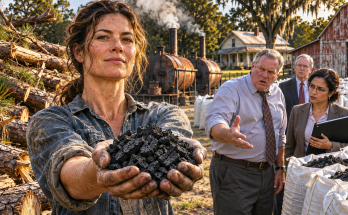
I woke before the alarm on the first morning of the expanded production schedule.
The house was dark.
I dressed quietly and went into the kitchen.
There was coffee to make and paperwork to review before heading outside.
I had barely finished either when I found myself looking through the window toward the barn.
The outlines of the timber rows were becoming visible.
The white bulk bags stood where we'd left them.
Behind the barn, the original kilns were waiting.
The additional permitted processing capacity we had arranged would allow us to increase production considerably.
Experienced workers were joining the operation.
There would be more activity on the property than at any time since I returned to Georgia.
I wanted everyone to understand the work before we started.
The schedule mattered.
So did the people performing it.
I had spent enough time around forestry operations to know that exhausted workers could make serious mistakes.
I didn't want the county's deadline to become an excuse for ignoring that reality.
When Tucker arrived, we reviewed the material-handling arrangements.
He was responsible for helping keep the timber and finished inventory moving through the operation in an organized manner.
The new workers brought experience with the additional processing equipment.
I was responsible for ensuring that the production remained consistent with the contract requirements.
That included the records.
Always the records.
I explained how the batch identification system worked.
We discussed keeping materials intended for different purposes separate.
The existing agricultural operation couldn't be allowed to create confusion with the filtration product.
The county needed clean, appropriately prepared material.
There could be no accidental mixing of nutrient-enriched amendment into the filtration inventory.
Everybody understood the distinction.
We began.
By the time the sun was fully above the trees, the property was already busy.
The sounds of equipment carried across the yard.
Workers moved between the relevant areas.
Tucker checked the material-handling arrangements.
I moved around the operation, reviewing information and answering questions.
There was a rhythm to the work, although it took some time to establish.
The expanded capacity changed the speed at which material could be processed.
It didn't change the need to handle it properly afterward.
Producing more biochar was only one part of the contract.
Preparing material that met the required specifications was another.
Maintaining identification throughout that process was equally important.
I couldn't allow a large quantity of finished product to become disconnected from the records establishing its origin.
Every batch needed a clear history.
Every bulk bag needed the appropriate information.
The first few days were demanding.
I frequently found myself moving from one task to another without having enough time to finish thinking about the previous one.
Somebody needed information about an available section of timber.
Somebody else needed clarification about a batch.
There were records to update and material waiting for the next stage of preparation.
I returned to the farmhouse in the evenings feeling as though the entire day had passed in a few minutes.
Then I sat down at the kitchen table and reviewed what we had accomplished.
That was when the exhaustion usually became noticeable.
My legs hurt.
My shoulders ached.
The dust seemed to follow me inside.
I would wash my hands and still notice traces of black material around my fingernails.
The production notebook remained close by.
There were entries from the expanded operation to review.
I wanted to make sure that the increase in activity hadn't created gaps in our documentation.
Sometimes I didn't finish until late.
Then I would go to bed knowing that the following morning would begin much the same way.
The six-week schedule hung over everything.
I was aware of it when checking our inventory.
I was aware of it when discussing the remaining timber.
I was particularly aware of it when calculating expenses.
The contract had created revenue that would become available after we fulfilled the agreement.
Until then, I still had to manage the cost of getting there.
There were wages.
Equipment costs.
Processing expenses.
Handling and transportation arrangements.
The figures accumulated quickly.
Every time I reviewed them, I reminded myself that a contract worth $190,000 could still become a financial disaster if managed badly.
I couldn't confuse the amount the county had agreed to pay with money already available to spend.
We had prospective purchase terms supporting the expansion arrangements.
But that didn't eliminate the pressure.
The work needed to be completed.
Properly.
Within the schedule.
I had no desire to discover what would happen to my finances if we failed.
A few days into the operation, Amos arrived carrying food.
I was examining some records near the barn when I heard him calling my name.
I looked up.
He was holding enough food for more than one person.
“Have you eaten anything today?”
I considered the question.
He gave me a look.
“That means no.”
“I had coffee.”
“That isn't food.”
I smiled.
He handed me what he had brought.
I hadn't realized how hungry I was until I sat down.
Tucker joined us when he had a suitable break.
Amos looked around at the operation.
“Whole place sounds different now.”
“It certainly does.”
He examined the growing rows of bulk bags.
“Starting to look like a proper business.”
I laughed.
“I thought it was a proper business before.”
“Looked more like you were collecting trees.”
Tucker smiled.
Amos stayed long enough to make sure we ate.
Then he returned to his own property.
I appreciated his help more than I told him.
There was something reassuring about seeing that familiar old man arrive while everything around me seemed to be moving faster than I could comfortably manage.
He wasn't interested in the precise amount of material we had produced that morning.
He wanted to know whether I had eaten.
It reminded me of my grandmother.
She had been capable of discussing a difficult harvest while insisting that somebody finish their lunch.
The two concerns weren't separate to her.
The person doing the work mattered as much as the work itself.
I tried to remember that during the following days.
The additional workers were experienced.
That didn't mean they could operate indefinitely without rest or attention to conditions.
Tucker was enthusiastic.
That didn't mean I should allow his enthusiasm to override his judgment.
We continued organizing the work around safe operations and the required procedures.
Occasionally, maintaining those procedures meant adjusting the immediate schedule.
I accepted that.
There was no point risking an injury or damaging the equipment in an attempt to save time.
Either outcome would cost us considerably more.
As the first week ended, I reviewed our progress.
We had made substantial advances.
The amount of prepared inventory was increasing.
The documentation was keeping pace.
I felt encouraged.
Then I calculated what remained.
There was still a great deal of work ahead.
A thousand cubic yards was an intimidating quantity when considered against the size of the operation I had started with.
I remembered proudly telling Priya that I had approximately three hundred cubic yards of untreated biochar available.
That had sounded substantial.
Now I was grateful for every usable portion of it.
Without that existing inventory, the production schedule would have been considerably more difficult.
The decision to keep material separate had saved us a significant amount of additional work.
I thought about the first yellow corn.
I had wanted to bury the memory of that failed trial.
Instead, I found myself depending on one of the decisions it had encouraged me to make.
Life was strange that way.
A mistake could remain a mistake while still producing something useful.
I was beginning to understand that better.
During the second week, the bulk bags became an increasingly familiar sight.
The white material of the bags contrasted sharply with the dark product inside them.
Each identifying tag mattered.
I checked them regularly.
Tucker became skilled at keeping track of material as it moved through the preparation process.
He would occasionally bring me information that needed clarification.
I encouraged him to do that.
I would rather answer a question immediately than discover later that somebody had made an unsupported assumption.
The quality requirements weren't negotiable.
Priya had made them clear.
We maintained the relevant testing and documentation throughout production.
The accepted samples had established that our material could satisfy the project's requirements.
Now the actual supply had to demonstrate the same suitability.
There was no reason to believe every batch would automatically be identical.
Differences in raw material and processing could affect the finished product.
That was why the records and checks existed.
I tried to explain this whenever someone became frustrated by the amount of attention we devoted to them.
The county wasn't paying us to fill bags.
It was paying us to supply qualifying filtration material.
The difference was important enough to repeat.
By the third week, I was beginning to feel the cumulative effects of the schedule.
Mornings arrived too soon.
Evenings disappeared into paperwork.
There were occasions when I stood in the kitchen and couldn't remember whether I had put something down a few minutes earlier or the previous night.
I recognized the warning.
Tiredness could become dangerous if ignored.
I made sure important checks weren't dependent on somebody's memory.
The written records became even more valuable.
A batch either had the relevant information or it didn't.
A bag either met the applicable requirements or it needed attention.
Nobody had to rely on whether I remembered approving something during a particularly busy afternoon.
The system supported us when our concentration was less than perfect.
One evening, I was reviewing the material prepared for an upcoming shipment.
The day's work had been long.
I was looking forward to going inside.
There were still a few things I wanted to check before leaving the area.
I stopped beside one of the bulk bags.
Something about the material associated with it needed closer attention.
I checked the identification information.
Then I examined the relevant quality-control findings.
The material wasn't within the required particle-size range.
I looked at the bag again.
It was an irritating discovery.
The bag was already among material being organized for delivery.
Correcting the problem would require additional work.
We would have to remove it from the shipment and process the contents appropriately before reconsidering it for use.
Tucker noticed that I had stopped.
He walked over.
“Something wrong?”
“This material doesn't meet the sizing requirement.”
He examined the tag.
Then he looked toward the surrounding bags.
“Just this one?”
“This is the one I've identified.”
He sighed.
I understood the reaction.
We had spent the day preparing material.
Everyone was tired.
The schedule was demanding.
And now one bag represented work that had to be performed again.
“Can we put it through screening another time?”
“Yes.”
He glanced toward the rest of the shipment.
“How much difference would one bag make, though?”
I looked at him.
He didn't say it with malicious intent.
He was tired and frustrated.
He was trying to understand the practical significance of a small portion of a much larger supply.
But the question bothered me.
I had asked myself variations of it before.
How much difference would one skipped preparation step make?
How much time would I save?
Would it really matter?
The pale corn had answered those questions.
I pointed toward the identification tag.
“What does this bag represent?”
He looked confused.
“Material from that batch.”
“Material that's supposed to meet the county's requirements.”
He nodded.
“Does it meet them right now?”
“No.”
“Then we can't send it.”
He looked at the bag again.
“Think they'd actually find it?”
I didn't answer immediately.
I wanted him to understand why the question itself was a problem.
Whether the county detected unsuitable material wasn't the standard we were working toward.
The material had to meet the specification because that was what we had agreed to provide.
It was intended for a filtration system that had an environmental function.
Our responsibility didn't disappear if a particular problem was difficult for someone else to notice.
“We're not checking these bags to see what we can get away with.”
He looked at me.
“We're checking them because we're responsible for what's inside.”
He nodded slowly.
I could see him reconsidering the situation.
Then he reached for the identification information.
“Alright. We'll pull it.”
Together, we removed the bag from the material prepared for shipment.
We made the appropriate records.
Its contents would be returned for additional screening and reprocessing as necessary.
It wouldn't leave the farm as qualifying material until the requirements had been satisfied.
The correction took time.
But when we finished arranging it, I felt better.
Not because we had discovered a problem.
Because we had responded to it appropriately.
Tucker stood beside me for a moment.
Then he spoke.
“Sorry.”
I shook my head.
“You asked a question. That's fine.”
He looked toward the separated bag.
“Won't ask that one again.”
I smiled.
“Good.”
We finished what remained of the evening's work.
By the time I returned to the farmhouse, I was exhausted.
I placed the notebook on the kitchen table.
Then I found the page containing the reminder I had written after my first failed agricultural treatment.
The two lines beneath the words were still visible.
I touched the page with my finger.
I had written that reminder because I had allowed financial pressure to influence a decision about preparation.
Now another deadline was placing similar pressure on the operation.
The circumstances were different.
The principle wasn't.
I closed the notebook.
The shoebox sat nearby.
I didn't open it.
I knew the amount of the debt.
I also knew that using the debt to justify careless work would undermine the very opportunity that might allow me to repay it.
The following morning, Tucker was already paying particular attention to the bags when I arrived.
He reviewed their identification information without being asked.
He made sure the separated material remained distinguishable from the approved shipment inventory.
There was nothing dramatic about the change.
He simply worked with a little more care.
I recognized that.
I'd seen the same change in him after our first hauling day, when he started checking the securing chains twice.
He was learning.
Not just how to move timber or handle biochar.
How to take responsibility for something.
That was important to me.
As production continued, I became increasingly dependent on the people working around me.
There was too much happening for me to perform every task personally.
I needed Tucker's attention to material handling.
I needed the experience of the additional workers.
I needed Priya's coordination concerning the engineering requirements.
I needed Amos's occasional intervention when I forgot ordinary things like lunch.
The operation existed because a number of people were doing their part.
I was grateful for that.
The later stages of the schedule were among the hardest.
The remaining production requirements occupied my thoughts constantly.
We monitored progress.
We addressed problems as they appeared.
We maintained the records.
The rows of white bags extended farther across the working area.
The timber available for processing gradually diminished.
Some evenings, I would stand near the barn and look at the amount of finished material.
I thought about the county yard where it had all begun.
A pile of broken trees.
Loose bark.
Twisted trunks.
Thousands of cubic yards of unwanted debris.
It had taken an extraordinary amount of ordinary work to transform that material.
Work that nobody would see when the filtration beds were finished.
I didn't mind.
I knew what it had involved.
As the six-week period approached its conclusion, I reviewed the production totals with particular care.
The figures indicated that we were getting close to the required supply.
There was still material to prepare and verify.
There were shipments to complete.
But the gap that had seemed so intimidating when Priya first mentioned one thousand cubic yards was becoming smaller.
I looked through the relevant paperwork.
Then I walked toward the finished inventory.
Tucker was checking the identification tags.
He looked up.
“How are we doing?”
“Getting there.”
“Think we're going to make it?”
I looked at the bags.
Then I looked toward the remaining material.
“Yes.”
This time, I allowed myself to say it.
The work wasn't finished.
But we had established a way to complete it.
I didn't need to imagine a miracle.
I needed to keep following the plan.
Tucker smiled and returned to his task.
I stood beside him for a moment.
Then I began checking the next section of material.
We had brought the operation too far to become careless now.