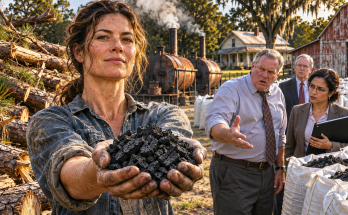
Priya Desai didn't look particularly interested in small talk when I arrived at her office.
There were engineering documents spread across her desk.
She moved several of them aside to make room for the binder I was carrying.
“That's yours?”
“Yes.”
I placed it in front of her.
She opened the cover.
The first few pages contained information about the materials I had been processing.
She turned another page.
Then another.
I sat quietly while she examined the contents.
After dealing with people who assumed I was making ordinary charcoal, it was refreshing to sit across from someone who immediately recognized the significance of production records.
She stopped at a section containing batch information.
“How far back do these go?”
“To the first batch I made after coming home.”
She looked up.
“And you've continued keeping them?”
“Yes.”
She turned toward the laboratory findings.
I explained the circumstances of the first agricultural trial.
There was no reason to conceal what had happened.
She needed accurate information about the material.
Leaving out an important failure would give her a misleading impression of my work.
I showed her the findings from Dr. Okafor and explained the changes I had made afterward.
Then we reviewed the second trial.
She appeared interested in the distinctions between the treatments.
But I could tell the agricultural results weren't her primary concern.
She had another problem to solve.
After looking through more of the binder, she closed it halfway.
“Let me explain exactly what we're trying to accomplish.”
I nodded.
She described the stormwater runoff issue at the highway bypass.
The county needed filtration measures capable of meeting specific environmental and engineering requirements.
Certain forms of biochar could potentially be incorporated into the filtration system.
However, the material had to be suitable for that particular application.
The original supplier had delivered something that didn't satisfy the requirements.
I listened as she described the problems identified through testing.
Excessive ash.
Inconsistent sizing.
Inadequate filtration performance.
Those problems weren't minor inconveniences.
The system was being designed to address specific contaminants.
The county couldn't substitute an unsuitable product and hope it would perform well enough.
Priya had rejected the shipment.
The replacement being offered would arrive too late for the existing schedule.
The county also faced higher costs if it accepted that alternative.
She needed another possibility.
Then she returned to the product her mother had purchased.
“What you've been selling for gardens isn't what we would install.”
“I understand.”
“We need material that hasn't been enriched with compost or other agricultural amendments.”
I sat a little straighter.
She continued explaining.
The biochar would need to be clean.
Its characteristics would need to be consistent with the engineering specifications.
The material would require appropriate screening and testing.
She couldn't guarantee that anything I produced would qualify.
I appreciated her making that clear.
I wasn't looking for someone to purchase my material without evaluating it.
That could create serious problems for both of us.
When she finished, I opened the binder again.
I turned to the sections relating to the untreated inventory.
“I've kept quite a lot of this separate.”
She leaned forward.
“Separate from the agricultural mixtures?”
“Yes.”
“How much?”
I considered the current inventory.
“Around three hundred cubic yards.”
She stopped moving the pages.
“Three hundred?”
“Approximately.”
She looked at me for a moment.
I could see her trying to understand why someone selling soil amendments would have retained such a substantial quantity of untreated material.
“Was that intentional?”
“Very.”
“Why?”
I smiled.
There was something funny about having to explain the most embarrassing mistake I'd made since returning to Georgia.
I told her how I had applied freshly produced biochar to part of my original corn experiment without the preparation I should have provided.
I described the pale plants and the disappointing growth.
I explained how the results had forced me to think more carefully about the intended applications of different materials.
I had stopped treating everything I produced as though it automatically belonged in the same finished product.
I had prepared quantities of agricultural amendment according to demand.
Much of the remaining material had stayed untreated and appropriately stored.
Priya listened.
When I finished, she looked at the inventory records again.
“I'm glad you didn't mix all of it.”
“So am I.”
I hadn't expected to say that about the experiment that had made me feel incompetent.
For weeks, I had regarded the yellow corn as evidence that my desperation had interfered with my judgment.
It was still evidence of that.
But something useful had come from the correction.
I had preserved a substantial supply of raw biochar.
And the county engineer needed to know whether it could meet requirements that had nothing to do with growing corn.
Priya and I discussed what would happen next.
She would need representative samples.
The material would need to be assessed according to the project's specifications.
I would need to provide information connecting the samples to the relevant production batches.
There would be no purchase decision based solely on how the material looked.
I understood.
Before leaving, I asked about the potential scale of the project.
Priya explained that the required volume was considerable.
We would need to establish suitability before working through the remaining details.
I agreed.
There was no sense making commitments about quantity before knowing whether my inventory could provide an acceptable product.
I gathered the binder.
It felt heavier when I lifted it from her desk.
Not because anything had been added.
Because, for the first time, the work documented inside it might support an opportunity large enough to change my circumstances.
I walked back to my pickup.
The county office looked much the same as it had when I first carried my one-page proposal inside.
I remembered Dale laughing at the idea that I wanted ownership of anything produced from the unwanted trees.
I wondered what he knew about Priya's search for a supplier.
Probably more than I did.
But there was nothing to discuss with him yet.
I still needed to find out whether my material was suitable.
When I returned to the farm, Tucker was near the barn.
He looked up when I approached.
“How'd it go?”
“They want to test some of our material.”
“For the highway thing?”
“Yes.”
His face brightened.
“The stuff from the newspaper?”
“That's the project.”
He looked toward the stored inventory.
“Are they buying it?”
“Not yet.”
I explained the difference between an inquiry and a purchase agreement.
He was disappointed by my caution.
I understood why.
But I had no intention of spending money we hadn't earned.
The bank statement waiting inside the farmhouse was enough of a reminder that assumptions could become expensive.
We began organizing the material for evaluation.
The production records allowed us to identify relevant batches.
We examined the untreated inventory and prepared representative material for the required tests.
We also began screening and sorting according to the specifications Priya had discussed with me.
It was detailed work.
The product couldn't simply consist of whatever happened to be underneath a protective cover.
The county required material appropriate for a designed filtration system.
Size consistency mattered.
Ash content mattered.
The absence of unsuitable contamination mattered.
And the performance of the material in the relevant tests mattered most of all.
Tucker gradually became familiar with the new requirements.
He had learned the procedures associated with our agricultural products.
Now he was discovering that a different application could require different preparations.
One afternoon, he held up a piece of char.
“Looks the same as the stuff we sell for gardens.”
“That's not enough.”
He looked at the material.
“How can they tell the difference?”
“That's why we have testing.”
I showed him the relevant identification information.
A finished batch had a history.
The records described that history.
The testing helped establish whether the material could satisfy the intended requirements.
Without those things, we would be asking the county to trust appearances.
That was exactly what Priya couldn't afford to do.
Neither could I.
Over the following weeks, we worked through the sample preparation and testing process.
Priya arranged for the appropriate laboratory analyses.
I provided supporting information from the production records when required.
There were periods when the waiting became difficult.
I still had the regular business to manage.
Customers continued purchasing small quantities of Satilla Black Earth.
The kilns continued operating.
There was remaining timber to organize.
And each evening, I returned to the farmhouse wondering whether the county project would turn into anything more than a series of tests.
Amos noticed my distraction.
I visited him one afternoon and told him about my meeting with Priya.
He listened with obvious satisfaction.
“Should've come to you in the first place.”
“They didn't know whether I could supply what they needed.”
“They know now.”
“Not quite.”
I explained the testing.
He gave me a familiar look.
“Always something else with you.”
I laughed.
“Usually.”
He seemed pleased that the county was finally evaluating my work.
I was pleased too.
But I couldn't ignore the possibility that the material might fail.
The first corn experiment had taught me not to confuse confidence with evidence.
I tried to apply that lesson while waiting for the engineering results.
When Priya eventually contacted me, I was working near the stored inventory.
I answered the telephone and moved away from the equipment.
She told me that the samples had met the applicable testing requirements.
I asked her to confirm what I had understood.
“The samples we've been evaluating are acceptable?”
“Yes, for the specifications we've tested them against.”
I closed my eyes for a moment.
Relieved.
That was the first feeling.
Then excitement.
Then a familiar concern about what the next stage would demand.
I thanked her.
We discussed the implications of the results and the need to ensure that any material delivered under a potential agreement would meet the same requirements.
Successful samples didn't mean that every piece of biochar on my property had automatically been approved.
The actual supply would have to remain consistent and properly documented.
I understood that completely.
Then we discussed the required volume.
Approximately one thousand cubic yards.
I looked toward the inventory behind the barn.
My three hundred cubic yards had seemed enormous when I told Priya about them.
Now they represented only part of what the county needed.
And some of that inventory would require additional preparation before delivery.
I told her I would need to assess what was realistically possible.
She understood the concern.
The county was working against a deadline.
Any supplier would need to provide a credible delivery schedule.
I finished the conversation and remained beside the barn for a while.
Tucker approached when he noticed me standing there.
“What'd they say?”
“The samples passed.”
He grinned.
“I knew they would.”
I smiled.
He hadn't known.
Neither had I.
But I wasn't going to spoil the moment.
Then I told him the approximate quantity the project required.
His expression changed.
“A thousand cubic yards?”
“Yes.”
He looked at the covered inventory.
Then he looked toward the two kilns.
“We're going to need a whole lot more.”
He was right.
Our existing operation wasn't capable of meeting a project of that size within the necessary period using its current equipment alone.
That evening, I carried the binder and my production notebook into the kitchen.
I spread the relevant records across the table.
I needed to know how much suitable timber remained.
I needed to account for existing inventory and the amount of usable product we could expect from additional processing.
I needed to consider screening and quality requirements.
There would also be labor, equipment, handling, and transportation costs.
Producing a thousand cubic yards of qualifying material was a very different undertaking from selling sacks of prepared soil amendment to gardeners.
It required investment.
Investment required money.
And money was the one thing I didn't have in generous supply.
I began working through the figures.
The shoebox remained beside the papers.
Every so often, I glanced at it.
I had spent nearly two years trying to find a business opportunity substantial enough to deal with the farm loan.
Now something potentially large enough was in front of me.
But accepting work I couldn't complete would be disastrous.
I refused to let the size of the opportunity blind me to the size of the obligation.
The county had already experienced one supplier failure.
I wasn't going to become another.
Over the following days, I assessed what additional processing capacity could be arranged.
The two original kilns had served me well.
They had given me a way to establish the business and accumulate material gradually.
They weren't enough for the potential county contract.
I began arranging access to additional permitted processing equipment and experienced help.
Any expansion had to comply with the relevant requirements.
There was no room for shortcuts involving safety or product quality.
The prospective purchase terms offered a basis for working through the expansion arrangements.
However, the final agreement still needed approval.
I kept reminding myself of that.
Nothing was guaranteed simply because I had spoken to Priya and received satisfactory sample results.
There were purchasing obligations to address.
There were delivery expectations to confirm.
There were financial details that would have to make sense for both the county and my business.
The calculations continued.
I looked at production capacity until the figures seemed permanently fixed in my mind.
I reviewed the material already available.
I considered what additional help would cost.
I considered the consequences of delays.
The margins for error were uncomfortable.
But unlike my early calculations about growing peanuts, these numbers suggested a possible route to the outcome I needed.
I could potentially supply the county with a locally produced material that satisfied its requirements.
The remaining storm-damaged timber could support the expanded production.
The work would be demanding.
The expense would be significant.
But it was no longer simply an idea I was trying to defend.
There were acceptable test results.
There was a demonstrated need.
There was a potential customer seeking a considerable quantity.
And there was a supply of raw material I had secured when nobody else seemed particularly interested in it.
Late one evening, I went outside.
The remaining logs were visible along the edge of the field.
Near the barn, the untreated material was organized for the work ahead.
The farmhouse windows reflected the last of the daylight.
I stood there thinking about the distance between that moment and my first visit to Dale Rucker's office.
Back then, all I had possessed was a one-page proposal and an idea that sounded foolish to most people.
Now the county's engineer was evaluating my business as a possible solution to a serious environmental problem.
I returned inside and opened the folder containing the original debris agreement.
The paper was still in good condition.
I read the ownership provision.
Then I looked at Dale's initials.
Nothing about the document had changed.
The trees transferred under the agreement belonged to me.
The products made from them belonged to me too.
I had worked for those products.
I had paid for their preparation.
I had documented their production.
I had absorbed the losses when my first soil treatment went wrong.
The county had purchased a removal service.
What I was potentially offering now was something entirely different.
I placed the agreement alongside the binder and my production calculations.
Then I opened the shoebox.
My grandmother's yellow note was still inside.
I held it briefly before returning it to its place.
For the first time, I could see a financially realistic possibility of paying what she had owed.
I wasn't there yet.
There was equipment to arrange, work to complete, and a substantial agreement still to negotiate.
But the figures no longer told me that saving the farm was impossible.
They told me what I would have to do to make it possible.
I closed the shoebox and returned to my calculations.
This time, I had something worth preparing for.