I learned about the county's environmental problem from the local newspaper.
There had been a recently completed highway bypass in the area.
Like most people living nearby, I had paid attention to the construction while it was happening.
Once the work was finished, I hadn't given it much thought.
Then the county received a notice from the state environmental agency.
Stormwater coming from the bypass was carrying excessive levels of certain contaminants toward the Satilla River.
The problem needed to be addressed within a specified period.
If the county failed to comply, it could face substantial penalties.
I read the article at my grandmother's kitchen table.
The bank reminder was still nearby.
I had been going through the business expenses when I stopped to look at the newspaper.
Initially, I was interested because of the river.
The condition of water moving through a landscape had been part of my restoration work in Oregon.
I understood that what happened on one piece of ground could create problems somewhere else.
The article described the situation in general terms.
I didn't know enough about the particular contaminants or engineering requirements to form an opinion about the appropriate solution.
But one detail caught my attention.
Priya Desai, the county engineer, had proposed using specially designed stormwater filtration beds.
I recognized her name from county matters.
I hadn't dealt with her personally.
According to the article, the filtration system would need suitable media capable of meeting particular performance requirements.
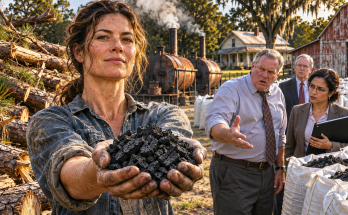
One material under consideration was biochar.
I stopped reading.
Then I went back over that portion of the article.
Biochar.
The word looked strange sitting there among descriptions of a highway project and environmental compliance.
For months, I had been explaining the material to people who had never heard of it.
Now the county was discussing a potential use for it.
I glanced toward the barn.
There was a considerable quantity of untreated biochar stored behind it.
I had kept it separate from the nutrient-enriched material used in Satilla Black Earth.
I wondered whether some of that inventory might have an application in filtration.
Then I reminded myself that the product I had been selling to gardeners wasn't automatically appropriate for an engineering project.
Different uses imposed different requirements.
The fact that some of my material had helped improve growing conditions in sandy soil didn't prove it could address contaminated stormwater.
That would require testing.
I continued reading.
Suitable filtration materials were expected to be expensive.
Priya had explained that appropriately specified biochar might offer a more economical component of the proposed system.
The county needed a supplier.
I sat back in my chair.
For the first time, I allowed myself to consider an opportunity beyond small agricultural sales.
It wasn't a guaranteed opportunity.
I didn't know what quantity the county required.
I didn't know whether my material could meet the necessary specifications.
And I didn't know whether my business could handle a project of that size.
But the possibility interested me.
I read the article one more time.
Then I placed the newspaper beside the three-ring binder.
Dale Rucker began looking for an appropriate supplier.
The county eventually approved a bid through its purchasing process.
The chosen company was a debris-processing contractor from Mobile.
I wasn't selected.
I hadn't been involved in their arrangement.
From the newspaper, I understood that the contractor had agreed to supply the material required for the filtration project.
It was a commercial operation with capabilities considerably beyond those of my two used kilns.
I could understand why a county dealing with a deadline would choose an established supplier.
I didn't particularly enjoy reading the announcement.
But I understood it.
One afternoon, I took the newspaper with me when I went to see Amos.
He had already heard about the bypass problem.
News involving potential county expenses usually traveled quickly around Satilla County.
We sat at his kitchen table.
I unfolded the newspaper and pointed toward the contractor announcement.
He reached for his glasses.
“Isn't that what you've been making?”
“Something related.”
He read a little farther.
“Why didn't they come see you?”
“I don't know.”
He looked toward me over his glasses.
“Thought you were the charcoal woman around here.”
I smiled.
“Apparently there's more than one.”
He didn't laugh.
“Seems to me they ought to have at least talked to you.”
I understood why he felt that way.
He had watched me work for months.
He had lent me his trailer and helped me find suitable material for preparing the soil amendment.
He knew how much pressure I was under.
Seeing the county purchase a potentially related product elsewhere frustrated him.
It frustrated me too.
But I wasn't convinced that arguing about the decision would accomplish anything.
“The county needs something very specific.”
He folded the newspaper.
“And you've got a field full of black stuff.”
“Having it doesn't mean it meets their requirements.”
He considered that for a moment.
“Does theirs?”
“I suppose that's what they'll have to establish.”
I explained that a product intended for one purpose couldn't simply be assumed suitable for another.
The raw material mattered.
The finished product's characteristics mattered.
The filtration project would have its own standards.
The supplier would need to demonstrate that the material satisfied them.
Amos looked at the article again.
“You think that company might send them the wrong stuff?”
“I have no idea what they'll send.”
That was the truth.
I had no access to the contractor's production methods or the county's detailed testing requirements.
I wasn't going to invent a problem simply because somebody else had received the business.
If the company's product met the specifications and arrived when needed, the county would have solved its immediate problem.
That would be a good outcome for the river.
It just wouldn't help me pay the bank.
Amos pushed the newspaper toward me.
“You're taking this better than I would.”
“Complaining won't make the corn grow.”
He smiled at that.
Then he reached for his coffee.
We talked about the farm for a little while longer.
By the time I returned home, I had decided not to spend my remaining energy worrying about a contract I didn't have.
I already had customers to serve.
I had material waiting to be processed.
I had a growing business that needed careful attention.
And I still needed to find additional sources of income.
The county's decision didn't change any of those obligations.
I folded the newspaper and returned to the barn.
Tucker was working around the stored material when I arrived.
He had heard about the filtration project too.
“Would've been nice if they'd bought ours.”
“It would have.”
“Could've saved us some trouble.”
“Probably would've given us different trouble.”
He looked at me.
I pointed toward the untreated biochar inventory.
“We don't even know whether that meets what they need.”
He nodded.
I was pleased that he was beginning to understand the importance of specifications.
A year earlier, he had looked at our first bucket of finished material and seen nothing more complicated than charcoal.
Now he understood that different batches could behave differently.
He understood why I didn't mix everything together.
He understood that a label represented information rather than decoration.
I hoped those lessons would stay with him.
As the months passed, we continued working.
The prepared soil amendment sold in modest quantities.
I maintained the separate inventory of untreated biochar.
Every time I considered turning more of it into agricultural product, I looked at the actual demand.
There was no reason to prepare far more finished garden amendment than I could reasonably sell.
Keeping some material in its unamended form made better business sense.
The inventory continued growing.
I also continued keeping records.
The three-ring binder occupied a regular place in the farmhouse.
Sometimes I carried it outside to consult information about earlier batches.
The spiral notebook was becoming crowded.
Tucker's prediction about needing more notebooks had proven accurate.
I maintained the practice anyway.
There was nothing glamorous about documentation.
Most evenings, it was the last thing I wanted to do.
My hands were tired.
My clothes needed washing.
The farmhouse required repairs I hadn't been able to prioritize.
Yet the records were among the most important things I possessed.
I knew that even before anyone from the county asked to see them.
Winter passed with the highway filtration project somewhere in the background of local discussions.
I occasionally wondered how it was progressing.
Then I would return my attention to whatever needed doing at the farm.
The loan deadline was approaching.
I tried not to think about it every morning.
That wasn't particularly successful.
There were days when the small sales made me hopeful.
A customer would return or bring somebody new.
I would see an encouraging pattern in the business.
Then I would calculate the remaining principal and realize how much money I still needed.
I had created a product with demonstrated potential.
What I hadn't created was sufficient revenue.
Those were two different accomplishments.
I needed both.
Several months after the county selected the Mobile contractor, its first shipment arrived.
I didn't witness the delivery.
What I learned later was that Priya examined the material before allowing it to be used in the proposed filtration system.
The material was grayish and inconsistent.
There was reason to question its suitability.
She arranged for the required laboratory testing rather than accepting the shipment based on the supplier's assurances.
The results confirmed her concerns.
The ash content was excessive for the specified application.
The material's particle sizes weren't sufficiently consistent.
Its performance in the relevant filtration tests failed to meet the project requirements.
The county rejected it.
When I eventually learned what had happened, I thought about the conversation at Amos's kitchen table.
I hadn't wanted the company's shipment to fail.
But I wasn't surprised that Priya had insisted on testing it.
A county facing environmental penalties couldn't afford to install unsuitable material simply because the delivery truck had arrived.
The rejected shipment created another problem.
The contractor offered to provide a replacement.
However, obtaining it would take several additional months.
It would also cost the county considerably more money.
Neither development was welcome.
The original compliance deadline had not changed.
The state agency still expected the county to address the runoff problem.
Priya had to locate another source of qualifying material.
I didn't know she was searching.
I was still carrying out the same routines on my grandmother's farm.
One evening, I stood behind the barn and examined the covered untreated inventory.
I had spent considerable time keeping it separate, organized, and identifiable.
I was trying to decide how much additional material to process.
The timber was available.
The equipment was available.
The challenge was making decisions about production while keeping expenses manageable.
I couldn't operate indefinitely on the assumption that someone would eventually purchase everything.
I needed to consider actual demand.
The irony was that only a short distance away, the county had a demand it was struggling to satisfy.
Neither Priya nor I had connected that demand with my inventory yet.
The connection came through something considerably smaller than the county's original shipment.
Two sacks of garden amendment.
Priya's mother had purchased them from my operation.
They were among the small sales I had been grateful to make.
I hadn't known anything about her daughter's work when those sacks left the farm.
To me, they were ordinary purchases.
Prepared agricultural material from a documented batch.
To Priya, they eventually became a clue.
As she searched for another biochar supplier, she remembered the product her mother had bought from a farm in the neighboring agricultural area outside Bell Creek.
She went looking for one of the sacks.
She found it in her mother's garage.
The label carried the name I had chosen months earlier.
Satilla Black Earth.
It also included the production lot information and my telephone number.
I had included those details because I wanted to be able to identify material if a customer contacted me about it.
I had never considered that the same label might help someone locate a potential supplier for a county engineering project.
Priya took down the number.
The following morning, I received a telephone call.
I was at the farmhouse.
When the woman introduced herself as Priya Desai from the county engineering office, I immediately recognized her name.
My first thought was that there might be another concern about the operation.
The previous visit from Dale remained fresh enough in my mind.
“Yes, this is Lena.”
“Do you manufacture Satilla Black Earth?”
“I do.”
She explained that her mother had purchased some of my product.
Then she asked whether I produced the biochar myself.
“Yes.”
“Here in the county?”
“Behind my barn.”
There was a short pause.
“Would you be available to discuss the material with me?”
I looked toward the three-ring binder.
“Of course.”
She briefly explained the nature of the highway filtration project and her interest in finding a suitable source of biochar.
I listened without interrupting.
When she finished, I clarified that the product her mother had purchased was a prepared soil amendment.
It wasn't necessarily suitable for the purpose she had described.
She understood.
That wasn't the only information she wanted.
She wanted to know whether I produced other forms of the material and whether I maintained records concerning its production.
I looked at the binder again.
“I can bring you everything I've documented.”
“That would be helpful.”
We arranged to meet at the county office.
After the call ended, I stood beside the kitchen table for a moment.
I didn't celebrate.
I didn't assume she was going to purchase anything.
She hadn't offered me a contract.
She hadn't even examined a sample of the untreated inventory.
But she had asked the right questions.
And I had information that might help answer them.
I picked up the binder.
Then I began checking its contents.
There were production dates, material descriptions, photographs, laboratory findings, and field reports.
The records extended back to the beginning of my operation.
The first failed soil treatment was still there.
So were the findings from the successful trial.
I made sure nothing important was missing.
The documents represented months of work that had frequently seemed invisible to other people.
I thought about Tucker asking who would ever read all those pages.
Now I had an answer.
I placed the binder beside the door, ready to take it with me.
For the first time, someone from the county wanted to discuss what I had made from the trees rather than how quickly I could remove them.