"Forty-seven thousand, three hundred twelve dollars."
I looked directly at June when I said it.
"That's what I'll take."
One of the supervisors leaned forward.
June looked at the treasurer's legal pad, then at the original invoice lying beside my hand.
"You're sure about that amount, Owen?"
"Yes."
My voice sounded steadier than I felt.
I had just turned down the opportunity to earn another ten thousand six hundred eighty-eight dollars.
There was no way to make that difference insignificant.
I wasn't wealthy enough to pretend it didn't matter.
Leah wasn't wealthy enough to pretend it didn't matter, either.
But I had finally stopped looking at the two offers as though they involved exactly the same exchange.
Richard's money would purchase the clock and the freedom to take it away.
The county's money would purchase something that was already sitting where it belonged.
I wanted that distinction recognized.
June glanced around the table.
The supervisors were considering the figure I had proposed.
Nobody immediately objected.
Nobody immediately accepted, either.
I waited.
The pocket watch rested against my leg.
I could feel its outline through the fabric of my trousers.
Before the officials began discussing how they might pay for the machinery, I moved my gutter-cleaning invoice toward June.
"There are some things I want included."
She picked up the paper.
I had written three conditions.
The handwriting wasn't particularly attractive.
There were no impressive headings or official seals.
Just the things I needed the county to agree to before I signed anything.
June read the first condition silently.
I explained it aloud.
"I want the clock put into the courthouse, and I want it to stay here."
One of the supervisors looked toward the ceiling.
The original movement was already several floors above us.
I understood that its physical presence made my request seem almost unnecessary.
But it wasn't.
A machine could be removed.
A decision made by one county board could be reconsidered by another.
People could forget why a particular object had been acquired.
That had already happened once.
I wasn't willing to accept less money for the sake of keeping the clock in Ashford Prairie unless the county agreed that keeping it was part of the purchase.
June read the condition again.
"You want that to be part of the actual agreement?"
"Yes. Not just something we say today."
She nodded.
I felt relieved that she hadn't treated my request as unreasonable.
I was young enough to understand that some of the people around the table had been conducting official business for longer than I had been alive.
But that didn't mean I had to accept an arrangement I didn't understand.
The clock needed more than a place in the tower.
It needed protection from becoming an item somebody could quietly sell when the county needed money for something else.
I thought about how quickly the original order had become an abandoned project.
The people responsible in 1931 had undoubtedly faced difficult financial decisions.
I wasn't judging them for being unable to pay.
I simply didn't want another difficult financial decision to separate the machine from the courthouse again.
June moved to my second condition.
It concerned Albert Finch.
I wanted a permanent brass plaque placed beside the clock.
His name needed to be on it.
So did the years he had looked after the shipment.
1931 to 1972.
I glanced toward Ruth.
She was listening with her hands folded in front of her.
I hadn't explained this part of my proposal to her beforehand.
I wasn't sure how she would react.
"The clock wouldn't be here without him," I said.
Nobody interrupted.
I explained that finding the machinery hadn't been the same as saving it from the conditions that could have destroyed it over the previous decades.
I had been responsible for the building during a relatively short period.
Albert had been responsible for it through forty-one years of his working life.
That was considerably more time than I had spent on earth.
The old man had never received the applause we heard on the courthouse lawn.
He hadn't stood beside a collector offering fifty-eight thousand dollars.
He hadn't been given recognition when the movement finally settled onto the four bolts.
He had done his work when the crates were still somebody else's unpaid freight.
That was why I wanted his name near the clock.
Not my name.
His.
I had my purchase receipt.
I would have the county's payment if we reached an agreement.
Albert's contribution deserved something that would remain long after the money had been spent.
June looked toward Ruth.
Ruth lowered her eyes for a moment.
Then she adjusted the chain holding her reading glasses.
I could see that she was having difficulty keeping her hands still.
June returned her attention to the paper.
The third condition was simpler.
"The pocket watch isn't included," I said.
I reached into my pocket.
The cloth bundle came out easily.
I placed it on the table and unfolded the material.
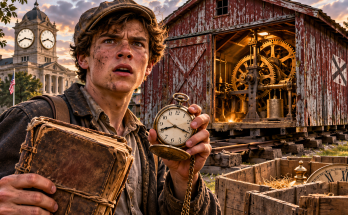
The Hamilton watch rested beneath my fingers.
I turned it over so the engraved initials were visible.
A.F.
June looked at it.
Then the treasurer looked.
I explained that I had found it inside the station agent's desk.
It had been carefully wrapped and left in a drawer.
Unlike the clock, it hadn't been shipped from Boston for the county courthouse.
It was a personal possession.
It belonged to a different part of the story.
I picked it up.
Then I stood and walked toward Ruth.
She looked at the watch before looking at me.
For a moment, I worried that I might be doing something awkward in front of the entire board.
Then I remembered why I had brought it.
I held out my hand.
"This was your dad's."
Ruth looked down at the engraved letters.
She didn't immediately take it.
I moved my hand a little closer.
"I think you ought to have it."
Her fingers closed gently around the watch.
She turned it over.
Then she looked at the face.
I watched her recognize something that I had known only as an object from a desk drawer.
Perhaps she remembered it in her father's hands.
Perhaps she remembered seeing him check it during his working day.
I didn't know.
What I did know was that she had a connection to that watch nobody else in the room possessed.
It couldn't be established by a collector's appraisal.
It couldn't be measured against the price of the clock.
Ruth held it close.
"He would've appreciated that you figured out who it belonged to."
I nodded.
I didn't trust myself to say much.
There was something about the way she held it that made me glad I hadn't allowed it to become part of the negotiations.
Richard had been interested in the discovery as a complete historical collection.
The watch might have increased that interest.
I could have asked how much more he would pay to include it.
The thought seemed unpleasant now.
I returned to my chair.
The cloth that had protected the watch was no longer wrapped around it.
Albert's initials were no longer hidden in a drawer.
Ruth had her father's watch.
That was one part of the morning I didn't need the county board to authorize.
June looked at my conditions once more.
She indicated that they could be incorporated into a formal purchase agreement.
The county would undertake the installation.
The clock would remain part of the courthouse property.
Albert Finch would receive permanent recognition.
And the pocket watch was excluded.
I listened carefully.
Those were the things I had come to ask for.
I didn't want any misunderstanding about them later.
Then the conversation returned to the money.
Forty-seven thousand, three hundred twelve dollars.
The supervisors needed to consider how the purchase would be financed.
I sat quietly while they discussed the county's restoration resources.
It became apparent that the full amount couldn't be provided immediately.
My heart sank a little.
I had known that might be the case.
Knowing it didn't make hearing it easier.
The utility deadline was still that afternoon.
I glanced toward Leah.
She remained attentive.
She wasn't going to interrupt an official discussion simply because our household had an urgent bill.
But I knew what she was thinking about.
I was thinking about it, too.
June explained that the courthouse restoration fund could provide an immediate deposit of five thousand dollars.
I looked up.
"Today?"
The treasurer confirmed that the deposit could be arranged that day.
I almost forgot what I had intended to say next.
Five thousand dollars.
Not a promise to discuss funding several weeks later.
Not an amount dependent on somebody else purchasing the clock.
An immediate payment against the agreed price.
I looked at Leah.
Her shoulders seemed to lower slightly.
The full utility balance was nineteen hundred forty dollars.
Five thousand would be enough.
For the first time that morning, I could think about the meeting without feeling as though the electricity deadline was waiting behind every sentence.
The remaining purchase price would have to be provided through authorized funding arrangements.
I understood that.
The county wasn't offering to hand me the entire amount before lunch.
I wasn't asking it to do something its finances couldn't accommodate.
I wanted a definite agreement.
The initial deposit would address our immediate problem while the county arranged payment of the balance.
The supervisors continued discussing the proposal.
I waited while the relevant terms were established.
My gutter-cleaning invoice remained on the table.
Beside it lay the original manufacturer's invoice from 1931.
I found myself looking at the two documents again.
One recorded a purchase that hadn't been completed.
The other contained conditions intended to ensure that the same purchase would finally reach its proper conclusion.
Ninety-four years separated them.
I couldn't make sense of that length of time by thinking about it as a number.
I could make sense of Ruth holding her father's watch.
I could make sense of the four iron bolts upstairs.
I could make sense of the unpaid notice at home.
Those were the things that brought the years down to a size I could understand.
Eventually, the proposal was put before the board.
I looked at Leah.
She gave me a small nod.
I turned my attention back to June.
The supervisors voted.
Every one of them supported the purchase.
There were no opposing votes.
For a moment, I stayed perfectly still.
I had expected to feel excited when the decision was made.
Instead, I felt the sudden absence of a worry I had carried for weeks.
The clock would remain in Ashford Prairie.
Albert's name would be honored.
Ruth had his watch.
And the money would be enough to help Leah.
I looked toward the treasurer.
He began preparing the arrangements for the deposit.
June made certain that the conditions were properly recorded.
The actual agreement required Leah's signature alongside mine because I wasn't yet eighteen.
I watched her read it carefully.
She took her time.
I was glad she did.
There was no reason to abandon the habits that had brought us this far simply because we were pleased with the outcome.
She finished reading and signed.
Then I added my signature.
My hand felt unfamiliar while writing my name.
I had signed plenty of invoices after completing gutter-cleaning jobs.
Those signatures usually meant somebody had paid me a modest amount for a few hours of work.
This signature meant I had agreed to sell a historic clock for forty-seven thousand three hundred twelve dollars.
I was still the same person.
I still had the same ladder.
I still lived in Leah's house.
But the circumstances waiting for us when we returned home were about to change.
I put the pen down.
June gathered the necessary papers.
The treasurer continued preparing the deposit.
I looked toward Ruth.
She was still holding the Hamilton watch.
I smiled at her.
She smiled back.
There was no celebration that could have meant more to me than that quiet exchange.
I thought about the price I had accepted.
The difference between it and Richard's offer hadn't disappeared.
I would probably think about that money again.
There would be expenses in my future that could have been easier to manage with another ten thousand dollars.
I wasn't pretending otherwise.
But I had made a decision I understood.
I knew why I had accepted less.
I knew what I had received in return.
The arrangement wasn't perfect because it contained the largest possible number.
It was right for me because I could accept everything it required.
When Leah and I were ready to leave, I looked toward the papers one final time.
There was now an agreement authorizing the purchase of the clock that had remained unpaid since 1931.
And there was a five-thousand-dollar deposit being arranged on the very day our electricity was due to be disconnected.
I stepped outside with Leah.
The courthouse tower was above us.
Eight seventeen.
For once, I wasn't frustrated by those motionless painted hands.
I knew they wouldn't be there forever.
Leah looked at me.
"We can pay the bill."
I nodded.
I wanted to say something about how much the moment meant to me.
Instead, I looked toward the street and tried to swallow the lump in my throat.
For weeks, I had been hoping to discover something worth enough money to help her.
Now we were leaving the courthouse with an agreement that would do exactly that.
The next place Leah needed to visit wasn't a bank in Minneapolis or a collector's warehouse.
It was the utility office.