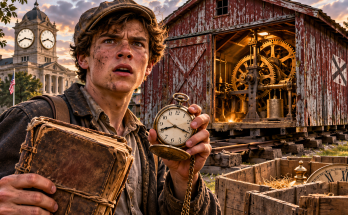
Tuesday morning arrived before I felt ready for it.
August 12.
I knew the date without looking at a calendar.
It had been printed on the notice attached to Leah's refrigerator.
I had seen it while carrying groceries into the kitchen.
I had seen it after gutter-cleaning jobs.
I had seen it while explaining the freight ledger and the canceled courthouse clock order.
Now the date was no longer something approaching.
It was here.
I looked at the notice while getting ready for the county board meeting.
Nineteen hundred forty dollars remained due.
Leah had managed to save eleven hundred.
The discovery of the clock hadn't altered either figure.
Richard Hale had made an offer worth fifty-eight thousand dollars.
But an offer wasn't money in an account.
And I hadn't agreed to accept it.
I was aware of how strange the situation must have looked from outside.
A teenager who couldn't afford an overdue electricity balance was considering turning down a substantial sum of money.
If somebody had described that situation to me a few months earlier, I probably would have thought the teenager needed to reconsider his priorities.
Now I was that teenager.
I understood why the choice wasn't simple.
I also understood why I couldn't let myself become careless about the household's needs.
I looked toward Leah.
She was preparing for the day in the same practical way she always did.
There was no dramatic conversation about what would happen if the meeting went badly.
We both knew the situation.
There was no benefit in repeating it.
I took the Hamilton pocket watch from its cloth wrapping.
The engraved initials were still visible.
A.F.
I slipped it carefully into my pocket.
I wanted it with me when I discussed the terms under which I might part with the clock.
It was small enough to carry without thinking about its weight.
Yet I was aware of it throughout the morning.
The watch reminded me that Albert Finch had been a person before he became part of a historical discovery.
He had been somebody's father.
Somebody who went to work.
Somebody who made ordinary decisions about how to carry out his responsibilities.
The town could honor what he had done.
It could also overlook him again.
I didn't want that second possibility to happen.
I made sure I had the things I needed for the meeting.
I had one of my gutter-cleaning invoices.
It was the sort of paper I normally used to record jobs and payments.
There was nothing impressive about it.
I had never needed formal business stationery.
I wasn't running a large company.
I was a seventeen-year-old with a ladder and customers who needed their gutters cleared.
But the paper provided somewhere to write down the conditions I was considering.
I didn't need those conditions to look expensive.
I needed them to be understood.
The county would have to retain the clock as part of its courthouse.
That was the main thing.
If I accepted less money than Richard had offered because I wanted the machinery to remain in Ashford Prairie, I didn't want it quietly sold to somebody else a few years later.
The reason for my decision needed to survive beyond the people making the agreement that morning.
I also wanted Albert Finch recognized.
Not merely mentioned in a conversation that would eventually be forgotten.
Something permanent.
Something that a person visiting the tower could see.
A brass plaque would do that.
His name deserved to be near the manufacturer's identification.
The people in Boston had built the clock.
Albert had ensured that the clock survived.
Both contributions mattered.
The pocket watch was my third consideration.
It wasn't to be included with the clock and its accompanying equipment.
I already knew where I wanted that watch to go.
I looked down at the ordinary invoice.
It was strange preparing conditions for the sale of an object worth more than I had ever expected to earn.
I wondered whether county officials would take a piece of paper from a gutter-cleaning business seriously.
Then I reminded myself that Albert's freight ledger had once been an ordinary working document, too.
The importance of a record came from what it established.
Not from how impressive it looked.
When I reached the courthouse, I looked up at the tower.
All four painted faces remained at eight seventeen.
I wondered how many more times I would see them that way.
The movement rested inside the clock room.
The original mounting bolts were no longer empty.
There was already a physical connection between the machine and the building.
But there wasn't yet a permanent legal arrangement ensuring that connection would remain.
That was why I was there.
June had organized the emergency meeting as promised.
The supervisors were assembling.
The treasurer had the original invoice available.
Leah was there, too.
Because I was seventeen, I understood that any agreement would require her involvement.
I was glad she would hear the discussion directly.
I didn't want to return home with an incomplete explanation of what the county had offered.
I wanted her to understand every part of the decision.
Ruth was present.
I noticed her before sitting down.
Seeing her made me feel the weight of the pocket watch again.
I had brought something that had belonged to her father.
Soon I intended to return it.
But first there was the question concerning the freight he had preserved.
I sat down and waited for the meeting to begin.
The furniture around me was nothing special.
A table.
Chairs.
Papers.
A legal pad.
People who had probably attended many discussions about county expenses.
I wondered whether the supervisors who met in 1931 had sat around a similar table.
Perhaps they had looked at the original price and tried to work out how they could afford it.
Perhaps they had discussed other expenses that seemed more urgent.
I had no access to those conversations.
I only knew the recorded result.
The order had been canceled.
The freight had remained unpaid.
Albert Finch had kept it.
Now another group of supervisors had the opportunity to make a different decision.
June began by addressing the situation plainly.
The machinery had been identified as the clock originally manufactured for the courthouse.
Its presence in the tower hadn't settled the question of purchase.
The county needed an agreement with me before the restoration could become a permanent public project.
She then mentioned the collector's offer.
I confirmed the amount.
Fifty-eight thousand dollars.
Hearing the figure in that room made it feel different from hearing it at Leah's kitchen table.
It was no longer merely a private opportunity.
It was the amount the county would have to consider when determining whether it could keep its original clock.
June didn't pretend the board could compete with Richard.
She made that clear immediately.
"We don't have fifty-eight thousand to offer you."
I nodded.
I had expected that answer.
It was better hearing it directly than spending the meeting pretending otherwise.
June also explained that the county recognized my ownership through the sale of the shed.
The original freight records established where the machinery had been intended to go.
They didn't mean the current board could simply claim it without paying me.
I appreciated hearing that.
The historical connection was important.
But it couldn't be used as an excuse to ignore the fact that I had purchased and preserved the building and its contents.
June said nobody would blame me if I chose Richard's offer.
There was no accusation in her voice.
No suggestion that I owed the town something because I lived there.
She appeared to understand that fifty-eight thousand dollars could make a substantial difference to my life.
I glanced at Leah.
She was listening carefully.
I knew that if I accepted Richard's money, she wouldn't have to stand at the utility office worrying about whether we had enough to settle the balance.
I could help her that afternoon.
I could help with the roof.
I could prepare for winter.
The county couldn't offer the same amount.
That fact needed to remain clear.
I looked around the room.
Nobody was laughing at my purchase anymore.
I remembered the photograph of the shed that had circulated around town.
I remembered the comments about the possible cream separator.
I remembered Travis looking toward me when the first crate opened and revealed nothing but old grease and dark metal.
Those reactions no longer mattered much.
I wasn't there to prove that I had been clever.
I was there to work out whether the clock could remain in the courthouse without my sacrificing everything the discovery could do for Leah.
I looked toward the treasurer.
"Could I see the original invoice?"
He passed it to me carefully.
I recognized the paper immediately.
It was the same document June had removed from the protected envelope on the hood of Grant's truck.
I looked at the manufacturer's name.
E. Howard and Company.
Boston.
Then I found the amount.
$2,211.
I rested the invoice where everybody could see it.
"This was what they were supposed to pay?"
The treasurer examined the document.
"That's the amount on the invoice."
I looked at the date again.
1931\.
I had no idea how many hours of work that sum represented to an ordinary person living at the time.
I knew only that it had been beyond what the county was able or prepared to pay.
The newspaper had explained that the courthouse project couldn't proceed for financial reasons.
The ledger had recorded the result at the railroad.
Albert had been left with six pieces of machinery and an unpaid shipment.
Those records had survived alongside the clock.
Now the original figure was sitting in front of a different county board.
I asked the treasurer what that amount would be worth in contemporary dollars.
He looked at me.
"You mean adjusted for the change in purchasing power?"
"Yes."
I could tell the question wasn't quite what the supervisors had expected.
They had been discussing the collector's offer.
I was asking them to consider a price written nearly a century earlier.
The treasurer began working out the equivalent.
I waited.
There was something comforting about watching him deal with a calculation.
Numbers could be difficult when you didn't possess enough money.
But at least they could be established.
They didn't depend on how somebody felt about an abandoned freight shed.
They didn't change because somebody laughed at the person doing the arithmetic.
I thought about the pencil Leah had used at our kitchen table.
I had watched her calculate our shortfall with the same sense of helplessness I had experienced when Grant asked me about the foundation.
The numbers had been accurate.
What we lacked was the money to make them work.
Now the county treasurer was performing a calculation connected to an entirely different amount.
Two thousand two hundred eleven dollars.
The treasurer worked quietly.
June waited.
The supervisors looked toward the documents.
I reached into my pocket and touched the wrapped watch.
I didn't remove it.
Not yet.
I thought about Ruth sitting beside the freight entrance with Albert's ledger on her knees.
I remembered her hands shaking when the four glass dials were exposed.
I remembered her sitting near the tower doorway after the movement settled onto its bolts.
That was what I wanted to protect with my decision.
Not a moment of personal satisfaction.
A connection that had almost been lost.
I knew the adjusted price might not be enough to solve every problem Leah and I faced.
It might be considerably lower than Richard's offer.
But I wasn't asking for an amount that would leave us without anything.
I wanted a fair payment.
I had done work.
I had accepted risks.
I had purchased the building and financed its move.
I had spent time researching the freight.
I didn't believe I needed to give all of that away to demonstrate that I cared about Ashford Prairie.
There had to be room for both things.
A payment that recognized the discovery.
An agreement that preserved the clock's place in the courthouse.
The treasurer finished his calculation.
He wrote a figure on a legal pad.
Then he turned it toward me.
$47,312.
I stared at the number.
Forty-seven thousand, three hundred twelve dollars.
It was more than I had expected the old invoice to represent.
It was also ten thousand six hundred eighty-eight dollars less than Richard's offer.
I understood that difference immediately.
More than ten thousand dollars.
That wasn't something I could casually dismiss.
It was money that could pay for training, tools, household expenses, and things I hadn't even anticipated yet.
I looked toward Leah.
She was looking at the legal pad.
I thought about what that smaller amount could still accomplish.
We could settle the utility balance.
We could repair the roof.
We could prepare for the cold months.
I could arrange reliable transportation and put money toward welding school.
It wasn't fifty-eight thousand dollars.
But it was an amount large enough to change the circumstances we had been living with.
I could help Leah without sending the clock away.
That was what I had been trying to determine.
The treasurer had given me a figure that made such a decision possible.
Of course, the county would still have to agree to it.
A calculation wasn't an authorization.
The supervisors would need to determine whether the money could be made available through their restoration resources and other approved funding.
I couldn't assume that would happen.
But I knew what I wanted to ask.
I looked back at the original invoice.
Somebody had written down two thousand two hundred eleven dollars before the shipment left Boston.
The county had been unable to complete the transaction.
The machinery had remained in Ashford Prairie.
Albert Finch had spent forty-one years caring for the consignment.
Then the freight had continued waiting in the sealed building long after his station closed.
Now I was looking at what that original unpaid sum represented in the money of my own time.
I didn't want the county to think I was attempting to extract the highest possible price merely because I possessed something it wanted.
Richard had already established that a higher price was available elsewhere.
I also didn't want the officials to think I was offering them the clock without conditions.
The place where it would remain mattered.
The recognition Albert would receive mattered.
The pocket watch mattered.
I reached for my gutter-cleaning invoice.
I placed it beside the original manufacturer's document.
The two pieces of paper looked nothing alike.
One belonged to a company that had constructed machinery for a courthouse in 1931.
The other belonged to a teenager who earned money carrying a ladder between houses.
Yet both concerned work for which somebody expected payment.
I looked once more at the treasurer's legal pad.
Forty-seven thousand, three hundred twelve dollars.
June waited for me to speak.
The supervisors were watching.
Leah sat beside me.
Ruth was close enough that I could see the chain holding her reading glasses.
I touched the pocket watch through the fabric of my trousers.
Then I thought about the four mounting bolts.
I thought about how easily the first nut had turned onto its threads.
I thought about the applause when the glass dial reached the south face of the tower.
And I thought about the painted minute hand that had never moved beyond eight seventeen.
I could accept Richard's offer.
Nobody in that room would prevent me.
I could receive more money than the amount written on the legal pad.
But I would also have to watch the machinery leave the building it had been made for.
I finally knew I didn't want to do that.
I rested my hand beside the figure the treasurer had calculated.
For the first time since Richard sat at our kitchen table, the amount I was prepared to accept was clear to me.
Not the largest amount available.
Not an amount invented to punish the county for forgetting its freight.
The present-day equivalent of the price that should have been paid in 1931.
I drew the legal pad slightly closer.
Then I looked at June.
I had made my decision.