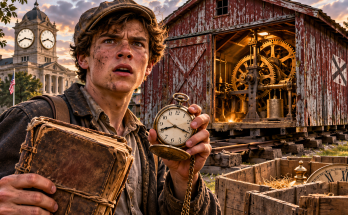
The first snow arrived on a bitter morning near the end of October.
I looked outside and saw a light covering settling over Ashford Prairie.
The ground around Leah's garden was beginning to turn white.
Snow rested on the tin roof of the railroad shed.
I stood near the window for a moment, thinking about the building's first winter in our backyard.
The oak sills were still raised above the ground.
The twenty-eight railroad ties were still supporting the floor.
There was no reason to worry about the timbers resting directly against wet soil.
Grant had helped me get that part right.
I was grateful for it whenever the weather changed.
That morning, however, my attention wasn't going to remain on the shed.
Ellis was ready to start the courthouse clock.
I put on warm clothes and prepared to leave.
The cold caught me as soon as I stepped outside.
I could see my breath.
I remembered standing near the abandoned railway during the summer, watching the shed rise above its original supports.
Back then, I had been worried about a wooden brace shifting against an old nail.
Now I was walking toward a courthouse where the freight from that building was finally prepared to do what it had been manufactured to do.
The distance wasn't great.
It had never been great.
That was something I still found difficult to accept.
A few blocks had separated the clock from its intended home for nearly a century.
The money hadn't been available.
The paperwork had become forgotten.
The people responsible for the original project had disappeared from the town's everyday life.
Yet the two parts of that unfinished project had remained close together.
All those years.
When I reached the courthouse lawn, people were already gathering.
Winter coats.
Scarves.
Hands wrapped around paper coffee cups.
Their breath appeared in the cold air as they spoke.
I recognized familiar faces.
Some were people who had been present when the crates were opened.
Others had followed the restoration after the discovery became known.
They had come to watch an ordinary thing happen.
A clock beginning to keep time.
In almost any other town, that wouldn't have been enough reason to stand outside in the snow.
Here, it was.
I found Grant near the courthouse steps.
His nephew was beside him.
I greeted them.
Grant looked up at the tower.
"Looks a little different now."
I smiled.
"It ought to."
He had seen the clock when it was still hidden beneath layers of grease.
He had watched the mechanism travel from Leah's backyard.
He had helped make sure it arrived safely.
Now the four original glass dials were installed above us.
The black iron hands were in their proper positions.
It was difficult to believe they had once been packed together inside the second crate.
I could still picture those long metal pieces resting among the drive rods and gearing.
At the time, they had looked almost awkward.
Against the white clock faces, they looked exactly right.
June Fenwick was standing beneath the bare trees.
Everett Miles was nearby.
I thought about the four bolts Everett had noticed during his work in the courthouse.
They had been part of an otherwise empty room.
He hadn't known why they were there.
Now a restored mechanical movement rested securely on them.
I wondered whether he would ever walk into that tower without remembering the day we brought the mechanism upstairs.
I knew I wouldn't.
Travis stood farther back among the people on the lawn.
I noticed him without attempting to catch his attention.
I was pleased he had come.
Our conversation in the shed had settled what needed settling between us.
There was no reason for me to remind him of his earlier offers.
No reason to make his presence uncomfortable.
He had acknowledged that he had missed something important.
Now he had come to see the result.
That was enough.
Leah arrived directly from the bakery.
I recognized her before she reached me.
She was still dressed for work beneath her coat.
I thought about the flour on her uniform when she paid the utility balance back in August.
She had come straight from the demands of ordinary life to witness something extraordinary.
I walked toward her.
"Cold enough for you?"
She smiled.
"I've been warmer."
We stood together for a moment.
Then I looked around for Ruth.
She was there.
Her coat was closed against the cold.
Pinned to it was the Hamilton watch.
I noticed it almost immediately.
There was something familiar about seeing the watch outside the little station office.
By then, I had become accustomed to the empty desk drawer.
But seeing it on Ruth's coat made me remember opening that drawer for the first time.
A small bundle of cloth.
A watch.
Two letters engraved on the back.
A.F.
I hadn't known then that those letters would lead me toward somebody who remembered the freight shed during its working years.
I hadn't known that the man who owned the watch had spent forty-one years maintaining the building.
I certainly hadn't known I would someday stand beside his daughter while the clock he had protected began operating.
I walked over to Ruth.
She looked pleased to see me.
I glanced at the watch.
"You brought it."
She touched it gently.
"Seemed like the right place for it today."
I nodded.
We turned toward the courthouse.
Somebody nearby adjusted a scarf.
A few people moved closer to the steps.
Others remained scattered across the lawn.
Nobody needed to be told where to look.
The south dial was visible above us.
Its white glass face stood out against the tower.
The hands indicated eight sixteen.
I stared at them.
That time looked unfamiliar.
For as long as I could remember, the courthouse had displayed eight seventeen.
It had displayed eight seventeen when I went to school.
When I carried my ladder to gutter-cleaning jobs.
When I visited the library.
When I came home worried about how much money remained in my coffee can.
Morning or afternoon made no difference.
The courthouse had insisted it was eight seventeen.
Now the minute hand was one mark behind that familiar position.
Ellis had deliberately prepared the restored mechanism that way.
We would be able to watch the clock approach the time everybody recognized.
Then we would see whether it could leave it behind.
High above us, inside the tower, Ellis was ready.
The pendulum had been assembled.
The suspension had been carefully handled.
The gear teeth had been inspected.
The old grease had been removed.
The drive mechanisms connected the movement to the four faces.
Everything that could reasonably be checked had been checked.
The remaining step was to put the clock into motion.
Ellis gave the pendulum a measured push.
From where I stood, the mechanism itself was hidden from view.
I couldn't clearly hear the ticking through the walls and across the lawn.
But I knew the movement was beginning inside the room we had once found empty.
I pictured the iron frame.
The brass wheels.
The wooden pendulum rod.
The heavy cast-iron weight.
I thought about the four anchor bolts beneath it all.
And then I looked at the hands.
The people around me became quieter.
There were still occasional voices.
Somebody moved closer to get a better view.
But most of us were watching the same thing.
I wasn't thinking about fifty-eight thousand dollars anymore.
I wasn't thinking about the difference between that offer and the price I had accepted.
I was thinking about whether the minute hand would move.
An ordinary minute seemed unusually long while I watched it approach.
My fingers were becoming cold.
I pushed my hands farther into my coat pockets.
Beside me, Ruth kept looking upward.
Leah stood on my other side.
Grant and his nephew were watching from near the steps.
June and Everett remained beneath the trees.
Travis was somewhere behind us.
And Ellis was upstairs with the machine.
The minute hand advanced.
I saw it reach the familiar mark.
Eight seventeen.
A strange feeling passed through me.
For one moment, the courthouse looked as though nothing had changed.
The hands occupied the positions people had been seeing for generations.
If somebody had arrived on the lawn at that exact moment without knowing about the restoration, they might have wondered what everyone was waiting for.
I kept staring.
Ruth's hand rested near her father's watch.
I thought about Albert standing inside the freight building.
I imagined the ordinary tasks Ruth had described.
Sweeping.
Checking the packing.
Looking beneath the floor after another winter.
I thought about the county's unpaid invoice.
The old envelope.
The newspaper report.
The watch wrapped inside the drawer.
I remembered Leah telling me not to decide the machinery was a clock simply because I wanted it to be one.
I remembered Ellis removing the grease.
I remembered the name appearing on the cast plate.
Then I saw the minute hand begin moving again.
It passed the position I knew so well.
Eight eighteen.
For a second, I couldn't react.
I had imagined that moment repeatedly.
None of those imagined versions had prepared me for how simple it actually was.
A black iron hand had moved by one minute.
That was all.
And it was everything we had come to see.
The lawn erupted.
People clapped.
Some shouted.
I heard laughter around me.
I looked toward Leah.
She was wiping her eyes.
I felt my own eyes becoming wet.
The cold gave me a convenient explanation, but I knew it wasn't the real reason.
Ruth touched the Hamilton watch pinned to her coat.
She continued looking toward the tower.
I stood beside her without speaking.
I wished Albert Finch could have seen those hands.
I wished he could have heard the people cheering.
I wished he could have known, during one of those lonely spring inspections, that somebody would eventually understand why he kept returning to the shed.
He would never know that his freight had made the final journey.
But his daughter knew.
And his name was upstairs beside the machinery.
That was as close as we could come to thanking him directly.
I looked toward Grant.
He was smiling.
His nephew was watching the tower.
I thought about their work beneath the old building.
The steel beams.
The dollies.
The trip across the disused railway.
The careful arrangement of the railroad ties.
Those practical decisions had helped make this morning possible.
I looked toward June and Everett.
The county had finally completed the purchase its predecessors couldn't afford.
There had been no way to change the past.
There had been a way to finish what remained unfinished.
They had taken it.
I thought about Travis.
He had once treated the idea of those clocks operating as something that belonged to an impossible future.
I could hardly blame him for thinking that way.
The tower had been motionless for longer than either of us had been alive.
But he was standing on the lawn now.
And the hands were moving.
I didn't turn around to make sure he was watching.
I was too busy watching them myself.
The snow continued falling lightly.
People remained on the lawn, reluctant to leave even after the moment they had gathered for was over.
I understood that feeling.
We wanted to watch the clock move again.
Not because we expected it to stop.
Because we were still adjusting to the fact that it could continue.
I looked at the south dial a little longer.
Then I looked at Leah.
She smiled at me.
I didn't need to say anything about the bill.
It had been paid months earlier.
I didn't need to tell her that keeping the clock here had been worth accepting less money.
She could see the result above us.
I reached into my pocket and warmed my fingers.
For the first time, the courthouse was telling us something useful about the day.
Time was passing.
We could see it passing.
And it wasn't going to remain eight seventeen simply because that was the way things had always been.
During the remaining weeks of fall, the county completed the payments authorized under our agreement.
By Thanksgiving, I had received the full forty-seven thousand, three hundred twelve dollars.
There was something satisfying about seeing the agreed amount paid in its entirety.
The original invoice had once represented money the county couldn't provide.
This purchase had finally been completed.
The clock was recorded as a permanent part of the courthouse property.
The conditions concerning its future were part of the agreement.
It couldn't simply be treated as something the county could dispose of when another collector came along.
That mattered to me as much after the final payment as it had when I first wrote the conditions on my gutter-cleaning invoice.
I kept my own financial decisions practical.
The winter utility costs were taken care of in advance.
The roof above the back bedroom was repaired.
There was no longer a reason for Leah to postpone that work because another expense might become more urgent.
I bought Grant the replacement hydraulic jacks I had been thinking about.
He objected.
I had expected that.
For about a week, he insisted that I didn't need to spend my money on his equipment.
I understood why he felt that way.
But I also knew what his assistance had meant to me.
Eventually, he accepted the jacks.
Seeing the new equipment in his shop gave me a quiet satisfaction.
I hadn't repaid every kindness he had shown me.
That wasn't possible.
I had simply been able to give him something useful when the opportunity came.
I found a used Ford Ranger with a ladder rack.
It wasn't the sort of pickup that made people stop and stare.
That suited me perfectly.
I could secure my ladder properly.
I could carry the tools I needed.
I could continue working without wondering how I would manage the transportation from one job to another.
The pickup represented independence rather than an announcement about how much money I had received.
I liked it for that reason.
The savings I had left went toward welding school in Bismarck.
I wanted something waiting for me after high school that didn't depend on another unusual discovery.
A skill.
A trade.
Work I could learn to do well.
Leah reduced her bakery schedule to three nights each week.
I noticed the difference in small ways.
There was an additional night when she didn't need to tie her hair back and prepare to leave.
An additional evening when she could remain at home.
Sometimes she went to sleep before midnight.
That might not sound particularly important to somebody who has always been able to rest when tired.
To me, it was one of the best things the discovery had made possible.
We weren't rich.
We still needed to make sensible decisions.
There would still be bills.
There would still be unexpected expenses.
But we weren't living with the same helplessness we had experienced during the summer.
That was enough.
The railroad shed remained behind Leah's house.
Between the garden and the clothesline.
Twenty-eight old railroad ties beneath it.
Forty-four inches of clearance.
My workshop occupied the main freight room.
The marks from the six crates remained visible on the floor.
Albert's desk stayed in the little office.
I kept the ledger open to the entry from 1931.
Sometimes, when I worked late, I heard the wind passing beneath the building.
I would stop what I was doing for a moment.
The sound reminded me of Grant explaining why the oak sills needed to remain above the ground.
It reminded me of Ruth describing her father crawling underneath to inspect the supports.
I could stand in the workshop and understand something about Albert's work simply by looking at the building around me.
I didn't have his pocket watch anymore.
That was with Ruth.
But I had the desk where he had maintained his records.
I had the building he had protected.
And whenever I looked toward the courthouse, I could see the result of the promise he had refused to abandon.
The clock no longer displayed the same time every day.
Sometimes I looked at it on my way to work.
Sometimes I checked it while returning home.
I found myself using it for the same ordinary purpose people elsewhere had always used courthouse clocks.
To find out what time it was.
Eventually, that became a normal part of living in Ashford Prairie.
I was glad.
The clock wasn't supposed to remain a curiosity forever.
It was supposed to work.
There were people who would grow up in our town without remembering the painted hands.
They would never experience the strange familiarity of seeing eight seventeen every time they passed the courthouse.
They would know a tower with four working clock faces.
Perhaps somebody would eventually tell them how the original machinery had been found.
I hoped Albert Finch would be part of that story.
The teenager who spent sixty-five dollars might make an interesting beginning.
But the station agent who spent forty-one years looking after somebody else's freight deserved to be remembered just as clearly.
I had purchased an abandoned building.
Albert had preserved what made the discovery possible.
Grant had helped me move it.
Leah had trusted me.
Ruth had shared what she remembered.
Ellis had brought the machinery back to life.
There was no way I could honestly look at the courthouse and claim I had accomplished everything alone.
One evening, I stood outside my workshop before going into the house.
The light was fading.
The old railroad ties were dark beneath the floor.
Through the nearby window, I could see part of Leah's kitchen.
There was no red notice on the refrigerator.
I looked toward the courthouse.
The hands were somewhere beyond eight seventeen.
I didn't need to know their exact position to appreciate what that meant.
I had once believed the important thing would be finding out what was hidden inside the shed.
I had been wrong about that.
Finding it had only given me the chance to decide what happened next.
I could have sold the machinery for more money.
I could have watched another truck take it away.
Instead, I had been able to help the person who had cared for me while keeping something important in the community where it belonged.
I had enough money to prepare for my future.
Leah had enough security to rest a little more.
Ruth had her father's watch.
And Albert Finch had his name beside a machine that was finally doing its work.
I listened to the wind moving beneath the shed.
Then I closed the workshop door.
The building was no longer full of unclaimed freight.
The courthouse was no longer waiting for its clock.
The promise Albert had kept through forty-one years of ordinary working days had finally been honored.
And Ashford Prairie had moved on from eight seventeen.
The End
Read more original stories on lastestdrama.com.