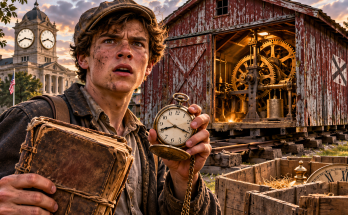
Ellis spent September working on the mechanism.
He had warned us that restoring it would take considerably longer than identifying it.
Now I understood why.
The movement was resting on the original mounting bolts in the courthouse tower, but that didn't mean it was ready to operate.
The years had left their own kind of work behind.
Protective grease had hardened around the metal.
Individual components needed examination.
The gear teeth needed to be checked before anybody allowed the machinery to move under its own power.
I remembered the little patch of brass Ellis had exposed when he first opened the largest crate.
That single clean area had changed the way everybody in Leah's backyard looked at the discovery.
Now he had to deal with the rest of the coating.
Carefully.
There was no value in removing decades-old material so aggressively that the machinery underneath suffered damage.
Ellis understood that the same substance we had initially mistaken for deterioration had helped protect the movement.
He wasn't going to punish the metal for having survived.
Whenever I thought about the restoration, I remembered the thirty-two screws from the original packing case.
The patience Ellis had demonstrated that Saturday hadn't been some special performance for the assembled witnesses.
It was how he worked.
He had no interest in being hurried by somebody else's excitement.
I appreciated that.
People in town were beginning to wonder when the clock would finally operate.
The question came up because they could look at the courthouse every day and see the same painted hands.
They knew the movement had been brought upstairs.
They knew the four glass dials had survived.
They wanted to see the result.
So did I.
But I remembered the small tin case from the second crate.
Inside it was the thin piece of spring steel associated with the pendulum suspension.
An entire tower clock depended partly on something that could be damaged by careless handling.
That thought helped me remain patient.
The biggest objects weren't necessarily the ones that required the most attention.
Sometimes the smallest component determined whether everything else could function.
Throughout September, the restoration progressed.
Ellis examined the old wheels.
He inspected the individual teeth that had been cut into them.
He paid attention to the parts of the mechanism responsible for regulating its movement.
None of that work produced a dramatic change visible from the courthouse lawn.
But it mattered.
Without it, the eventual installation might have been nothing more than an attractive arrangement of machinery that couldn't reliably keep time.
The purpose wasn't to display an old clock.
The purpose was to have a working one.
I liked thinking about that distinction.
For nearly a century, the town had displayed the idea of a clock.
Four faces.
Painted hands.
A permanently indicated time.
The actual clock would change those faces from decoration into useful instruments.
People could look at the courthouse and discover what time it really was.
That seemed like an ordinary thing to want from a clock.
It had simply taken Ashford Prairie an extraordinarily long time to achieve it.
Back at Leah's house, I continued putting the freight shed to use.
I had begun treating the main room as my workshop.
My tools no longer needed to compete with six unopened packing cases for space.
I could carry equipment through the freight entrance and put it where I wanted it.
The places where the old braces had rested remained visible.
I didn't mind those marks.
There was no need to make the floor look as though nothing important had ever stood there.
I wanted to use the building without removing every indication of its former purpose.
The little office remained much as I had found it.
Albert's slant-front desk was still there.
The stool remained nearby.
The old lamp hadn't been replaced merely because something newer might look better.
I kept returning to that room even after I no longer needed to search the ledger for clues.
Sometimes I simply sat there.
The freight record remained open to the 1931 entry.
The county had agreed to purchase the clock.
The restoration was underway.
There was nothing further I needed the handwriting to prove.
Still, I liked having it visible.
It reminded me of the difference between what Albert had known and what everybody else had believed.
He knew the county's machinery had arrived.
He knew the charges remained unpaid.
He knew the crates were still his responsibility.
Other people remembered that the clock order had been canceled.
They hadn't necessarily known what the cancellation meant for the freight.
Albert had preserved the part of the story that didn't fit neatly into the newspaper report.
I owed him more than I could express in a conversation.
Fortunately, the county was keeping its promise about the plaque.
It would identify Albert Finch and the years during which he had safeguarded the consignment.
1931 to 1972.
I wanted those dates included because they helped a person understand the duration of his work.
A name alone would have been meaningful.
But forty-one years told somebody something about the man.
He hadn't made a single impressive decision and then forgotten about it.
He had returned.
He had checked the building.
He had corrected the supports when they needed attention.
He had continued doing those things when nobody appeared to have any intention of collecting the shipment.
That was the contribution the plaque needed to recognize.
I wondered how many visitors would eventually climb the tower and read it.
Perhaps some would know Albert's story before they arrived.
Others might encounter his name for the first time.
I hoped they would understand why it had been placed beside the original manufacturer's plate.
There were people responsible for making the machine.
There was also a person responsible for ensuring that the machine was still there when the county finally became capable of using it.
Both belonged in the room.
As the weeks passed, I continued thinking about Grant's equipment.
The hydraulic jacks I wanted to give him were something practical.
I knew he would use them.
I also suspected he would object to receiving them.
Grant hadn't helped me because he expected an expensive reward.
That much had been obvious throughout the summer.
He could have refused to get involved when he realized how limited my budget was.
Instead, he had helped work through each difficulty as it appeared.
I had seen his expression when I suggested lowering the shed onto the grass.
He hadn't laughed.
He had explained what moisture would do to the oak sills and the conditions inside the building.
That advice might have mattered as much as any part of the move itself.
I wanted to repay some of his generosity.
But I knew there was no point attempting to turn our relationship into an account that could be balanced perfectly.
Somebody had helped me.
I could help him in return when I was able.
That was enough.
I was learning that money felt different when I thought about it in those terms.
It wasn't merely something to accumulate.
It wasn't something to spend so that other people would recognize my success.
It could be used to make somebody's work easier.
It could be used to solve a household problem before it became serious.
It could be saved for an education.
The important part was deciding which of those purposes mattered before spending it.
One evening, while I was sweeping the freight room, Travis appeared at the entrance.
I heard him before I turned around.
He stood near the doorway.
For a moment, I wondered whether he had come to ask about the county's payments or the clock restoration.
He didn't say anything immediately.
His attention was directed toward the floor.
I followed his gaze.
The marks from the old packing braces were visible in the wood.
There was no machinery left to buy.
No unopened crate to speculate about.
Just the empty spaces where the freight had stood.
I rested the broom against my shoulder.
"Evening."
Travis acknowledged me.
He remained near the doorway.
I noticed that he seemed less comfortable than he had during his earlier visits.
Before, he had always known what he wanted to say.
Three hundred dollars.
Fifteen hundred dollars.
Twenty-five hundred dollars.
He had arrived with offers and expected me to respond.
This time, there was no amount attached to the conversation.
He looked around the shed.
I waited.
Eventually, he began talking about the work he had done over the years.
Old buildings.
Structures that needed removing.
Places where the contents had been left behind after the people who used them were gone.
He had dealt with enough of those buildings to develop opinions about what was likely to be inside.
Often, those opinions were probably correct.
Experience could save a person considerable time.
It could also encourage a person to stop examining things that deserved another look.
Travis glanced toward the empty freight room.
"I've knocked down a lot of old buildings around here."
I nodded.
He didn't need to explain his experience to me.
I already knew about it.
"After a while, I thought I could tell what was worth keeping without looking too hard."
He paused.
I moved both hands onto the broom handle.
I wasn't sure where he was going with the conversation.
But I knew enough not to interrupt.
He looked at the marks on the floor again.
Then he looked at me.
"You saw something I missed."
I remained quiet.
Travis shifted his weight slightly.
"I should've paid more attention to what you were telling me."
There it was.
Not an elaborate speech.
Not an attempt to explain away everything he had said.
An admission.
I looked at him.
I had imagined receiving an apology from Travis several times during the summer.
Usually, those imagined conversations had involved me saying something clever in return.
I had wanted him to recognize that his assumptions about the shed were wrong.
I had wanted him to understand that being seventeen didn't make my observations meaningless.
Now that he was standing in front of me admitting precisely that, I didn't feel the satisfaction I had expected.
I felt uncomfortable watching him struggle with it.
It was easy to demand that somebody admit a mistake.
It was another thing to stand beside them while they did.
"I appreciate you saying that."
Travis gave a small nod.
He didn't offer his hand.
He didn't stay to discuss the collector's offer.
He didn't ask what I planned to do with the money.
After a moment, he turned and left.
I remained inside the shed with the broom.
I watched the doorway after he disappeared from view.
The conversation had probably lasted less time than it had taken Ellis to remove one difficult screw from the first crate.
Yet I knew Travis had said something that wasn't easy for him.
I respected him for that.
I returned to sweeping.
Dust gathered near the broom.
The marks from the braces remained.
I thought about the moment when the first crate opened.
Travis had looked toward me as though the brown grease had proved him right.
I had almost accepted the same conclusion.
For a few seconds, I had looked at the contents and wondered whether I had wasted everybody's time.
Ellis had been the person who continued examining the machinery without reacting to its appearance.
Remembering that made it impossible for me to feel superior to Travis.
I had been fooled by appearances, too.
The difference was that somebody with more knowledge had been there to show me what I wasn't seeing.
I finished sweeping the floor.
Then I stepped into the station office.
The ledger was where I had left it.
I looked at Albert's writing.
There was nothing judgmental about that old entry.
It simply recorded what had happened.
Perhaps that was part of why I found it so reassuring.
The freight had arrived.
The charges hadn't been paid.
The shipment hadn't been released.
Those facts had remained true regardless of what people believed about the canceled clock.
Travis had finally accepted the evidence in front of him.
I didn't need anything more from him.
As October progressed, Ellis continued preparing the courthouse clock.
The original milk-glass dials were cleaned and eventually installed.
The actual iron hands were fitted.
The connecting mechanisms were put into place.
I looked up at the tower whenever I passed the courthouse.
The work that had once been confined to a hidden freight room was becoming part of the building everyone could see.
That was exciting.
It was also a little strange.
I had spent so much time looking at four painted circles that seeing the original glass faces in their proper positions took some getting used to.
I knew the new arrangement was actually the older design.
It had been intended for the tower from the beginning.
The appearance people remembered was the temporary solution that had lasted far longer than anybody originally expected.
Inside, Ellis gave particular attention to the pendulum suspension.
He hadn't forgotten the thin steel component he had identified inside the little tin case.
Neither had I.
When I thought about the six crates now, I no longer pictured them as separate mysteries.
I pictured the parts of one machine returning to their proper relationships.
A movement.
Drive rods.
Gearing.
Four dials.
The pendulum.
Everything needed to work together.
The brass plaque honoring Albert Finch was placed beside the manufacturer's cast identification.
I was pleased when that part of the agreement was fulfilled.
It was exactly where I had hoped his name would appear.
Ruth visited the tower to see it.
She brought the Hamilton watch with her.
I thought about the day I had found that watch wrapped inside the desk drawer.
At the time, the engraved letters had been nothing more than a clue.
Now Albert's full name was mounted beside the mechanism he had spent forty-one years protecting.
His daughter could stand there holding his personal watch.
There was something about that connection I could never have expressed through the price of the sale.
The county had fulfilled that promise.
The clock had found its place.
And Albert Finch was no longer simply the forgotten station agent whose name appeared inside a canvas-bound ledger.
I began looking toward the end of October with an anticipation I hadn't experienced before.
The weather was becoming colder.
The trees around the courthouse were losing their leaves.
Winter was approaching.
Ordinarily, that would have brought another set of financial worries into our house.
This year, we had a little more protection.
And Ellis was preparing to set a mechanism in motion that had waited through more winters than anyone standing beside me could remember.
I looked at the courthouse one afternoon.
The original hands were finally there.
Soon, the time they displayed would have an entirely different meaning.
They wouldn't be fixed in place merely because somebody had chosen eight seventeen when the painted faces were made.
They would move.
I thought about the first screw Ellis had removed.
The first patch of brass he had uncovered.
The first mounting bolt that had entered its corresponding hole.
We had reached this point through hundreds of small actions performed carefully.
Now there was just one more small action I particularly wanted to witness.
Ellis would set the pendulum moving.
And the people of Ashford Prairie would finally see what happened afterward.