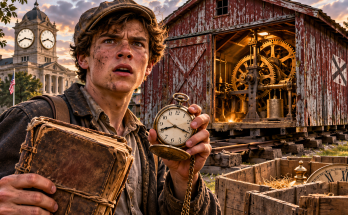
People began gathering behind Leah's house that Saturday morning.
Some stood beside the garden.
Others remained near the porch, where they could see the old freight entrance without getting too close.
I hadn't expected our backyard to feel quite so small.
The shed occupied most of my attention, but it was the people surrounding it who made me nervous.
They had come to see whether my judgment had been worth anything.
At least, that was how I felt.
June Fenwick arrived with the two supervisors and the county treasurer.
I greeted them and showed them where the building stood.
June examined the old seal from a short distance.
She didn't touch it.
The treasurer looked at the ledger I had brought outside.
I was grateful that nobody treated the gathering as an official celebration.
There was nothing to celebrate yet.
Grant parked his truck nearby.
His nephew was with him.
I felt better when I saw them.
They were familiar faces in a situation that had become much more public than anything I normally experienced.
Ruth arrived, and we arranged a chair for her.
She sat where she could see the freight entrance clearly.
I handed her the canvas-covered ledger.
She settled it across her knees.
Her reading glasses hung from their chain.
For a moment, she looked like somebody waiting for an ordinary appointment rather than a woman preparing to witness the opening of a room her father had sealed more than half a century earlier.
I wondered what Albert Finch would have thought of all these people standing around his old building.
I couldn't imagine that he had ever expected it.
Travis arrived, too.
I noticed him looking at the shed.
He glanced toward the county officials before acknowledging me.
I greeted him.
There was no mention of his offer from the previous evening.
That suited me.
I didn't want to discuss money before we had established what was inside.
Ellis began preparing his equipment.
He opened several cases and arranged the tools he expected to need.
There were no enormous hammers.
No equipment intended for tearing the wooden crates apart.
I understood why.
If the packing had preserved delicate machinery for decades, destroying it unnecessarily would have been a foolish way to begin examining it.
Ellis addressed the people who had gathered.
He asked everyone to remain back from the entrance.
The crates weren't to be disturbed until he had inspected and recorded them.
Nobody was to reach inside a box without permission.
Nothing was to be pulled free simply because somebody wanted a better look.
He also explained that we would examine the crates according to their original numbers.
One through six.
I looked toward the freight door.
He spoke again.
"No prying things apart."
Grant nodded.
Nobody objected.
Some of the neighbors appeared surprised by the formality of the procedure.
I could understand that.
From the outside, we were opening a dilapidated railroad building.
Ellis was treating the occasion like the examination of something that couldn't be replaced.
I hoped the contents justified his approach.
But I also knew that there was no way to establish their importance until we had opened them.
I took Calvin's seal cutters.
The handles felt familiar in my hands.
I walked toward the wire.
For several seconds, I simply stood there.
I could see the old seal clearly.
I thought about the last man who had handled it.
Albert Finch had been leaving the station in 1972.
He had wanted the freight entrance secured because the goods inside hadn't been released to their intended recipient.
He couldn't have known that an eighty-one-year-old Ruth would someday sit in a backyard holding his ledger while a teenager prepared to undo his work.
I glanced toward her.
She was watching my hands.
I looked back at the wire.
Ellis indicated where I should make the cut.
I positioned the jaws carefully.
Then I squeezed.
There was a small, brittle sound.
That was all.
The wire separated.
I lowered the cutters.
Nobody spoke.
The quiet was so complete that I could hear an insect moving against the screen on the porch.
I turned toward Ruth.
One hand had risen to the base of her neck.
I couldn't tell exactly what she was feeling.
I knew better than to interrupt her.
Grant stepped forward to deal with the padlock.
The lock was old, and he cut it without unnecessary interference with the surrounding wood.
Then he and his nephew positioned themselves beside the freight door.
They began moving it.
The old rollers resisted.
A harsh scraping noise traveled through the building as the heavy door slowly shifted along its track.
I took a step backward.
The opening grew wider.
Sunlight reached a floor that hadn't received direct light through that entrance since before I was born.
Dust and dark wood became visible.
Then I could see the packing cases.
All six of them.
They were still arranged within the wooden supports I had observed through the gap in the siding.
The ends bore painted numbers.
I found the first.
Then the second.
The remaining four stood within their braces.
Ellis asked everybody to wait.
He stepped into the freight room and began examining the arrangement.
I watched from the doorway.
The old packing supports seemed even more substantial from inside.
Until then, I had only seen portions of them through the boards.
Now I could appreciate how much work had gone into preventing the crates from moving.
Ellis recorded their positions.
He looked at the fastening points.
He examined the accessible surfaces before allowing anybody to interfere with the packing.
I glanced at Grant.
He was looking at the same supports he had been so careful to protect during the move.
I remembered shouting when one of the braces shifted against that old nail.
Standing inside the opened building, I understood why he had taken my concern seriously.
A seemingly minor movement could have affected more than one crate.
I was glad we hadn't found out what would happen.
Ellis approached the largest box.
It was marked with the number one.
The wood had aged, but the lid remained in place.
He examined the screws holding it down.
There were thirty-two.
I thought the number seemed excessive until I considered the weight and possible value of the machinery inside.
Whoever had secured that lid hadn't wanted it coming loose during transportation.
Ellis selected a hand tool.
Then he began.
The first screws took time.
They had been sitting in the same timber since 1931.
Some resisted when he attempted to loosen them.
He worked each one carefully rather than applying enough force to damage its head or surrounding wood.
A few came free more easily.
Others required repeated attention.
I stood nearby, watching his hands.
It was difficult not to become impatient.
Every screw removed brought us slightly closer to the answer.
But there were thirty-two of them.
The yard remained full of people.
Occasionally, somebody shifted position or glanced toward the house.
I wondered whether they had expected the whole examination to take ten minutes.
I certainly hadn't expected opening a single wooden lid to occupy so much time.
Ellis didn't allow the presence of an audience to change his pace.
When a screw resisted, he dealt with it.
When one loosened, he moved to the next.
There was something almost stubborn about his patience.
It reminded me of Ruth's description of Albert checking the shed every spring.
Neither man seemed particularly concerned with whether somebody else found the work interesting.
They understood what neglect could cost.
I looked toward Leah.
She was watching quietly.
I remembered the conversation we had shared the previous evening.
Twenty-five hundred dollars.
She hadn't asked me to accept it.
She hadn't even suggested that I ought to reconsider.
Now she stood there while an elderly specialist removed screws from a wooden crate.
I hoped she wasn't regretting the advice she had given me.
Nearly forty minutes passed.
Finally, Ellis finished freeing the lid.
He examined its edges to make certain nothing remained attached where it shouldn't.
Then he asked Grant to help him lift it.
They took hold of the wood.
I leaned forward.
"Straight up," Ellis said.
They raised the lid carefully.
The opening beneath it gradually became visible.
I had spent a considerable amount of time imagining that moment.
The reality was considerably less impressive.
There was brown material everywhere.
Old grease had combined with stiff packing fibers.
Dark pieces of metal appeared beneath the unpleasant mass.
Nothing gleamed.
Nothing resembled a beautiful historic clock.
It looked like the contents of a neglected container in the corner of somebody's workshop.
I stared at it.
For a few seconds, I couldn't make sense of anything I was seeing.
One of the supervisors let out a disappointed breath.
Travis glanced in my direction.
I recognized the expression.
He didn't need to say what he was thinking.
I had imagined that opening the box might embarrass me.
Now I was experiencing the possibility in front of everybody I had invited.
I felt my face become warm.
Was that really what I had protected?
Was that why I had turned down twenty-five hundred dollars when my aunt needed money?
The brown material looked awful.
I wished there had been some unmistakable feature that would immediately explain it.
A dial.
A recognizable clock hand.
Anything that could silence the doubts suddenly moving through my head.
Ellis didn't appear disappointed.
He didn't appear pleased, either.
He examined the exposed material.
Then he put on protective gloves.
From his equipment, he took a rag and a small quantity of solvent.
He selected a particular area where the dark coating covered something curved.
I watched him apply the solvent carefully.
He wiped a small patch.
At first, the rag merely became dirty.
Then the surface underneath began to change.
Something yellow appeared.
Ellis continued cleaning the same area.
A smooth metal surface emerged.
I leaned closer without touching the crate.
There was a curve to it.
Then I saw a series of evenly spaced projections.
Teeth.
A large brass wheel had been hidden beneath the old protective material.
I looked at Ellis.
He kept working.
The clean section widened enough to reveal more of the wheel.
Behind it were other metal components.
They weren't random pieces thrown into a wooden box.
They occupied deliberate positions within a heavy iron framework.
I felt something shift inside me.
Not certainty.
Not yet.
But the disappointment I had experienced when the lid rose was beginning to give way to something else.
Ellis explained that the brown material had served a purpose.
The machinery hadn't necessarily deteriorated into the filthy condition it appeared to be in.
Much of what we were looking at was an aged protective coating.
It had separated the important metal surfaces from conditions that could have damaged them during storage.
The ugliness had helped preserve what lay underneath.
I stared at the brass.
I felt embarrassed again, but for a different reason.
I had nearly judged the machinery by the appearance of the material protecting it.
The same mistake other people had made when they looked at the outside of the shed.
Ellis located another area of the mechanism.
There was a cast plate attached to the frame.
He began clearing the accumulated grease from its surface.
Letters slowly appeared.
I could make out the first part of the name.
Then more of it became visible.
E. Howard and Company.
Boston.
I read the lettering silently.
The manufacturer's name was there.
Not somebody's guess.
Not a rumor passed around town.
It was cast into the actual machinery.
Ellis continued examining the exposed components.
I looked at the large brass wheel and the iron frame around it.
Then I looked beyond the backyard.
Above the neighboring buildings stood the county courthouse.
Its painted clock faces still displayed eight seventeen.
There was a terrible temptation to announce that I had found what belonged inside that tower.
I almost did.
Then Ellis turned his attention back to the underside of the crate lid.
Something had been secured there.
I hadn't noticed it when the wood was first lifted.
He examined the attachment carefully.
There was an envelope wrapped in protective oilcloth.
The covering had aged, but the bundle remained attached to the timber.
Ellis freed it without tearing the surrounding material.
The people near the door became quiet again.
I watched him unfold enough of the protective covering to expose the front of the envelope.
There was writing on it.
Faded.
Still readable.
I recognized the words because I had seen them in Albert's ledger.
Red Willow County Board of Supervisors.
I looked toward June.
She was staring at the envelope.
Travis had stopped looking at me.
Nobody seemed interested in the dirty appearance of the machinery anymore.
I thought about the canceled order reported in the newspaper.
I thought about Albert's frustration whenever somebody had mentioned it.
And I looked at an envelope addressed to the county board that had remained attached to a shipping crate since the machinery was packed.
Ellis didn't open it himself.
He carried it carefully toward June.
Whatever that envelope contained, the county's representatives were going to see it before anybody else.