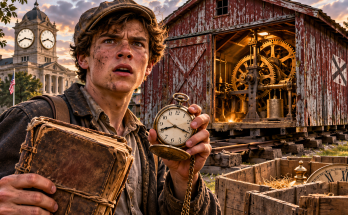
June accepted the envelope with both hands.
She examined the writing before turning it over.
Nobody attempted to take it from her.
The county treasurer suggested opening the documents on a clean surface.
Grant's truck was nearby.
We moved toward its hood.
The treasurer placed a clean sheet of paper beneath the envelope to protect whatever came out of it.
I stood close enough to watch.
The old paper looked fragile.
I could see why Ellis had insisted on preserving anything attached to the packing.
If somebody had thrown the wooden lid aside without examining it, the envelope might never have been noticed.
Worse, it might have been torn apart.
June worked carefully.
The first document she removed was an invoice.
I recognized the manufacturer's name immediately.
E. Howard and Company.
The year was 1931.
The same year recorded in the freight ledger.
The same year the newspaper had reported the cancellation of the courthouse clock.
I looked at the page while the treasurer examined it.
There was a monetary amount on the invoice.
Two thousand two hundred eleven dollars.
I didn't know what that figure would represent in modern money.
I knew it must have been a substantial expense for a county struggling to find sufficient funds during those years.
The fact that the invoice remained inside the crate seemed particularly significant.
There was another document.
A letter concerning the shipment.
It established that payment was to be collected upon delivery.
Leah's explanation of the abbreviation in Albert's ledger returned to me.
The goods couldn't simply be handed over when they arrived.
The required charges had to be paid first.
The letter and the ledger supported each other.
I looked toward Ruth.
She was still holding the book.
Her father's handwriting described the refusal of a shipment.
The document on Grant's truck described the terms under which that shipment had been sent.
For the first time, those separate pieces of information were coming together in front of the people responsible for the county today.
June removed another item.
It was a folded drawing.
The paper had been packed away for so long that opening it required patience.
The treasurer helped support it as June unfolded the sections.
I saw lines and measurements.
There was a representation of a tower.
Then I read the identification printed on the drawing.
Red Willow County Courthouse.
Ashford Prairie, North Dakota.
I stopped looking at the machinery.
I stopped looking at the people.
My attention remained on those words.
The drawing belonged to our courthouse.
There was no longer any need to speculate about whether the county had ordered some other kind of equipment.
The document established the intended location.
I examined the illustration more closely.
It showed a mechanical clock inside the tower.
There were four dials.
Each measured five feet across.
The drawing included the arrangement required to support the movement.
Four mounting bolts were indicated.
I looked from the drawing to the actual courthouse.
The tower stood above the surrounding rooftops.
Its four painted faces had been part of my everyday surroundings for seventeen years.
Until recently, they hadn't seemed particularly important.
Now there was an original architectural drawing identifying the mechanism intended to operate them.
I felt the backs of my legs against the edge of the ground where I was standing.
I hadn't realized I had been leaning forward so much.
I straightened.
Then I looked at Leah.
She was reading the same identification.
She turned toward me.
Neither of us spoke.
There was no need for me to explain what the document meant.
It meant precisely what I had hoped to establish.
The county had ordered a clock.
The manufacturer had prepared it specifically for the courthouse.
The shipment had been dispatched under terms requiring payment.
And the freight ledger showed that the county hadn't paid.
The newspaper had reported a canceled project.
It hadn't accounted for the physical goods waiting at the railroad station.
Albert Finch had known about those goods because they had been left in his care.
I finally understood why Ruth remembered him becoming irritated when people spoke of the canceled order.
From his point of view, cancellation hadn't made the shipment disappear.
The crates had remained.
He had continued looking after them.
I glanced toward the shed.
The first crate stood open.
The brass gear was visible through the patch Ellis had cleaned.
It was difficult to believe that something so unimpressive a few minutes earlier could now be identified as part of the courthouse's original equipment.
But there it was.
The documents mattered more than my excitement.
Ellis returned his attention to the crate.
He photographed the manufacturer's identification.
He recorded the condition of the fasteners and the original packing materials.
I noticed that his behavior hadn't changed after the discovery.
He remained as careful as he had been when nobody knew what the machinery contained.
That impressed me.
Everybody else seemed ready to move more quickly now that the answer was becoming clear.
Ellis appeared to understand that this was precisely when we needed to remain cautious.
Identifying the movement wasn't the same as establishing that it could operate.
There might be missing components.
Something could be damaged beyond repair.
The other crates still needed examination.
I had spent months imagining an entire clock.
At that moment, we had identified a mechanism and found documentation explaining where it belonged.
The rest remained to be established.
Ellis approached the second crate.
He examined its original arrangement before beginning to open it.
I watched with a different feeling from the one I had experienced beside the first.
There was a sense of purpose now.
We weren't simply trying to discover what category of machinery had been hidden in the building.
We were looking for the remaining components of a particular clock.
The second crate opened.
Inside were long pieces of black iron.
At first, the shapes seemed awkward in the limited space available.
Then I recognized the clock hands.
Real ones.
Not painted imitations.
The hands had been packed together with drive rods and gears intended to transfer movement through the tower.
There were components designed to change the direction in which that motion traveled.
Ellis examined them individually.
He explained enough about their purpose for those of us watching to understand that the movement in the first crate couldn't operate the four faces without the necessary connections.
There was also a wooden pendulum rod.
A heavy weight made of cast iron lay within the packing.
I looked at it for a long moment.
I had seen smaller pendulum clocks.
I had never considered the size of the components required to regulate a clock intended to serve an entire courthouse.
Ellis didn't lift anything unnecessarily.
He checked the condition of the parts where they rested.
He also found a small metal container.
Its size contrasted sharply with the larger pieces surrounding it.
When he examined the contents, I saw a thin piece of steel.
It hardly looked important beside the heavy iron and brass machinery.
Ellis made it clear that appearances were misleading again.
The thin steel formed part of the suspension for the pendulum.
It was delicate.
Careless handling could damage it.
I kept my hands away.
That small component made a particularly strong impression on me.
The shed had weighed six tons.
Grant had used enormous steel beams to move it.
The county road crossing had required the assistance of an electrical crew.
We had spent twenty-eight dollars on discarded railroad ties to recreate the building's old foundation.
And part of what we had been protecting was a piece of steel thin enough to be damaged by somebody handling it without understanding its purpose.
I thought about the brace shifting during the lift.
For the first time, I could picture some of the machinery that might have suffered if the crate had moved.
I was grateful for every occasion when Grant had chosen to stop and inspect something.
I was grateful Ellis had told me to leave the packing alone.
I was even grateful for the old supports that had made opening the crates more difficult.
They had done their job.
The next four crates were of particular interest.
The architectural drawing showed four large dials.
We had six crates altogether.
The first had held the movement.
The second contained the associated operating components.
That left four.
I could see Ellis approaching the third crate with particular care.
I didn't need him to tell me that the contents might be fragile.
The dimensions shown on the old drawing were considerable.
Five feet.
Whatever materials the manufacturer had used for the dials, transporting them would have required substantial protection.
Ellis examined the packing.
When the contents became visible, I saw a pale surface held within a wooden frame.
White glass.
It was much larger than anything I had expected to encounter in the shed when I first bought it.
The dial had been packed vertically with protective padding around it.
Ellis brought out a flashlight.
He moved the light along the accessible edges.
I watched his face for an indication of damage.
He didn't rush his inspection.
A crack could have been difficult to notice beneath part of the packing.
A damaged edge might become significant during restoration.
I waited while he finished examining the visible sections.
There was no obvious break.
No immediately visible chip.
The fourth crate contained another glass dial.
Then the fifth.
Then the sixth.
Four original milk-glass faces.
All still contained within the frames that had protected them during transportation.
Ellis examined each one.
I could hardly believe what we were looking at.
The movement existed.
The iron hands existed.
The pendulum and associated components existed.
And all four glass dials had survived.
Their condition would need to be assessed more thoroughly, but there were no obvious cracks or damaged edges during that first inspection.
I looked toward Ruth.
Her hands were trembling where they rested against the ledger.
I walked closer.
She was staring at the crates.
I didn't know whether she was thinking about the spring inspections or the time she had watched her father correct the frost-damaged supports.
Perhaps she was remembering something else entirely.
She didn't have to explain.
Her father had kept the floor level.
He had protected the building.
He had maintained conditions around four large glass dials he wasn't permitted to release.
Year after year.
Nobody had come to collect them.
Nobody had arranged for the clock to be installed.
Still, he had gone beneath the shed to make sure its supports hadn't shifted.
I looked at the twenty-eight railroad ties beneath the building.
I had thought I was solving a problem created by moving the shed.
In reality, I had continued something Albert had understood long before me.
Keeping the floor raised and stable had mattered.
It had mattered enough that we were now standing in front of four surviving pieces of glass intended for a courthouse tower nearly a century earlier.
I glanced toward Travis.
He was looking down at his boots.
I didn't feel the urge to remind him of the things he had said about the building.
I had been ready to dismiss the machinery myself when I first saw its dirty protective coating.
The difference between his doubts and mine wasn't as great as I might have liked to believe.
Ellis explained what rough handling could have done.
A crowbar inserted carelessly into one of the crates might have damaged a gear.
It could have destroyed the original documentation.
It might have cracked one of the glass dials before the person using it even knew what was inside.
The packing had been effective against ordinary storage conditions.
It wasn't designed to withstand somebody tearing through it.
I looked at the screws from the first crate.
Thirty-two of them.
Nearly forty minutes of patient work.
That time suddenly seemed insignificant.
I would gladly have stood there for several hours if doing so meant preserving what we had found.
June returned her attention to the architectural drawing.
She asked Everett Miles, the courthouse custodian, to examine it.
Everett looked closely at the representation of the clock movement.
Then he studied the four indicated mounting points.
I watched him consider the measurements.
"There are bolts up there," he said.
June turned toward him.
"In the tower?"
He nodded.
Four old iron bolts projected from the floor of the clock room.
He had seen them during his work in the courthouse.
Their purpose hadn't been apparent.
There had been no machinery attached to them.
They were simply part of the unfinished room.
I looked at the drawing again.
Four mounting points.
Four existing bolts.
The correspondence was another piece of evidence that could be checked directly.
Ellis was interested.
He wanted to compare the original drawing with the actual dimensions in the tower.
I could understand why.
The documents identified the destination, but the existing mounting arrangement might provide physical confirmation that the mechanism had been built for that particular space.
I glanced toward the courthouse.
I tried to imagine the empty room beneath its roof.
For all those years, four bolts had been waiting there.
Meanwhile, the machine intended to rest on them had remained inside a freight shed a few blocks away.
The distance between the two locations had never been particularly large.
The obstacles separating them had been money, paperwork, and time.
I looked at Leah.
The money problem in our own house still existed.
It hadn't disappeared because we had opened the crates.
The electricity company still expected payment on Tuesday.
We didn't have an agreement with the county.
We didn't know the market value of the discovery.
We couldn't assume that finding the courthouse clock would immediately provide the eight hundred forty dollars we were missing.
But something important had changed.
I no longer had to defend a theory about six unidentified boxes.
I had evidence.
Original documents.
A manufacturer's identification.
A complete set of machinery and four glass dials that appeared to have survived their extraordinarily long stay inside the railroad shed.
June looked toward the tower.
There would be practical arrangements to make.
Ellis would need to supervise any movement of the equipment.
The components couldn't simply be carried across town and placed wherever they happened to fit.
The county had lifting equipment that could assist.
Grant understood the precautions required to transport the heavy movement.
I listened while the necessary arrangements began taking shape.
Monday, August 11, was identified for the transfer.
One day before the utility deadline.
I looked down at the architectural drawing spread across the clean paper on Grant's truck.
The machinery would finally travel the remaining distance toward the building for which it had been manufactured.
I had refused three offers from Travis to reach that point.
Three hundred dollars.
Fifteen hundred.
Twenty-five hundred.
None of those numbers told me what the clock was actually worth.
I would have to deal with that question soon.
For the moment, I was looking at a drawing that showed exactly where the mechanism belonged.
Four anchor bolts.
Four mounting holes.
Four glass dials.
On Monday, we would find out whether the courthouse had been waiting for this particular machine all along.