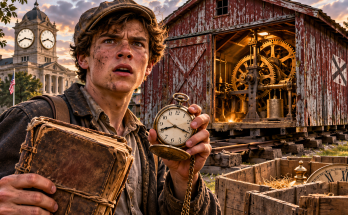
When I got home from Ruth's apartment, I went straight to the little station office.
I put Albert Finch's ledger back on his desk.
For a while, I stood there looking at the tall stool.
I could almost understand why Ruth had spoken so carefully about her father.
He hadn't been waiting for somebody to congratulate him.
He had simply believed that certain things were his responsibility.
Even when nobody else seemed to care.
I opened the drawer and took out his pocket watch.
The cloth was still folded around it.
I turned the watch over and examined the initials again.
A.F.
I had found something that belonged to a man whose daughter was still living a few streets away.
That made me think differently about everything else in the building.
Buying the shed had given me possession of its contents, but possession didn't necessarily answer every question about what ought to happen to them.
I wrapped the watch again.
Then I went inside the house.
There was somebody else I needed to contact.
Several weeks earlier, while trying to understand the markings on the freight crates, I had located a man named Ellis Whitcomb.
He lived in western Minnesota.
His work involved restoring mechanical clocks, particularly the enormous mechanisms installed in towers.
I had kept his contact information.
At the time, I hadn't possessed enough evidence to make a convincing case for asking him to examine my discovery.
Now I had Albert's ledger.
I had a date, a consignee, and the description of six pieces of machinery that hadn't been collected.
I also had Ruth's recollections.
Those weren't proof, as she had reminded me, but they provided information that a person familiar with historic machinery might find useful.
I gathered the photographs I had taken.
There was one of the original freight seal.
Another showed the lettering that remained visible through the opening in the siding.
I included pictures of the supports and the arrangement beneath the building.
Then I photographed the relevant entry in the ledger.
I tried to explain everything without making it sound more certain than it was.
That took some effort.
I kept wanting to write that I had probably discovered the missing courthouse clock.
Instead, I described what I could establish.
The shipment had arrived in 1931.
The county board had been named as its intended recipient.
The charges hadn't been paid.
Six crates remained inside the sealed building.
The courthouse had four painted clock faces.
The newspaper reported that the clock project had been abandoned.
I included that last detail because leaving it out would have been dishonest.
If Ellis was going to help me, he needed to see the evidence against my theory as well as the evidence supporting it.
I sent the message.
Then I looked toward the kitchen refrigerator.
The notice was still there.
I wondered how quickly somebody who spent his working life restoring old clocks might answer an inquiry from a seventeen-year-old in North Dakota.
The answer came the following morning.
I read Ellis's message standing beside the kitchen table.
He hadn't identified the machinery.
He hadn't suggested what it might be worth.
He had given me instructions.
The crates were to remain level.
The old packing supports weren't to be disturbed.
Under no circumstances was I to open the boxes before he arrived.
He could come on Saturday.
I read that final sentence again.
Saturday.
He was actually coming.
I called Leah over and showed her the message.
She read it quietly.
"Well, that sounds promising."
"He didn't say what he thinks it is."
"Maybe that's why he's worth listening to."
I couldn't argue with that.
I had encountered plenty of people willing to tell me what was inside the building without ever examining it.
Ellis was apparently not one of them.
His willingness to make the journey interested me more than any guess he might have offered.
I returned to the shed.
Nothing had changed since the previous evening.
The seal remained intact, and the six crates remained where Albert Finch had left them.
I crouched near the opening in the siding.
I wanted to see whether I could identify anything else before Saturday.
Then I remembered Ellis's instructions.
I stood up.
There was nothing useful about risking damage simply because I was impatient for him to arrive.
I had already waited this long.
The crates had waited considerably longer.
When Ellis's van arrived, it didn't look like the vehicle of somebody coming to evaluate a fortune.
It was dusty and practical.
Inside were cases containing tools that looked much more carefully organized than anything I carried to my gutter-cleaning jobs.
Ellis had gray hair and an unhurried way of moving.
He introduced himself, then asked me to show him the building.
I led him around the side of the house.
He stopped a few steps from the shed.
For a moment, he examined the whole structure without saying anything.
I waited beside him.
He looked at the roof.
Then the siding.
Then the old timber supports beneath the floor.
"That's where you moved it?"
"Yes."
"How far?"
I explained the journey from the abandoned branch line.
I told him about Grant, the steel beams, and the dollies.
I mentioned the moment when the brace had shifted.
That was something I didn't particularly enjoy admitting.
But it seemed important.
Ellis asked whether the crate itself had moved.
"Grant checked it. He said it was still held in place."
Ellis nodded.
He walked toward the main freight entrance.
From one of his cases, he took a magnifying glass.
He examined the wire and the old seal.
He looked at the places where they connected to the door.
I watched him without leaning over his shoulder.
He spent more time on that little piece of metal than most people had spent looking at the entire building.
When he finished, he didn't announce a discovery.
He moved toward the opening in the siding.
He studied the surviving letters.
He adjusted his position several times to get a better view.
I could hear the garden moving slightly in the wind behind us.
Otherwise, the yard was quiet.
Eventually, Ellis crouched beside the railroad ties.
He asked about the height of the building.
"Forty-four inches."
"Was it that high before you moved it?"
"Yes. We kept it the same."
He looked at the arrangement Grant and his nephew had constructed.
Then he examined the underside of the floor.
I told him what Ruth remembered about her father's annual inspections.
I explained how Albert had corrected a corner that had shifted when the ground froze.
Ellis moved beneath the building far enough to examine the old structural work.
I stood beside the supports and waited.
When he emerged, he brushed dirt from his clothes.
"Somebody cared about keeping this thing standing."
"Albert Finch."
I told him more about the station agent.
Ellis listened without interrupting.
He seemed particularly interested in the fact that Albert had continued inspecting the freight even after many years had passed without anyone paying to collect it.
I showed him the ledger.
He read the entry from 1931.
Then he examined the newspaper clipping.
I watched his eyes move from the county board's name to the report about the abandoned courthouse project.
Finally, I asked the question I had been holding back.
"Do you think it's the clock?"
Ellis closed the ledger.
"I think those boxes were prepared by people who knew how to ship machinery."
I waited.
"And somebody kept them in good condition."
"That's all?"
"That's what I can tell you without seeing what's inside."
I felt a little disappointed.
I had hoped that a specialist would recognize something I hadn't recognized.
A particular mark.
A familiar packing method.
Some small feature that would settle everything before the door opened.
Ellis wasn't willing to do that.
He explained that machinery could be protected in similar ways regardless of its intended purpose.
A careful examination might reveal useful evidence, but he wasn't going to identify a mechanism he hadn't seen.
I nodded.
Looking back, I was glad he had answered that way.
If he had encouraged my theory without evidence, I might have become even more determined to reject anything that contradicted it.
Instead, he brought me back to the building itself.
Six crates.
An old freight seal.
A written record.
Those were the things we actually possessed.
He asked who currently represented the county board.
I told him about June Fenwick.
She was the chair.
Ellis thought she ought to be present when the freight was examined.
I wasn't expecting that.
"Why?"
He indicated Albert's ledger.
"The shipment was addressed to the county. Whatever we find, they should see how we find it."
I understood.
If the crates did contain something purchased for the courthouse, opening them privately would leave room for questions later.
People might disagree about what had been inside.
They might question the condition of the machinery.
They might wonder whether documents had been removed or whether parts had disappeared.
Ellis wanted witnesses before any of that became an issue.
He also wanted Ruth there.
That suggestion made immediate sense to me.
Her father had secured the freight room.
She deserved to see what had remained behind the door he had closed.
Ellis looked back toward the shed.
"Anybody around here think you've wasted your money?"
I almost laughed.
"Quite a few people."
"Invite one."
I stared at him.
He explained that a person who doubted my theory could be an especially useful witness.
If everybody present already believed the crates contained a historic clock, other people might question their willingness to examine the evidence objectively.
Somebody skeptical would have no particular reason to support my account.
I knew immediately whom Ellis's suggestion brought to mind.
Travis.
The man who had offered three hundred dollars for the building and later increased his offer to fifteen hundred.
The man whose opinions about the shed were considerably less encouraging than mine.
Inviting him wasn't something I would have thought to do.
Part of me didn't want him anywhere near the freight room.
I had grown tired of feeling as though I needed to defend my purchase.
Opening the boxes in front of him might prove embarrassing.
What if the first crate contained something worthless?
What if he had been right about the building all along?
I realized that those questions were precisely why Ellis wanted somebody like Travis to attend.
This couldn't be an examination arranged to make me look clever.
It needed to be an honest examination.
I looked down at Albert's ledger.
"All right."
Ellis nodded.
He made it clear that nobody should attempt to remove the old crates or separate their contents before he could record their original positions.
He wanted the packing examined as carefully as the machinery.
Even something attached to a lid might provide important information.
I hadn't considered that.
Until then, I had thought of the crates primarily as obstacles between me and whatever was hidden inside them.
Ellis regarded them as evidence in their own right.
The arrangement of the supports mattered.
The labels mattered.
The fasteners mattered.
How everything had been packed mattered.
I thought about what could have happened if I had simply purchased the shed, taken a crowbar to the door, and started pulling boards away.
Perhaps I would have learned what was inside more quickly.
Perhaps I would also have destroyed the very things needed to understand it.
Ellis returned his tools to the van.
I carried the ledger back to Albert's office.
Before putting it down, I looked once more at the old entry.
There was something reassuring about knowing the next stage wouldn't depend on my judgment alone.
I was still the person who had spent sixty-five dollars on the shed.
I was still the person who had refused Travis's money.
But I no longer had to pretend I knew enough to handle every part of the discovery myself.
I had Grant for the building.
Ruth for her father's recollections.
Mrs. Adler for the historical records.
And now Ellis for whatever machinery waited inside.
Each of them had helped me understand something I couldn't have figured out on my own.
I went inside to speak with Leah.
The unpaid notice was visible from where I stood.
I told her what Ellis had recommended.
County representatives.
Witnesses.
A careful opening.
No unnecessary damage.
Leah listened, then looked toward the yard.
"Sounds like you're going to do it properly."
"I hope so."
I was nervous about asking county officials to attend.
There was every possibility that I would bring them to our backyard to witness the opening of six boxes that had nothing to do with their courthouse.
But the embarrassment of being wrong wasn't a good enough reason to keep the examination private.
I picked up the telephone.
For the first time, I was preparing to tell the people named in Albert Finch's old freight record that their shipment might still exist.