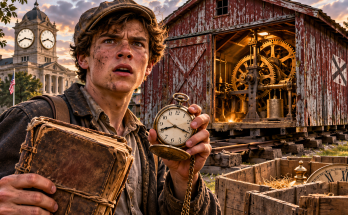
I had never been so afraid of hearing a piece of wood break.
"Hold it!"
My voice came out louder than I intended.
Grant stopped what he was doing.
His nephew turned toward me, and for a moment, nobody moved beneath the summer sun.
I was looking through an opening in the wooden siding of the railroad shed I had bought for sixty-five dollars.
Something inside had shifted.
I couldn't see enough to know exactly what had happened, but I knew the wooden supports around the freight crates weren't supposed to move independently of the building.
Not even a little.
Grant lowered his head until he could look through the same opening.
"Show me."
I pointed without putting my fingers through the boards.
"That piece there. It wasn't sitting like that before."
He studied it for several seconds.
I waited for him to tell me I was imagining things.
Instead, he moved closer.
An old nail had caught against part of the wooden brace as the building shifted during the lift.
The brace itself had moved slightly.
Fortunately, the crate behind it hadn't come loose.
Grant straightened up.
"Good thing you were watching."
Those words should have made me feel better.
They didn't.
They made me realize how easily something could happen that none of us could undo.
The shed weighed approximately six tons.
Six tons of aging timber, roofing, flooring, freight, and whatever else had been left behind when the railroad stopped using the building.
And I was seventeen.
I owned the building because I had been willing to spend sixty-five dollars when other people thought sixty-five cents might have been too much.
Now I was discovering that purchasing something and taking responsibility for it were two different things.
The purchase had taken money.
The responsibility was taking considerably more.
Grant checked the equipment again.
His nephew returned to his position.
"We're going slower from here," Grant said.
Nobody argued.
The building rose another small distance.
I watched the opening in the siding.
There were six crates inside that shed, and I didn't know what any of them contained.
That was the truth.
I had suspicions.
I had details that seemed worth investigating.
But suspicions weren't proof, and I couldn't afford to confuse the two.
Calvin had taught me to respect the things that other people overlooked.
An old seal wasn't simply a piece of wire.
A shipping mark wasn't merely dirty paint.
Something that had remained undisturbed for decades deserved more attention than somebody's impatient guess.
I was trying to remember that while watching a building I could barely afford hang above the ground.
Grant's equipment did the work.
My contribution was mostly standing where he told me to stand and paying attention.
It felt insufficient.
I wanted to help with everything.
I wanted to make the job go faster.
I wanted to justify the trouble Grant and his nephew were going through because of something I had purchased.
But making the job go faster was precisely what I needed to avoid.
Another adjustment.
Another inspection.
Another stretch of waiting beneath the hot sky.
The shed finally reached the position Grant needed.
Heavy steel beams supported its weight.
The dollies were placed beneath it.
I walked around the outside, looking at the weathered siding and the old tin roof.
It was an ordinary-looking building.
That was partly what made the whole situation so difficult to explain.
Nothing about it announced that it deserved this much effort.
There were no polished signs.
No attractive windows.
No impressive entrance.
Just faded boards, a freight door, and a roof that had endured more North Dakota winters than I could imagine.
People had laughed at what I had bought.
Standing there, with the equipment beneath it and the money disappearing from my coffee can, I understood why.
Understanding wasn't the same as agreeing.
By midday, Grant had the shed ready to move.
The steel beneath the building looked enormous compared with the narrow strips of old timber above it.
Planks had been laid where we needed to cross the abandoned railway.
I looked down at the rails.
For years, trains had carried freight through Ashford Prairie.
Now workers were preparing to remove what remained of the branch line.
Once those tracks were gone, there would be even less to remind people of what had stood there.
The shed began moving.
Slowly.
So slowly that watching it for a few seconds made it appear stationary.
Grant concentrated on the load.
His nephew walked alongside it.
I stayed where I could observe the gap in the siding without getting in anybody's way.
The first time the dollies crossed an uneven section, I held my breath.
Nothing fell.
Nothing snapped.
The brace remained in place.
We continued.
I had thought about what I might find inside those crates so many times that I had started forgetting how much could go wrong before I ever reached them.
A damaged support could let a crate shift.
A careless movement could disturb something delicate.
The fact that I didn't know what was inside made every risk harder to judge.
I couldn't tell Grant whether we were protecting heavy iron or fragile machinery.
Possibly both.
All I could tell him was that somebody had gone to considerable trouble to secure the freight before the shed had been sealed.
And somebody had apparently believed it was worth leaving undisturbed.
That mattered to me.
At the county road, another problem waited above our heads.
The electric lines.
I looked from the conductors to the tin roof.
There wasn't enough clearance to simply pull the building through and hope for the best.
Fortunately, the electric cooperative had arranged for its crew to meet us.
Their truck was already there when we approached.
The linemen used equipment specifically designed for the job.
Nobody on our moving crew was allowed to interfere.
We stayed clear while they prepared the crossing.
I watched the upper edge of the roof approach the raised lines.
My stomach tightened again.
The building seemed taller than it had beside the tracks.
Perhaps that was because it was sitting on equipment now.
Perhaps it was because I was looking at the cost of my decision from underneath a collection of electrical conductors.
Either way, I wanted that roof past them.
Grant moved the shed forward at the pace the situation required.
There were only inches to spare.
I followed the roof with my eyes until the last section cleared.
Then I finally let out the breath I had been holding.
The linemen finished their work.
The cooperative truck was another expense I would have to cover.
I knew that.
But watching those men handle the crossing properly made me grateful that we hadn't attempted anything foolish to save money.
There were things a person could repair after making a mistake.
There were other mistakes that didn't give you that opportunity.
I was beginning to understand the difference.
By the ninth day, every part of the move seemed to have occupied more space in my mind than anything else in my life.
The distance between the railroad and Aunt Leah's house wasn't particularly impressive.
The time it took to get there was.
When her yard finally came into view, I almost smiled.
Almost.
We still needed to get the building into position.
Leah had a little garden behind the house.
There was a clothesline nearby.
Between those familiar things was the place where the railroad shed would stand.
Seeing that narrow patch of ground made the building seem enormous.
Grant maneuvered the load carefully.
His nephew checked the available space.
I stood back.
The shed moved behind the house.
Another small adjustment brought it into position.
For the first time since the move began, the building was completely clear of railroad property.
I looked at the dirt beneath my shoes.
Then I looked at the roof.
We had made it.
The siding was still attached.
The freight remained inside.
The old seal hadn't been disturbed.
I felt proud for approximately five minutes.
Then Grant asked me about the foundation.
I looked at the ground again.
"What about putting it down here?"
He glanced at me.
"Directly on the ground?"
"Just for now."
Even as I said it, I knew my answer sounded poorly considered.
He crouched beside the building and indicated the old oak timbers underneath.
"See how those have been sitting?"
I nodded.
"They've had room to dry. You take that away, you're asking for trouble."
He explained that moisture would collect around the bottom of the structure if we placed the timbers directly against the earth.
The damage wouldn't necessarily announce itself immediately.
It would happen slowly.
Wood would absorb dampness.
Air wouldn't circulate properly.
The conditions that had helped preserve the contents could disappear.
I had spent days protecting six crates during a difficult move.
Now I was suggesting putting them in a building that might gradually deteriorate because I hadn't budgeted for proper supports.
Looking back, I felt embarrassed by how quickly I had offered that solution.
Grant wasn't criticizing me to make himself feel important.
He was trying to prevent me from wasting everything we had already accomplished.
"How much have you got left?" he asked.
"Not much."
That was an understatement.
The cooperative's charge had taken another portion of my savings.
I had given Grant sixty dollars toward the fuel he had used.
The coffee can that had held the money for this project was becoming painfully light.
I couldn't produce a proper foundation simply because I needed one.
Grant looked beneath the shed.
Then he looked at the dollies.
"I can leave it like this for a little while."
I knew what that meant.
His equipment belonged on paying jobs.
It couldn't remain behind our house indefinitely while I tried to solve a problem I should have anticipated.
"I'll figure something out," I said.
He nodded.
"I know. Just don't make the next decision because you're in a hurry."
After he and his nephew left, I remained in the yard.
The clothesline looked strangely small beside the shed.
The garden was still there.
The house was still there.
Everything familiar had stayed exactly where it belonged, and now there was a six-ton reminder of my decision sitting among it all.
I thought about my sixty-five dollars.
People had treated that purchase as the expensive mistake.
They hadn't seen the rest of the expenses.
Neither had I, apparently.
I went inside and found my coffee can.
I took the remaining money out and arranged it where I could count it.
Then I counted it again.
There was no hidden bill folded beneath another bill.
No forgotten amount that made the total more encouraging.
What I had was what I had.
I put it back in the can.
Leah's house was quiet.
The financial problems we already had weren't going to disappear because I had brought home an old building.
I knew that before I bought it.
I understood it much better now.
Later, I went outside again.
I crouched near the bottom of the shed and looked at the oak sills Grant had pointed out.
There was plenty of open space underneath them while the building remained on the equipment.
Air passed through.
I could feel it against my face.
For decades, that space had been part of the building.
Not an attractive feature.
Not something most people would notice.
But it had served a purpose.
I thought about how easily I could have destroyed that arrangement just because I was trying to save money.
The cheapest solution wasn't always the one that cost the least.
Sometimes it was simply the one that delayed the expense until you could no longer afford to fix what you had done.
I stood up and studied the shed.
I needed something strong enough to support it.
Something that wouldn't consume money I didn't possess.
Then I thought about the abandoned tracks.
The workers were dismantling them.
The steel rails weren't what I needed.
The timber beneath them was.
Old railroad ties had supported enormous loads for years.
If I could get enough usable ones, and if Grant could arrange them properly, perhaps I could recreate the space that had existed beneath the shed.
I didn't know whether the railroad workers would sell them.
I didn't know what they would charge.
But for the first time since Grant had asked about the foundation, I had a possibility that didn't involve putting the building directly on the grass.
I looked once more at the narrow opening in the siding.
Whatever those six crates contained, they had survived decades inside that structure.
They had survived the move.
I wasn't going to let wet ground become the thing that finally ruined them.