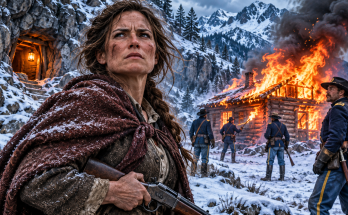
The flames reached the roof while I was still trying to understand what I was seeing.
I had watched fires before.
We had burned fallen branches.
We had heated our home with wood.
I had seen sparks rise from the stove on bitter nights.
But I had never watched a house burn.
Not a house that belonged to my own life.
The fire moved faster than I expected.
Dry pine caught along the walls.
Smoke gathered beneath the roof.
The flames climbed around the window openings.
I could see the shape of the cabin beginning to disappear behind the smoke.
Dr. Coulter stood beside me.
His face remained turned toward the clearing.
He was watching carefully.
I knew he understood the importance of what was happening.
But I could not think about legal consequences yet.
I was watching the only home Elias and I had built together being destroyed.
There was no way to make that ordinary.
The soldiers remained outside.
The young lieutenant stood with the others.
Finch watched from nearby.
I wondered whether he was satisfied.
He had delivered the notice three months earlier.
He had offered me fifty dollars.
He had explained that Elias's death had ended my right to occupancy.
Now he was watching the building burn.
I wanted to ask him whether this was what he had meant by reclaiming the property.
I wanted to ask whether a widow's furniture and memories were obstacles that needed destroying.
I said nothing.
The words remained inside me.
Below, flames moved through the interior.
The windows glowed.
Smoke poured upward into the clear winter sky.
The color was darker than the faint plume rising from my hidden chimney.
That small plume had helped people find warmth.
This smoke marked the destruction of a home.
I could see it from far above the clearing.
Black against blue.
I remembered how carefully Elias had chosen the cabin's location.
The ground was firm.
The slope received good sunlight.
The creek was close enough to be useful without threatening the foundation.
He had studied the drainage.
He had examined the trees.
He had decided where the windows should face.
Nothing about the place had been accidental.
We had not possessed enough money to waste materials.
Every board mattered.
Every nail mattered.
When something could be salvaged, we used it.
That was why the cabin had taken so much effort.
We built it slowly.
We improved it as we could.
The fireplace came from stones Elias gathered and fitted by hand.
The kitchen table came from ponderosa pine.
Its uneven leg had remained a small household joke.
I remembered placing the folded leather beneath it.
I wondered whether the leather was burning.
That thought nearly broke me.
Of all the things I might have remembered, I thought about a piece of leather under a table leg.
Not the silver deposit Elias discovered.
Not the company's claim.
Not the expensive work of surveying the mountain.
Just a small object that kept our supper from wobbling.
I pressed my lips together.
Coulter glanced toward me.
I shook my head slightly.
I could not speak.
Below us, the fire continued.
The soldiers had moved far enough away to avoid the heat.
They were not trying to save anything.
Their orders were to destroy the building.
I watched them obey.
The sound reached us faintly through the cold air.
Cracking wood.
The dull collapse of burning boards.
The occasional sharper noise as part of the structure gave way.
I had heard those sounds when we split wood.
But never on that scale.
The smoke grew thicker.
For a moment, the cabin disappeared completely.
Then the wind shifted.
I could see the roof again.
It sagged in the middle.
I knew what was coming.
I had helped Elias set the timbers.
I knew where the main support lay.
I knew the roof could not remain standing after enough of the structure beneath it burned.
I wanted to turn away.
I did not.
The roof collapsed.
The sound was heavy.
A rush of sparks rose above the clearing.
Burning fragments fell into the snow.
The cabin's shape changed in an instant.
Where the roof had been, there was open sky and smoke.
I closed my eyes.
Only briefly.
When I opened them, the roof was gone.
I had expected to feel anger.
I did feel it.
But beneath the anger was something worse.
The knowledge that Elias would never see what had happened to our home.
He had spent years working for Sterling.
He had helped locate the silver that made the claim valuable.
He had died while carrying out geological work in the upper basin.
Six months later, the company sent Finch to remove me.
Three months after that, soldiers burned the house he built.
The sequence was so plain that I could hardly bear it.
I wondered what Elias would have said.
He had been a measured man.
He rarely raised his voice.
When something angered him, he became quieter.
He would examine the facts.
Then he would decide what could be done.
I tried to follow that habit.
I looked at the soldiers again.
Six men.
One lieutenant.
Mr. Finch.
The cabin.
The fire.
Dr. Coulter.
I repeated those details silently.
I wanted to remember them accurately.
Not because I imagined revenge.
But because I knew Sterling would eventually describe the event in its own words.
I had already learned how easily a company's papers could make cruelty appear routine.
An eviction became a terminated occupancy agreement.
A widow's home became a parcel on a mining claim.
A payment of fifty dollars became compensation.
I wondered what phrase they would use for this.
Removal of an unauthorized structure.
Enforcement of an order.
Protection of company property.
I did not know.
But I knew what I had seen.
Men had set fire to an empty house.
The house belonged to the life Elias and I had made.
And the person whose removal supposedly justified the action was standing alive on the mountain.
Coulter remained beside me.
I could see him observing the soldiers and the fire.
He had already examined the shelter beneath the granite.
He had documented its construction.
He had measured the temperature difference between the chamber and the outside air.
He had studied Elias's journals.
Now he was witnessing what the company had persuaded soldiers to do.
The contrast was almost unbearable.
A few days earlier, he had described my work as an important example of practical shelter design.
Now armed men were destroying the cabin from which many of its materials had come.
The soldiers did not know about Coulter's measurements.
They did not know about his federal report.
They did not know the hidden chamber remained warm and occupied.
They had gone to the place Sterling expected me to be.
They had found it empty.
And they had burned it anyway.
I understood then why my decision to leave furniture behind had not mattered.
I had hoped the cabin would appear recently inhabited.
Perhaps that would make someone hesitate before treating it as abandoned.
But the soldiers had not needed proof of neglect.
They had orders to prevent further occupation.
The structure itself was considered a problem.
Its destruction was the answer they had been sent to provide.
The realization left me exhausted.
I thought about the work I had done beneath the ridge.
The floor excavation.
The dry-stacked wall.
The salvaged oak door.
The stove.
The chimney.
The long days of cutting wood.
The storm that buried the entrance.
The people who followed the smoke.
Everything had happened because I refused to accept that losing the original cabin meant losing my life.
Now the building was gone.
But I remained.
The company could destroy the place where I used to sleep.
It could not make the granite chamber disappear by burning a wooden house.
I looked toward the hidden draw.
It was concealed from the clearing.
The soldiers had not searched it.
They were watching the fire finish its work.
I could hardly believe the shelter had remained undiscovered.
So many people in Prospect knew about it.
Tom Miller had visited.
Other families had followed.
Coulter had examined it.
Yet the soldiers had gone directly to the old cabin.
They had treated the absence of a person there as proof that the eviction was complete.
I wondered what Finch believed.
Perhaps he assumed the rumors about me were exaggerated.
Perhaps he thought I had finally fled.
Perhaps he believed the cabin was the only place where I could survive.
I would never know exactly what passed through his mind.
I only knew he had watched the destruction.
When the roof had fallen and the walls were badly burned, the soldiers began preparing to leave.
The lieutenant looked over the remains.
One man moved closer to inspect the fire.
Another turned toward the trail.
Finch remained with them.
I watched the group gather.
Their work was finished.
The cabin was no longer a usable shelter.
They had found no widow to remove.
The company could report that the structure had been destroyed.
I imagined the entry in some official ledger.
February twelfth.
Property cleared.
I felt a bitter kind of disbelief.
So much could be erased with so few words.
The soldiers began moving downhill.
Their snowshoes pressed fresh tracks into the white ground.
Finch followed.
None of them looked toward the rocks where Coulter and I stood.
I watched until the last blue uniform disappeared beyond the bend.
Then I continued staring at the clearing.
The cabin was still burning.
Smoke rose from the collapsed roof.
The stone fireplace remained visible through the ruined walls.
It was the one part I could clearly recognize.
Elias had fitted those stones himself.
The fire that destroyed the logs could not consume granite in the same way.
The fireplace stood amid the wreckage.
I looked at it for a long time.
Coulter finally spoke.
"I'm sorry, Mrs. Thorne."
I nodded.
He did not say anything else immediately.
I was grateful.
There was nothing he could say that would restore the house.
I understood that.
I also understood that he had witnessed the destruction.
That mattered, though I could not yet bear to think about why.
I looked toward the south-facing slope behind the cabin.
Elias's grave was there.
The fire had not changed that.
He remained buried on the land where we had lived.
The company had burned the house.
But it had not erased the years we spent there.
I tried to hold on to that thought.
It was difficult.
The smoke made everything feel final.
I had prepared myself for eviction.
I had prepared myself for winter.
I had even prepared myself for the possibility that someone might discover the hidden shelter.
I had not prepared myself to watch our home burn while the men responsible walked away believing their duty was complete.
For a long time, Coulter and I remained among the rocks.
Then I turned toward the hidden draw.
The cold had begun reaching through my clothing.
My hands were stiff.
I knew I needed to return to the shelter.
I could not remain outside simply because I was grieving.
The mountain still demanded care.
The stove still needed fuel.
The food still needed protecting.
I had survived by doing what was necessary even when my heart was elsewhere.
That day was no different.
I took one last look at the burning cabin.
Then I followed the rocky ground toward the place Elias had discovered.
The hidden entrance remained beneath the granite shelf.
The oak door still stood in its frame.
Inside, the stove was warm.
I stepped into the chamber and closed the door.
For a moment, I could not move.
Then I sat beside the fire.
I looked around the room.
The wall I had built was still standing.
The supplies were still there.
Elias's journals rested beside the lamp.
The soldiers had destroyed the wrong shelter.
They believed they had removed me.
Instead, they had left me alive beneath the mountain.
But I did not feel victorious.
I had just watched the last house Elias and I shared burn to the ground.
And no amount of warmth inside the granite could take away that loss.