I had spent most of the winter believing my shelter was the only protection I possessed.
After Dr. Coulter's visit, I began thinking differently.
The chamber still kept me warm.
The granite still protected me from the wind.
The stove still burned steadily.
But someone outside Prospect now knew what I had built.
And he had taken measurements.
That mattered.
I did not know whether it would help me.
I had learned not to trust promises that had not been made.
Dr. Coulter had not offered to defend my home.
He had not said he could stop Sterling Consolidated.
He had simply examined the chamber and recorded what he found.
But I had seen how seriously he treated accurate records.
He had looked at the wall.
Measured the room.
Read my temperature notes.
Studied Elias's drawings.
And examined the eviction notice.
He had treated each fact as something worth understanding.
That was different from the way Finch approached me in November.
Finch came with a decision already made.
Coulter came with questions.
I thought about that distinction while sitting beside the stove the evening after his visit.
The fire was low.
The chamber remained warm.
I opened Elias's journal.
I read the entry describing the double-bottomed draw.
October twelfth, 1886.
Two years before the company told me to leave.
Elias had recorded the formation without knowing I would need it.
Now the same notes had helped a federal scientist understand my shelter.
I traced the drawing.
Then I looked toward the oak door.
I had taken that door from our bedroom because I could not afford another one.
The company had treated the upper cabin as something it could reclaim without considering what it meant to me.
But Coulter had seen that door as part of an engineered structure.
He had examined the hinges.
The frame.
The fit.
The way the opening worked with the thick granite wall.
I remembered standing alone beneath the rock while trying to hang it.
My arms had trembled.
My hands had slipped.
I had used stones to support the weight.
It had taken hours.
At the time, I cared only whether it would close.
Now someone had recorded the result.
I found that strangely comforting.
The work had not disappeared into the darkness of the chamber.
Someone had seen it.
I closed the journal and checked the stove.
Then I made my evening meal.
I had beans and a small portion of salt pork.
The food was plain.
It had become familiar enough that I no longer thought much about it.
I knew the supplies would continue shrinking until spring.
That was why I kept calculating.
I checked the flour.
The beans.
The lard.
The remaining coffee.
Everything was still adequate, provided I remained careful.
I did not waste food because someone had praised my shelter.
I did not burn more wood because the chamber had been described as efficient.
I continued living as I had before.
The next morning, I stepped outside to examine the entrance.
Snow remained deep across the draw.
The passage was narrow but usable.
The boulders still concealed the doorway from anyone unfamiliar with its location.
I checked the area around the chimney outlet.
The pipe was functioning.
A faint trace of warm exhaust rose among the rocks.
I watched it disappear into the cold air.
That little plume had brought Tom Miller to my door.
It had made the shelter known in Prospect.
And the stories had eventually brought Dr. Coulter.
I had feared the smoke would expose me.
It had.
But not in the way I expected.
The first man who followed it needed help.
The second came to study what I had built.
Neither had tried to remove me.
I could not assume that would remain true.
Still, I had begun to recognize how much had happened because the shelter could not remain completely invisible.
If Tom had never found me, his family might have continued struggling to keep warm.
If people in Prospect had never spoken about the chamber, Coulter might never have heard of it.
And without his visit, no federal observer would have recorded the structure before Sterling took further action.
I did not know what action the company was preparing.
That ignorance troubled me.
I had heard enough about its dissatisfaction to remain wary.
But I had no direct communication from Sterling.
No new notice.
No visit from Finch.
No sheriff.
The silence was uncomfortable.
I remembered the first weeks after December fifteenth.
I had assumed the company believed I was gone.
Now I knew it had heard otherwise.
The lack of communication no longer felt reassuring.
It felt uncertain.
I checked the rifle.
Then I put it back near the entrance.
I did not want to use it.
I had never wanted a confrontation.
My decision to remain on the mountain came from necessity, not a desire to challenge armed men.
But I would not pretend the possibility of force did not exist.
I had lived through enough to know that paperwork could lead to physical consequences.
A signature in Denver had produced Finch at my door.
An eviction notice could produce a sheriff.
A complaint from the company might produce something worse.
I did not know how much power Sterling could persuade others to exercise.
That was the part I could not measure.
I could calculate wood consumption.
I could estimate the heat retained by stone.
I could examine a wall for movement.
I could check whether the chimney drew properly.
But I could not predict what decisions men would make in offices far from the mountain.
I disliked that uncertainty.
It reminded me of the months after Elias died.
I had waited for information.
Waited for money.
Waited for the company to decide what it intended to do.
Then Finch arrived.
And the decision had already been made.
I refused to spend the rest of the winter waiting helplessly for another messenger.
So I continued working.
I inspected the stone wall.
I checked the packed earth around the frame.
I made certain the oak door closed securely.
I examined the chimney.
I kept the wood stacked neatly.
I preserved enough provisions to remain inside if another storm made travel impossible.
Those were things I could control.
I had learned that taking care of ordinary tasks was sometimes the best response to fear.
The work kept my mind clear.
It also kept the shelter ready.
One afternoon, I sat beside the stove and reviewed the records I had made since December.
The figures told a consistent story.
The chamber remained much warmer than the outside air.
The granite reduced rapid temperature changes.
The snow around the entrance provided additional insulation.
The stove required less fuel than an exposed cabin of comparable comfort would have needed.
The natural drainage kept the floor dry.
The front wall remained stable.
The chimney worked.
I had not created a perfect structure.
There were improvements Elias might have suggested.
There were things I would have done differently if I possessed more money or assistance.
But the shelter had survived the worst storm I had experienced that winter.
That was proof enough for me.
I thought about Coulter's language.
He had described my work as innovative.
He had spoken about thermal stability.
He had examined the wall's structural integrity.
He had said the arrangement deserved to be documented.
I remembered feeling embarrassed.
I had not wanted to appear proud.
Now, alone in the chamber, I allowed myself to consider what those words meant.
I had been a widow facing eviction.
I had been given thirty days in late autumn.
I had found a geological drawing.
I had turned it into a place where I could survive.
That was not nothing.
I had spent months minimizing my own achievement because I knew how much I owed to Elias.
But his knowledge did not move the stones.
His drawing did not excavate the floor.
His observations did not carry the stove.
I had done those things.
I had made decisions.
I had taken risks.
I had worked through pain.
And I had kept the shelter functioning afterward.
Elias had shown what might be possible.
I had proved that it could work.
That realization did not make me less grateful to him.
It made me feel closer to him.
He had trusted me to understand his work when he was alive.
I had continued learning after his death.
And together, though separated by circumstances I would never have chosen, we had created something useful.
I looked at his handwriting.
Then at my own notes beside it.
The contrast was obvious.
His letters were small and precise.
Mine were less even.
Sometimes I pressed too hard with the pencil.
Sometimes I wrote around a stain or an older annotation.
But the pages belonged together now.
His observations.
My measurements.
One record of the same place.
I thought about the people in Prospect who had benefited from what I shared.
Tom Miller and his family.
The widow whose firewood had been buried.
The young couple who needed help.
The others who came because their cabins lost heat too quickly.
They had taken the ideas home.
They had used them.
Some had made their houses warmer.
Some had reduced the amount of fuel they needed.
I had never asked for payment.
I had not offered my advice as a business.
I had simply wanted to help people survive a winter that was punishing all of us.
Coulter had noticed that too.
He had asked about the people who visited.
He had written down what I told him.
I wondered whether those details would appear in his report.
Perhaps they would.
Perhaps he would focus only on the geology and construction.
Either way, the work was now recorded by someone other than me.
That was important.
The company could say I had no right to occupy the land.
It could describe me as a squatter.
It could point to the eviction notice.
But it could not easily change the temperature readings.
It could not deny that the chamber existed.
It could not erase the granite wall or the stove.
And it could not make Elias's original measurements disappear from the journal I kept beside my bed.
I did not yet understand the legal significance of those records.
I was not trained in law.
I had no experience arguing a claim before government officials.
But I understood evidence.
Elias had taught me that evidence mattered more than confidence.
A man could insist a rock formation lay in one place.
But a careful survey might show it lay somewhere else.
A company could describe a boundary on paper.
But the actual markers still stood on the land.
I remembered Coulter asking about the original survey points.
I remembered his interest in the claim description on my eviction notice.
He had not said the company was wrong.
He had not promised that I owned the land.
But he had considered the possibility that the records deserved closer examination.
That was enough to make me preserve everything carefully.
I returned the notice to my papers.
I closed Elias's journal.
Then I placed it where it would remain dry and safe.
I had protected those books because they were the last records of my husband's mind.
Now I understood that they might also protect the truth about the land.
That evening, the light faded early.
I fed the stove.
The flames caught.
Warmth moved through the chamber.
I sat near the granite wall and listened to the winter outside.
For a while, I felt almost peaceful.
I had survived since December fifteenth without leaving the mountain.
I had endured the great blizzard.
I had helped people in Prospect.
A federal scientist had documented my work.
And Elias's observations had been recognized as valuable.
Those were real things.
I did not need to pretend otherwise.
Still, I knew the company had not withdrawn its claim.
The legal problem remained.
The notice remained.
The land was still disputed, whether anyone admitted it or not.
I looked toward the oak door.
I wondered how much longer I would be allowed to live quietly behind it.
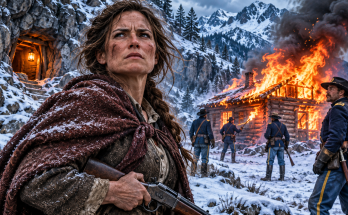
I did not know that six soldiers had already been dispatched from Fort Logan.
I did not know that Sterling had asked the authorities to remove the person it called a trespasser.
I did not know that the company wanted structures destroyed so I could not return.
Had I known, I might have felt differently about the silence.
But I knew none of those things.
I only knew that Dr. Coulter had visited before the company's next move.
He had seen the chamber.
He had measured it.
He had written down what he found.
And he had examined the records Elias left behind.
Those facts could not prevent every harm.
But they meant that if someone came to destroy what I had built, there would be an independent record of what existed before the destruction.
I did not understand how important that would become.
I simply continued preparing for another cold night.
I checked the fire.
I folded my blanket.
I placed the rifle near the door.
Then I turned down the lamp.
Outside, the mountain remained covered in snow.
Inside, the granite held its warmth.
And I slept beneath the ridge, still unaware that the men sent by Sterling were making their way toward Prospect.