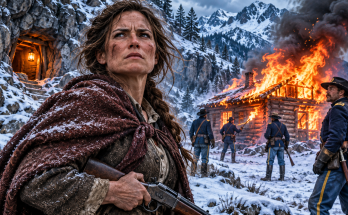
I did not celebrate when the soldiers left.
For several days, I found it difficult to think about anything beyond the burned cabin.
I knew I was safe inside the mountain.
I knew the stove still worked.
I knew the food and wood I had stored remained untouched.
But the view of the collapsing roof would not leave me.
Whenever I closed my eyes, I saw sparks rising into the winter sky.
I remembered the smoke.
The soldiers.
Finch standing near the clearing.
The stone fireplace visible after the walls gave way.
I had imagined losing the cabin many times after the eviction notice arrived.
But imagining a loss and watching it happen were different things.
The company had taken something I could not replace with money alone.
That was the part I struggled to explain.
The logs could be replaced.
The roof could be rebuilt.
A carpenter could make another table.
But those things would not be the same ones Elias had touched.
They would not hold the same six years.
I knew that.
I also knew I could not remain frozen in grief.
Spring would eventually come.
The snow would melt.
The company might send more men.
And I still needed to survive long enough to learn what would happen to the land.
Dr. Coulter's work became important in ways I had not expected.
He had already measured my hidden chamber before the soldiers arrived.
He had examined the granite formation.
He had studied the heating arrangement.
He had recorded the temperature difference between the shelter and the outside air.
He had read Elias's journals.
And he had seen the company notice.
Now he had witnessed the burning.
He had watched six soldiers and a company agent approach the old cabin.
He had seen the lieutenant enter.
He had watched the men gather brush.
He had seen the torch applied to the logs.
He had remained beside me until the soldiers departed.
There was no need for him to rely on rumors from Prospect.
He had been there.
That fact became the foundation of what followed.
Coulter prepared his report for the Department of the Interior.
The larger document concerned the geological resources of the Argentum range.
That was the work he had been sent to perform.
But he included a separate section dealing with the unusual habitation beneath the granite shelf.
He described the formation in careful scientific terms.
The fallen slab.
The concealed chamber.
The south-facing opening.
The thick granite mass behind the shelter.
The dry floor.
The natural drainage.
He recorded the wall I had constructed.
The oak door.
The stove.
The chimney.
The way the chamber retained warmth during severe weather.
He used the measurements he had taken inside.
He included my observations about fuel consumption and temperature.
I had written those figures in the margins of Elias's journal because I wanted to know whether my wood would last.
Now they were becoming part of an official scientific record.
I found that difficult to believe.
I had never expected my handwriting to matter to anyone beyond myself.
It was uneven.
Sometimes crowded.
Sometimes written while my fingers were stiff.
But the figures were accurate.
I had checked them carefully.
That was what mattered to Coulter.
He did not treat the records as the work of an untrained woman who should have been grateful merely to survive.
He treated them as observations that could be examined.
I remembered how Elias approached scientific work.
He believed facts had value even when the person recording them possessed no authority.
Coulter seemed to believe the same.
He described the shelter as an unusual example of using natural rock and carefully arranged construction to conserve heat.
He also recorded what had happened to the upper cabin.
That section was not about thermal efficiency.
It was about men acting under authority.
And the destruction of a home.
Coulter stated that he had witnessed United States Army soldiers deliberately burn the structure.
He identified the connection to Sterling Consolidated.
He described the company's effort to remove me from land it claimed.
And he raised questions about the accuracy of the boundaries recorded for that claim.
Those questions came from his geological work and the records Elias had left.
I remembered the afternoon Coulter examined the eviction notice.
He had studied the description of Lot Fourteen.
Then he looked through Elias's original observations.
He had asked whether the company's filed boundaries agreed with my husband's measurements.
I could not answer.
I had never seen Sterling's complete claim records.
But Coulter had access to the information needed for his survey.
He could compare the locations.
The markers.
The descriptions of the ridge and creek.
The distances recorded in the field.
And the boundaries claimed by Sterling.
His work revealed discrepancies.
The company's filed claim did not agree in important respects with the original survey evidence.
That meant the company's assertion of ownership could not simply be accepted as unquestionable.
The matter required investigation.
I had spent months assuming Sterling's documents were stronger than anything I possessed.
They had lawyers.
Officials.
A mining operation.
Money.
And the ability to summon soldiers.
I had a folded eviction notice and a dead man's journals.
But those journals contained measurements.
And measurements could expose errors.
The same careful habits that helped Elias discover the hidden chamber had also preserved information about the land surrounding it.
I began to understand that his work might protect me in more than one way.
The chamber had saved me from the winter.
The records might help establish what the company had done.
I did not expect the government to act quickly.
I had learned how slowly official matters could move.
But Coulter's report was not a private complaint made by a widow.
It came from a federal geologist carrying out assigned work.
He had documented the shelter.
He had witnessed the burning.
And he had identified problems with the company's land claims.
Those matters could not be dismissed as easily as my objections to Finch.
An inquiry followed.
Sterling Consolidated came under investigation.
The questions concerned the boundaries of its claim.
They also concerned the use of federal soldiers to destroy property when the company's asserted rights to the land were in doubt.
I learned that the company faced accusations connected to improper acquisition of claim land.
The authorities began examining the differences between the filed boundaries and Elias's original survey markers.
The issue was serious.
Mining claims depended on accurate descriptions.
A company could not lawfully expand its rights merely by placing incorrect lines on a map.
The land itself did not change to match an inaccurate document.
I thought about that often.
The mountain had remained exactly where it was.
The creek followed its course.
The ridge stood above the draw.
The granite shelf had lain across the ravine for generations.
Only the papers were disputed.
And those papers were what Sterling had used to tell me I had no right to remain.
I remembered Finch's confidence.
He had not been harsh when he delivered the notice.
He had spoken as though the decision was administrative.
Routine.
Final.
I had almost believed that calmness made the decision unchallengeable.
Now government officials were asking whether the company had possessed the rights it claimed.
The question changed everything.
It did not restore the cabin.
It did not bring Elias back.
But it meant the company might have to answer for what it had done.
The inquiry also examined the soldiers' involvement.
They had been sent to remove a supposed trespasser.
They had destroyed the upper cabin under orders intended to prevent further occupation.
But the structure had stood on land whose ownership and boundaries were now disputed.
Coulter had seen the burning.
His account provided a direct record of the event.
The company could not simply claim that the cabin had disappeared during a storm.
It could not say the fire started accidentally.
It could not pretend that no one had witnessed the destruction.
The facts had been written down.
I thought about the difference between the smoke from my hidden chimney and the smoke from the burning cabin.
The first had drawn a desperate father to my door.
The second had been witnessed by a federal scientist.
Both had changed my life.
One brought people who needed help.
The other brought an official inquiry into the company that wanted me gone.
I had never planned either result.
I had simply tried to survive.
Mr. Finch's position became uncertain as the investigation developed.
I later learned that Sterling dismissed him.
He also faced the possibility of indictment connected with the events surrounding the eviction and destruction.
I did not feel pleasure when I heard that.
I remembered him as a young man standing outside my door in a coat too thin for the altitude.
He had seemed uneasy.
He had avoided looking directly at me while explaining the notice.
Perhaps he had understood that the company's decision was cruel.
Perhaps he had not.
Either way, he had carried it out.
And on February twelfth, he had accompanied soldiers who burned the cabin.
I could not separate those actions from the polite manner in which he spoke.
A person could behave gently while helping accomplish something terrible.
I had learned that from him.
The company faced a much larger problem.
Its claim boundaries were under scrutiny.
Its use of soldiers had become part of a federal investigation.
And the widow it had tried to erase had survived the winter in a shelter officially documented by a government scientist.
I did not know how the company discussed me in Denver.
I could imagine the concern.
Not concern for Elias.
Not concern for the six years I had lived on the land.
Concern over the legal and public consequences of its actions.
I had seen enough of Sterling to understand the difference.
The company had offered fifty dollars when it believed I had no power.
Now it faced questions that could threaten far more than that amount.
I continued living inside the granite while the inquiry developed.
The stove remained my daily concern.
I still gathered wood when the weather allowed.
I still rationed food.
I still checked the chimney.
I still cared for Jericho.
Nothing about an official investigation reduced the amount of work required to survive the mountain winter.
Sometimes I found that almost comforting.
The rock did not care about lawyers.
The stove did not care about claim boundaries.
The snow did not change because government officials were examining Sterling's conduct.
I still had to do the work.
And I could.
My hands had become stronger again.
The worst cuts from construction had healed.
The scars remained.
I noticed them whenever I washed.
I had made the shelter with those hands.
The same hands had once helped Elias build the cabin that soldiers destroyed.
I thought about the two places.
One stood in ruins.
The other remained warm beneath granite.
The company had burned the visible house because it believed that would end the matter.
Instead, the hidden one had become evidence of my survival and of the work I had performed after being threatened with eviction.
That reversal seemed almost impossible.
I had never wanted to embarrass Sterling.
I had never wanted a federal inquiry.
I had never wanted the attention of officials or lawyers.
I wanted to remain on the land where Elias was buried.
I wanted enough shelter to survive winter.
And I wanted the company to stop treating my life as something that could be disposed of through a stamped notice.
Now those wishes were beginning to enter official discussions.
Not because I had begged.
Not because I had threatened.
But because the facts had become impossible to ignore.
Coulter's measurements showed what I built.
His observations established what the soldiers did.
Elias's journals preserved the land as he surveyed it.
And the company's documents were being compared against those records.
I did not know what the final result would be.
I had learned not to celebrate before a matter was settled.
The company still possessed money and influence.
The officials still had work to do.
The burned cabin remained gone.
And I remained a widow living in a stone chamber through a bitter winter.
But for the first time since Finch arrived in November, I felt that the company might be required to answer questions instead of merely issuing commands.
That mattered.
The reckoning was beginning.
And it was happening through the same kind of papers Sterling had once used against me.