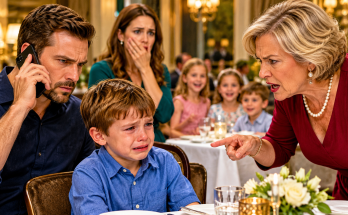
I need to tell you about the worst Saturday of my daughter’s life and how it turned into the best thing that ever happened to my family.
But I’m getting ahead of myself.
My name’s Blake. I’m 44. I’m a mechanical engineer for a defense contractor in Maryland, and I have one kid, Norah.
She just turned 18, graduated high school with a 3.87 GPA, and got accepted to Virginia Tech’s engineering program with a partial merit scholarship.
First person in our family to go to a four-year university. Not just my household, the entire Whitfield family, going back as far as anyone can trace.
I need you to understand what that means to me.
My dad, Frank, was a landscaper. Good man, hands like leather, never complained about anything in his life.
He died five years ago, and I don’t think he ever sat in an office chair.
My mom, Donna, still lives in the condo I helped her move into after he passed.
My younger sister, Trish, married a sales guy named Doug, and they’ve got an 11-year-old son, Connor, who attends a private school called Ridgemont Academy.
Who pays for that private school?
Funny you should ask.
I do.
$14,800 a year, paid directly to the school from my checking account.
I also book and pay for our annual family ski trip to Snowshoe Mountain every January.
This year’s bill came to $14,200 for five days, two cabins, lift passes, the whole thing.
And I cover about $600 a month in supplemental costs for my mom’s condo. HOA fees, a plumbing emergency here, a new dishwasher there.
I’m not complaining about any of that.
Or I wasn’t.
My dad would have wanted me to take care of the family, and I had the means to do it.
I put myself through college on scholarships and a part-time welding gig my uncle Ray taught me.
Bought my house at a foreclosure auction and renovated it room by room over three years.
I’m not rich. I’m just careful, and I’ve been working since I was 16.
So when Norah got that acceptance letter, I wanted to throw her a real party.
Nothing crazy.
Backyard cookout, maybe 30 people, a banner I ordered online that said “Future Hokie,” because Virginia Tech’s mascot is a Hokie, and Norah thought it was hilarious.
I set it up for the first Saturday in June.
Rented a couple of folding tables, borrowed a smoker from my buddy Marcus at work, made my dad’s brisket recipe.
Norah helped me string up lights in the backyard the night before, and she was grinning the entire time.
“Dad, do you think Grandma will actually come?” she asked me while we were hanging the last strand.
That question tells you everything about my mother.
Norah had to wonder whether her own grandmother would show up to celebrate the biggest accomplishment of her life.
I told her, “Yes, of course Grandma will come.”
And she did.
Donna arrived at 2:15, fifteen minutes after it started, wearing sunglasses she didn’t take off and carrying a store-bought veggie tray with the price sticker still on it.
She gave Norah a side hug and said, “Well, look at you, little Miss College Girl. Don’t let it go to your head.”
That was her congratulations.
Trish and Doug showed up around 2:30 with Connor in tow.
Connor walked in already bored, face buried in his tablet, and Trish immediately started scanning the backyard like she was appraising real estate.
She looked at the banner, looked at the tables, looked at the smoker, and then turned to Doug and said something I didn’t catch.
Doug just shrugged.
For the first hour, things were fine.
Marcus and his wife were there, a few of Norah’s friends from school, some neighbors.
Uncle Ray drove down from Deep Creek Lake.
Chapter 2: The Act of Sabotage
Ray is 71, and he’s the kind of guy who shows up with a card that has cash in it and says, “Don’t spend it on anything boring.”
Norah loves him.
The presents were sitting on a folding table near the pool.
Cards, a few wrapped boxes, a gift bag from her friend Mia.
Nothing extravagant.
Norah wasn’t expecting a pile of loot. She was just happy people came.
At about 3:30, I was pulling the brisket off the smoker, and Marcus was helping me slice it when I heard a splash.
Not a person-falling-in splash. More like something being thrown.
I looked up and saw Connor standing at the edge of the pool, laughing.
He had Norah’s acceptance letter in his hand.
Or he’d had it, because it was now floating face down in the water.
The Virginia Tech letter was bleeding purple ink into my pool.
He’d pulled it right out of the frame Norah had put it in.
The frame was on the ground in two pieces.
“Connor, what the heck?” Norah said.
She wasn’t yelling. She sounded confused. Hurt.
Connor didn’t even look at her.
He grabbed one of the wrapped presents off the table, tore it open, and pulled out a planner.
“This is boring,” he said, and tossed it over his shoulder.
Then he opened another one, a set of nice pens from Marcus’s wife.
He uncapped one, drew a line on the tablecloth, and dropped it.
Thirty people were watching.
Nobody moved.
You know that thing where everyone’s waiting for someone else to intervene?
All thirty of them frozen, looking at each other.
I set down the brisket knife and started walking toward the pool.
But before I got there, Trish grabbed my arm.
“Blake, relax. He’s a kid. He’s just bored because there’s nothing here for children.”
I looked at her.
“He just threw Norah’s acceptance letter in the pool.”
Trish waved her hand.
“She can print another one. It’s not a big deal.”
I pulled my arm free and walked over to Connor.
I knelt down so I was at his eye level and said very calmly, “Connor, those aren’t yours. You need to stop.”
Connor looked past me at Trish.
Trish gave him a little nod, and he reached for another present.
That’s when my mother laughed.
Not a nervous laugh. Not an uncomfortable titter.
A real laugh from her gut, like she’d just watched the funniest thing she’d ever seen.
She was sitting in one of my patio chairs with her sunglasses still on and a glass of sweet tea in her hand.
And she laughed.
Then she said it.
She said it loud enough for the people nearest to her to hear.
And Uncle Ray told me later he caught every word.
“I told him he could ruin her big moment. She thinks she’s too good for us.”
Trish raised her glass and smiled.
I stood there at the edge of my own pool, in my own backyard, at a party I threw with my own money for my own daughter, and I watched my mother toast to my kid’s humiliation.
I didn’t yell.
I didn’t flip a table.
I walked over to Norah, who was standing near the fence with her arms crossed, staring at the acceptance letter sinking to the bottom of the pool.
Her eyes were wet, but she wasn’t crying.
She was doing that thing where you clench your jaw so hard your neck hurts because you will not give them the satisfaction.
“Hey,” I said. “Let’s get you some brisket.”
She shook her head.
“I want to go inside.”
“Okay.”
She went inside.
I went back to the smoker and finished serving food because thirty people were standing in my backyard, and someone had to feed them.
Marcus stood next to me the entire time and didn’t say a word.
He didn’t have to.
But here’s the thing that stuck with me.
The thing I couldn’t let go of even after everyone left, and I fished the ruined letter out of the pool filter and sat on the porch by myself until midnight.
When Connor was throwing those presents, when he tossed that letter into the water, Trish had her phone out.
I assumed she was texting or scrolling the way she always does.
She wasn’t.
She was recording, and she was smiling.
Why would she record that?
What exactly was the plan with that footage?
I didn’t know yet.
But I was going to find out.
Chapter 3: Gathering Evidence
The next morning, I woke up at 5:30 the way I always do, made coffee, and sat at my kitchen table with the ruined acceptance letter drying on a paper towel next to my mug.
The ink had bled so badly you could barely read it.
The Virginia Tech seal looked like a purple bruise.
Norah came downstairs around eight. She poured herself cereal, sat across from me, and looked at the letter.
“I already emailed admissions to ask for a replacement,” she said quietly.
“Good thinking.”
She ate three bites of cereal and then set her spoon down.
“Dad, why does Grandma hate me?”
I’m not going to tell you what that question did to my chest because I think you already know.
I told her the truth, or as much of it as I could without dumping adult problems on an 18-year-old.
“She doesn’t hate you, Nor. She’s angry at me, and you’re easier to aim at. That’s not an excuse. It’s just the mechanics of it.”
“Because you went to college and she didn’t?”
“Something like that.”
Norah nodded.
She finished her cereal, rinsed the bowl, and went back upstairs.
I heard her bedroom door close.
Not a slam, just a click.
Somehow, the click was worse.
I sat there for another twenty minutes.
Then I opened my phone.
I don’t use Instagram. Never have, but I know Trish’s handle because she tags family photos constantly.
I created a throwaway account the previous year when Trish posted pictures from Norah’s seventeenth birthday without asking, and I wanted to see what she’d written.
So I logged in and navigated to Trish’s profile.
Her story had expired.
Instagram stories disappear after twenty-four hours.
But Trish isn’t careful about technology.
She’s careful about appearance, which is different.
She’d posted the video to her Close Friends story, thinking that made it private and permanent.
But she’d also cross-posted a screenshot to a private group chat she runs with a handful of friends and family.
How do I know this?
Because my cousin April, who is in that group chat, texted me at 6:00 that morning with a screenshot and said, “Blake, I am so sorry. You need to see this.”
The screenshot showed the video thumbnail of Connor throwing Norah’s acceptance letter into the pool.
Trish had captioned it:
“Norah’s big day. Connor keeping it real.”
With a crying-laughing emoji and a graduation cap emoji.
Thirty-seven people saw it.
Thirty-seven people watched my kid’s acceptance letter get destroyed by an 11-year-old, and the caption treated it like content.
I stared at it for a long time.
Then I did something I shouldn’t have done, but I’m not going to pretend I regret it.
I scrolled through the group chat screenshots April sent me, and I found the planning thread.
Three days before the party, Trish had texted my mother in a separate conversation that April also had access to because Donna can’t figure out group chats and accidentally added April to the wrong thread six months ago.
Neither of them had noticed April was in there.
The messages were simple.
Trish had written:
“Connor’s going to be impossible at this thing. There’s nothing for kids to do. I’m just going to let him do whatever.”
Donna replied:
“Good. Let him. She needs to be taken down a peg. Walking around like she invented college.”
Trish: “Should I let him open the presents? He’s been asking.”
Donna: “Just make sure he does it before the cake. I want to see her face.”
I read that last line four times.
I want to see her face.
My 68-year-old mother wanted to watch her granddaughter’s face crumble at her own graduation party.
She planned it.
She coordinated it with my sister.
They used an 11-year-old as the delivery mechanism so they could keep their hands clean.
“He’s just a kid.”
“He’s bored.”
“There’s nothing here for children.”
Yeah, I’ll give you a second with that one.
I needed one, too.
I forwarded every screenshot to my personal email, then backed them up to a cloud folder.
Not because I was planning anything yet.
Because I’m an engineer.
I document things.
It’s reflex.
That afternoon, Donna called me.
I let it ring three times and then picked up.
“Blake, I hope you’re not still pouting about yesterday.”
“I’m not pouting, Mom.”
“Good, because Trish is upset. She said you gave Connor a look that scared him. And frankly, I think you owe her an apology.”
I held the phone away from my face for a second and looked at it.
Just looked at it.
Then I brought it back.
“I’ll think about it,” I said.
“Don’t think too long. Family is family, Blake. Your father never held grudges.”
“Dad also never let anyone throw his kid’s stuff in a pool.”
Silence.
“Then you’re being dramatic. Connor is eleven.”
“Right. Talk soon, Mom.”
I hung up.
I sat on the porch with my coffee going cold, and I pulled up the spreadsheet on my laptop.
I keep a spreadsheet.
I know.
I’m an engineer. I track things.
When Dad died and I started covering expenses for Mom and for Trish’s family, I logged every payment.
Not because I expected to be paid back.
Not because I was building a case.
Because that’s what I do.
I track things.
My coworker Marcus once watched me build a spreadsheet to calculate the optimal mowing pattern for my lawn.
And he said, “Blake, you need a hobby that isn’t math.”
Fair point.
The spreadsheet had three tabs.
Mom. Trish. Shared expenses.
I scrolled to the totals row at the bottom and looked at the number.
$94,217.
That’s what I’d spent on my family in three years.
$94,217.
Tuition for Connor, ski trips, condo fees, the dishwasher, the car repair when Doug’s transmission blew and they couldn’t afford the deductible, the loan for Trish’s kitchen renovation that everyone quietly agreed would never be repaid.
Ninety-four grand.
And my mother coordinated the humiliation of my daughter at her own graduation party because she thinks she’s too good for us.
I closed the laptop.
Chapter 4: Planning the Financial Cut
I went inside and took a shower.
I stood under the water for a long time, just letting it run.
Organizing my thoughts the way I organized projects at work.
Define the problem.
Identify the constraints.
Map the critical path.
The problem was clear.
I’d been funding people who actively wished my daughter harm.
The constraints were also clear.
I couldn’t undo what happened to Norah.
I couldn’t make my mother into a different person.
I couldn’t force Trish to feel shame she was incapable of feeling.
But I could stop being the engine that powered their entire lifestyle.
Quietly. Methodically. On my timeline.
I got out of the shower and got dressed.
I drove to the store, bought Norah’s favorite ice cream, the good stuff from the local dairy, and brought it home.
We sat on the couch and watched a stupid movie, and ate ice cream out of the carton with two spoons.
She fell asleep on my shoulder around 10:00.
I carried my laptop to the kitchen table and started making a list.
The ski trip reservation was on my credit card.
Cancellation policy: full refund if canceled more than sixty days before the trip.
The trip was in January.
I had months.
Connor’s tuition at Ridgemont was billed annually.
I’d already paid the current year.
Next year’s invoice would come in August.
I had about six weeks.
Mom’s condo fees autodrafted from my account on the fifteenth of every month.
Every single one of these financial threads ran through me.
My name. My accounts. My credit card.
None of it was contractually required.
No signed agreements. No court orders. No legal obligations.
Just a son trying to do what his dead father would have wanted.
But my father wouldn’t have wanted this.
My father would have put his fist through a wall before he let anyone hurt Norah.
I know that in my bones.
The question wasn’t whether to cut them off.
The question was how to do it so they understood exactly why.
I started typing, and I didn’t stop until 2:00 in the morning.
Over the next two weeks, I did absolutely nothing unusual.
That was the plan.
Act normal. Respond to texts. Show up to Sunday dinner at Mom’s condo like I always do.
You want to know the hardest part of the whole thing?
Sitting across from my mother at her dining table, eating her dry pot roast, listening to her complain about the neighbor’s dog while knowing she’d orchestrated the worst day of my daughter’s life, and not saying a word.
Norah didn’t come to those dinners anymore.
She said she had to work on her college prep.
I didn’t push it.
If my kid needed distance from her grandmother, she’d earned it.
The first thing I did was call my buddy Marcus on Monday morning.
“I need you to keep me honest on something,” I said.
We were in the parking lot before our shift, leaning against his truck.
“Is this about Saturday?”
“It’s about what comes after Saturday.”
I told him everything.
The texts, the planning, the video Trish posted.
Marcus is the most level-headed person I know.
His face didn’t change while I talked.
When I finished, he took a sip of his coffee and said, “So, what’s the move?”
“I’m pulling the money. All of it. Tuition, ski trip, Mom’s condo expenses.”
Marcus nodded slowly.
“You know they’re going to lose their minds.”
“I’m counting on it. But I’m not doing it as a punishment. I’m doing it because I’m done funding people who go out of their way to hurt my kid.”
“Those are the same thing, Blake.”
I thought about that.
Maybe.
But one of them I can live with.
Marcus looked at me for a long moment and then said, “All right, what do you need from me?”
“Witness. If this gets ugly and anyone tries to rewrite history, I need someone who knows the timeline.”
“You got it.”
That same week, I called Uncle Ray.
Ray picked up on the first ring because Ray always picks up on the first ring.
He’s 71, and he still answers his phone like it might be an emergency.
“I heard about the party,” he said before I could even start. “April called me. Blake, your mother has lost her damn mind.”
“Ray, I need advice.”
“You need a spine, but go ahead.”
I laughed.
First time I’d laughed since Saturday.
I told him my plan.
Cut the tuition.
Cancel the ski trip.
Stop covering Mom’s extras.
Do it cleanly on paper with no drama.
Ray was quiet for a while.
Then he said, “Your dad would have done the same thing. Probably would have done it louder and sooner, but the same thing.”
“You know, Frank covered half my mortgage for two years when the union went on strike back in the nineties. And when I offered to pay him back, he said, ‘Ray, I’m not keeping score. I’m keeping family.’”
“But here’s the thing, Blake. He meant family that acts like family. He didn’t mean family that uses a child as a weapon.”
“I know.”
“So do it, and don’t feel guilty about it. Guilt’s a tax they put on people who care. You’ve paid enough of it.”
I called the Snowshoe Resort the next day.
Cancellation was straightforward.
Full refund to my card within seven to ten business days.
The reservation had been for January fifteenth through the twentieth.
Two cabins, ten lift passes, full equipment rental.
I’d booked it back in March because Trish had asked me to lock in the good rates early.
Trish, who had never once offered to split the cost, not even the gas money for the drive.
The refund went through the following Tuesday.
$14,200 back on my Visa.
I moved it to my savings account and didn’t think about it again.
Next, Ridgemont Academy.
This one was more involved.
Connor’s tuition for the current school year was already paid.
The next academic year’s invoice was due August fifteenth.
I called the school’s billing office and explained that I would not be renewing the tuition agreement for the upcoming year.
The billing coordinator asked if there was a problem.
I said, “No, just a change in family financial arrangements.”
“We’ll need to notify Connor’s parents,” she said. “They’ll need to make alternative arrangements or apply for financial aid before the enrollment deadline.”
“That’s fine. I’d appreciate it if the notification came from the school, not from me.”
“Of course, Mr. Whitfield.”
Handled.
Clean. Professional.
Mom’s condo was the simplest.
I logged into my bank, canceled the autodraft for the HOA supplemental payments, and set a calendar reminder to check that it processed.
It would take effect after the next cycle, which meant Donna would notice in about three weeks when the payment didn’t post and the condo association sent her a courtesy notice.
All three cuts done in under a week.
Total future savings: roughly $32,000 a year.
Chapter 5: Confronting the Family
And here’s the part that surprised me.
I didn’t feel vindictive.
I didn’t feel powerful.
I felt tired, like I’d been carrying three suitcases through an airport for three years and finally set them down and realized how badly my shoulders ached.
I told Norah that evening.
Not the details. Not the strategy. Just the truth.
“I’ve been helping Grandma and Aunt Trish with some expenses. I’m going to stop doing that.”
She looked at me over her laptop.
She was working on her Virginia Tech orientation paperwork.
“Because of the party?”
“Because of a lot of things. The party made it clear.”
She closed her laptop halfway.
“Are they going to be okay?”
That’s my kid.
Her grandmother humiliated her in front of thirty people, and her first question is whether they’ll be okay.
“They’ll be fine, Nor. They’ll just have to live on what they actually earn. Most people do.”
She nodded.
“Good.”
And she went back to her paperwork.
Now I waited.
And the waiting was the strangest part because for two weeks, nothing happened.
Life went on.
I went to work.
Norah started her summer job at a tutoring center.
I mowed my lawn in my mathematically optimized pattern that Marcus makes fun of me for.
I went to Sunday dinner at Mom’s, ate the pot roast, nodded at the stories, and drove home.
Trish and Donna were in peak form during this window.
They were actually planning to ask me for more money.
Mom called me on a Wednesday evening, her voice doing that careful, buttery thing it does when she’s about to make a request.
“Blake, sweetie, I wanted to talk to you about Connor.”
“What about him?”
“Trish found this wonderful summer enrichment program. It’s STEM-focused, very prestigious. They think Connor could really thrive.”
“How much?”
“It’s only $3,400. And I know you want what’s best for your nephew.”
I let the silence hang for three full seconds.
An old trick from negotiations at work.
People can’t stand silence. They fill it.
Donna filled it.
“You owe this family, Blake. Your father built everything so you could have opportunities. The least you can do is make sure Connor gets the same chances. Honestly, your father would be ashamed of how selfish you’ve become.”
There it was.
The Frank card.
She played it at least once a month.
My dead father’s name deployed like a guilt-seeking missile whenever she needed money.
The man who mowed lawns for a living so his kids could eat, reduced to a rhetorical weapon.
I took a breath.
“I’ll think about it, Mom.”
“Don’t think too long. The deadline is next Friday.”
I hung up.
I walked to my kitchen table, opened my laptop, and pulled up the spreadsheet.
Three tabs.
Mom. Trish. Shared.
The totals row glowed at the bottom of the screen.
$94,217.
That’s what being a good son cost.
That’s what keeping the peace ran.
Nearly $100,000 over three years.
And my mother’s version of gratitude was telling an 11-year-old to ruin his cousin’s graduation party so she could watch the look on the girl’s face.
I closed the laptop and went to bed.
They had no idea what was coming.
As far as Trish and Donna knew, the money spigot was still running, and I was still the reliable, guilt-compliant oldest son who’d never push back because Dad wouldn’t have wanted a conflict.
They were half right about Dad.
He hated conflict, but he loved Norah more.
And so do I.
The ski trip was the first domino, but it didn’t fall the way I expected.
I’d figured Trish would find out when she tried to check the reservation online or when she called Snowshoe to ask about adding spa packages the way she did every year.
Instead, she found out because she’d already been telling people about it.
My cousin April texted me on a Tuesday afternoon.
“Trish just posted about the Snowshoe trip in the family group chat. She’s telling everyone to start shopping for ski gear. Thought you should know.”
I checked the group chat.
I’m in it, but I never post.
Sure enough, Trish had written:
“Ski trip is January 15th to 20th. Start thinking about what you want to do this year. Blake’s got us the two big cabins again. It’s going to be amazing.”
Followed by a ski emoji and a snowflake emoji and one of those celebration emojis with the confetti.
I didn’t respond.
I waited.
Three days later, Trish called me.
I could hear it in her voice before she said a single word.
That particular frequency where confusion and anger haven’t fully separated yet.
“Blake, I just called Snowshoe to ask about the hot tub cabin, and they said our reservation was canceled. They said you canceled it three weeks ago.”
“That’s right.”
Silence.
“What do you mean, that’s right?”
“The trip is in January. I canceled it.”
“Why? Is there a problem with dates? Are we doing a different resort?”
“No. I canceled the trip.”
More silence.
Longer this time.
I heard Doug in the background asking what was wrong.
Trish covered the phone for a second, then came back.
“Blake, that trip is for the whole family. Connor has been talking about it since March. You can’t just cancel it without telling anyone.”
“I can. It was my reservation, my credit card, my money. I canceled it. There is no trip.”
“Is this about the graduation party? Are you seriously still upset about that?”
I sat down at my kitchen table.
I had the screenshots printed.
I’d printed them the day after I found them.
Two pages, color, on my home printer.
I’d been carrying them in a folder next to my laptop for three weeks, waiting for exactly this moment.
“Trish, I’m going to read you something. On June fourth, three days before the party, you texted Mom: ‘Connor’s going to be impossible at this thing. There’s nothing for kids to do. I’m just going to let him do whatever.’”
Dead silence on the phone.
“Mom replied, ‘Good. Let him. She needs to be taken down a peg. Walking around like she invented college.’”
I heard Trish’s breathing change.
Shorter. Faster.
“Then you wrote, ‘Should I let him open the presents? He’s been asking.’ And Mom wrote back, ‘Just make sure he does it before the cake. I want to see her face.’”
Nothing.
Absolute nothing on the other end.
I could hear a clock ticking somewhere in Trish’s house.
I could hear Connor’s voice in another room, playing a video game.
Then Trish said very quietly, in a voice I’d never heard from her before:
“Mom said you’d never find out.”
And there it was.
Not “Those texts aren’t real.”
Not “You’re taking it out of context.”
Not “I can explain.”
Just confirmation.
Mom said you’d never find out.
Like the only problem with planning the sabotage of a teenage girl’s graduation party was operational security.
“Well,” I said, “she was wrong.”
“Blake, listen to me. Connor just gets worked up. He didn’t mean to throw the letter in the pool. That part wasn’t planned. He just got carried away, and we figured it wasn’t worth making a scene about.”
“You filmed it, Trish. You posted it to your Instagram story. Thirty-seven people saw you caption my daughter’s humiliation with a laughing emoji.”
“That was just for fun. I didn’t mean anything by it.”
“You captioned it, ‘Connor keeping it real.’ You thought it was funny.”
“Blake, you’re blowing this out of proportion.”
I looked at the printed texts on the table.
I want to see her face.
“No, I think I’ve got the proportions about right.”
“So what? You cancel one ski trip and you feel like a big man? You think that fixes anything?”
“The ski trip isn’t the only thing, Trish.”
Pause.
“What does that mean?”
“You’ll find out.”
“Blake, don’t you dare threaten me. Mom is going to hear about this.”
“I’m sure she will.”
Trish hung up.
Chapter 6: The Fallout and Consequences
I set the phone down, poured myself a glass of water, and drank the whole thing standing at the kitchen sink, looking out the window at my backyard.
At the pool where that acceptance letter sank to the bottom.
At the spot where my mother sat and laughed and toasted with sweet tea.
My phone rang again within forty minutes.
Donna.
I let it go to voicemail.
She left a message.
I listened to it once.
“Blake David Whitfield, your sister is hysterical. I don’t know what you said to her, but you need to call her right now and fix this. That ski trip is for the whole family, and you don’t get to just cancel it because your feelings are hurt. Your father would never have done this. Call me back.”
I didn’t call her back.
The next morning, my phone started going off at 7:00.
Donna, then Trish, then Donna again, then Doug, which was unusual because Doug almost never calls me directly.
I let them all go to voicemail.
I was making Norah’s lunch for her tutoring job.
Turkey sandwich, apple, granola bar.
Same thing every day because she’s a creature of habit, just like me.
“Who keeps calling?” she asked from the doorway.
“Grandma and Aunt Trish.”
“About the money stuff?”
“About some of it.”
Norah leaned against the doorframe.
“Are you okay?”
“I’m fine, Nor.”
She studied my face for a second, the way she does when she’s deciding whether to push.
She decided not to.
“Okay. Love you, Dad.”
“Love you, too. Have a good shift.”
She grabbed her lunch and left.
I listened to her car pull out of the driveway, and then I sat down and listened to the voicemails.
Doug’s was the interesting one.
He sounded different from Trish and Donna.
He sounded embarrassed.
“Hey Blake, it’s Doug. Listen, I know things are heated right now. Trish told me about the texts. I didn’t… uh, I didn’t know about the planning thing. I swear I didn’t. Can you call me when you get a chance? Not about the ski trip. Just… I want to talk man-to-man.”
I saved that voicemail because that was the first honest thing anyone in that family had said to me since June seventh.
But I didn’t call him back.
Not yet.
Because the ski trip was just the first piece, and the second piece was about to land.
That afternoon, Trish’s phone rang.
It wasn’t me calling.
It was Ridgemont Academy.
The billing coordinator, the same polite woman I’d spoken to three weeks earlier, called Trish to inform her that the third-party tuition arrangement for Connor Callaway would not be renewed for the upcoming academic year.
They needed to discuss alternative payment options or financial aid applications before the enrollment deadline.
The enrollment deadline was August fifteenth, seventeen days away.
Annual tuition: $14,800.
And Trish and Doug, who lease a BMW, carry two maxed credit cards, and just last Thanksgiving asked me to help out with their property taxes, were about to discover what Ridgemont costs when someone else isn’t paying for it.
I know exactly when Trish got that call because, at 4:27 that afternoon, my phone lit up with nine consecutive text messages.
I read the first one.
“YOU ARE PULLING CONNOR OUT OF HIS SCHOOL? ARE YOU INSANE? THIS IS MY SON’S LIFE, BLAKE. HIS LIFE.”
I set the phone face down on the counter, and I waited for the morning.
At 7:45 the next morning, Trish’s phone rang again.
It was Ridgemont Academy, but this time it wasn’t Billing.
It was the headmaster, Dr. Alderman.
I know what Dr. Alderman said because Doug called me that evening and told me everything.
His voice sounded like a man whose floor had just dropped out.
“Blake, did you know about the science fair thing?”
“What science fair thing?”
And that’s how I learned what Trish had been doing with my name.
Three months before the graduation party, Connor had vandalized another student’s science fair project at Ridgemont.
A seventh grader named Hannah Chun had built a working model of a water filtration system for the county science fair.
Connor poured his Gatorade into it during setup, ruined the filters, and told Hannah it was an accident.
Security camera footage showed him laughing while he did it.
The school called Trish.
Standard discipline referral. Possible suspension.
And Trish, instead of dealing with it like a parent, called Hannah’s family directly.
She told them that her son’s uncle, Blake Whitfield, was a senior defense contractor engineer with connections at the school and in the community.
She implied that if they pushed for formal discipline, things might get complicated for Hannah’s family.
She used the phrase:
“According to Doug, my brother funds half the programs at this school. You really want to make an enemy of him?”
She didn’t fund anything.
I did.
And I had no idea any of this was happening.
Hannah’s parents backed off.
The school agreed to handle it internally with a warning.
Dr. Alderman had been willing to let it stay quiet because the tuition relationship was valuable, and nobody wanted to escalate.
But now that I’d pulled the tuition, Dr. Alderman had no reason to extend any courtesies.
The call that morning was to inform Trish that Connor was being placed on formal behavioral probation.
The science fair incident, which had been shelved, was being reopened, and Hannah’s parents were being notified that the family connection Trish had invoked no longer existed.
Doug told me all of this sitting on my back porch that evening.
He’d driven over without telling Trish.
He looked like he’d aged five years in a week.
He was holding a beer I’d given him, but he wasn’t drinking it.
“I didn’t know, Blake. About the texts, about the graduation party planning, about any of it. And I definitely didn’t know she was using your name to intimidate a 12-year-old’s family.”
“I believe you.”
“She told me the science fair thing was handled. She told me Connor bumped into the project by accident and the other family was being dramatic.”
He stared at the beer.
“I should have asked more questions.”
“Yeah, you should have.”
Doug flinched, but he didn’t argue.
That was the thing about Doug.
He wasn’t a bad guy.
He was a passive guy.
And sometimes that’s worse because passive means you let the bad thing happen by standing in the doorway with your hands in your pockets.
“What are you going to do?” he asked.
“I’ve already done it. The money’s gone. All of it. Tuition, ski trip, Mom’s condo fees. I’m not paying for anything anymore.”
Doug nodded slowly.
“Trish wants to come over here and scream at you.”
“She can try. I won’t open the door.”
“And your mom?”
“My mom coordinated the sabotage of her granddaughter’s graduation party because she resents a teenager for getting into college. I don’t have anything to say to my mom right now.”
Doug set the beer on the porch railing.
“Trish is going to tell everyone you’re the villain. You know that, right? She’s going to call every cousin, every aunt, every family friend, and tell them you’re punishing an 11-year-old because of a misunderstanding.”
“I know. And I’ve got screenshots. Anyone who wants the real story can have it.”
Doug sat there for a long time.
The sun was going down behind my neighbor’s oak tree, and the light was turning that golden shade that makes everything look like a photograph.
Finally, he stood up.
“I’m going to look into public schools for Connor,” he said. “There’s a good one in our district. Trish is going to fight me on it, but it’s the right thing.”
“It probably is.”
“Blake, I’m sorry.”
“For what it’s worth, it’s worth something, Doug.”
He left.
I sat on the porch until the fireflies came out, which is something I’ve done since I was a kid and never gotten tired of.
Chapter 7: Moving On
The fallout played out over the next few weeks exactly the way Doug predicted.
Trish called every relative in the extended family with her version of events.
Uncle Ray called me laughing about it.
“Your sister told me you’re having a mental breakdown because you’re jealous of Connor’s academic potential,” he said.
“I told her Connor’s academic potential involves throwing Gatorade at other kids’ science projects, and she hung up on me.”
Cousin April shared the original screenshots with anyone who asked.
The text thread between Trish and Donna.
The Instagram story caption.
The planning.
The “I want to see her face.”
One by one, the family quietly picked sides.
Most of them picked mine, not because I lobbied for it, but because the texts spoke for themselves.
Donna called me one last time about a month after everything blew up.
I almost didn’t answer, but something made me pick up.
“Blake, this has gone far enough.”
“I agree.”
“Then come to dinner on Sunday, and we’ll talk it out.”
“Mom, I’m not coming to dinner. I need you to understand why.”
“Because you’re punishing me for a joke. Connor is a child, Blake. Children act out.”
“Children act out when adults tell them to. You told Trish to let him ruin the party. You wanted to watch Norah’s face when it happened. Those are your words, Mom. Not my interpretation. Your words.”
Silence.
Then she said something that, honestly, I’ve been waiting my whole life to hear her say.
“She got into a better school than you did, Blake. Virginia Tech gave her a scholarship. Nobody gave you anything. You had to work for everything. And instead of being angry about that, you threw her a party. I don’t understand you.”
And there it was.
The real thing.
Underneath the guilt trips and the martyrdom and the pot roast and the sighing, the actual engine.
She resented me for not being resentful.
She couldn’t comprehend a father being proud of his daughter for surpassing him.
In her world, someone else’s success was your failure.
And if your own granddaughter succeeded, you had to cut her down to size before she made you feel small.
“Mom,” I said, “I threw her a party because I’m proud of her. That’s it. That’s the whole thing. And I’m sorry you can’t understand that, but I’m not going to apologize for it.”
She hung up without saying goodbye.
That was four months ago.
Norah moved into her dorm at Virginia Tech in August.
I helped her carry boxes up three flights of stairs and assemble an IKEA desk that came with instructions clearly written by someone who hates humanity.
She pinned her replacement acceptance letter to the corkboard above her desk.
The new one didn’t have a pool water stain.
Connor enrolled in public school.
Doug pushed for it and won.
By all accounts, Connor’s actually doing fine.
Better, even.
Turns out he needed boundaries more than he needed a $14,800-a-year building.
Doug and I text sometimes.
Short messages.
He sends me pictures of Connor’s math tests with decent grades circled.
I send back a thumbs up.
It’s not much, but it’s honest.
Trish hasn’t spoken to me since August.
I’m told she’s devastated and can’t believe her own brother would abandon family.
She’s also had to take a part-time job at a home goods store to help cover the bills that I used to cover.
I don’t enjoy that, but I don’t feel guilty about it either.
Mom pays her own condo fees now.
She’s managing.
She was always capable of managing.
She just didn’t have to as long as I was writing checks.
Uncle Ray came to visit Norah at school last month.
He drove three hours to bring her a care package full of beef jerky and those oatmeal cookies she likes, and a card that said:
“Make us proud, kid. You already have.”
She called me that night to tell me about it.
She was laughing.
She sounded like herself again.
Not the version of herself that existed at that graduation party, standing by the fence with her jaw clenched, watching her acceptance letter sink.
The real version.
The one who’s going to be an engineer, just like her old man, but probably better.
I’m sitting on my porch right now.
The fireflies are out.
The pool is clean.
The backyard is quiet.
I spent $94,000 trying to hold a family together that was never going to hold together.
And all it took was one graduation party to make me see it.
My mother wanted to see my daughter’s face fall.
She wanted to watch an 18-year-old girl learn that her own family thought she was getting too big for her britches.
Instead, she watched that girl pick herself up, go to college, and leave them all behind.
And I’ve never been prouder.