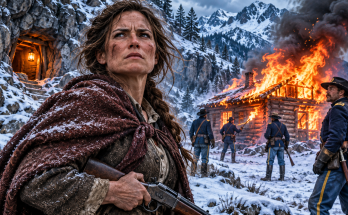
The company that once offered me fifty dollars eventually offered me five thousand.
I remember looking at the amount and thinking about the first notice.
Thirty days.
Fifty dollars.
A signature releasing every further claim.
That had been Sterling Consolidated's original idea of fairness.
Now the company faced a federal inquiry.
Its claim boundaries had been questioned.
The destruction of my cabin had been documented.
And Dr. Coulter's report had established what lay beneath the granite on Argentum Ridge.
Sterling wanted the matter settled.
This time, it did not send Mr. Finch.
It sent a lawyer from Denver.
I could understand why.
Finch had been dismissed.
The company had become concerned about the consequences of what its agent and the soldiers had done.
And the question was no longer whether one widow could be persuaded to leave quietly.
The question was how much damage the company had caused by acting as though its authority could not be challenged.
The lawyer came with terms.
I listened.
I had learned a great deal since the first time a company representative stood before me with official papers.
I no longer believed calm words were necessarily fair words.
I no longer assumed a document became truthful merely because it carried a stamp.
And I no longer thought my lack of money meant my work had no value.
I let the lawyer explain the proposal.
Sterling Consolidated would recognize my ownership of the original forty-acre parcel.
The title would be placed in my name.
It would be clear and undisputed.
I would no longer occupy the land merely because the company allowed it.
The land would legally belong to me.
I did not answer immediately.
For years, Elias and I had lived there.
We had built the cabin.
We had worked the ground.
We had buried our hopes in that place as surely as I later buried him on the south-facing slope.
Yet the company had always retained the power to tell us whether we could remain.
Now it was offering to surrender that power over the parcel.
I thought about how much suffering might have been avoided if Sterling had recognized my position months earlier.
The cabin would still be standing.
I would not have spent twenty-eight days moving stone in freezing weather.
I would not have emptied most of our savings.
I would not have watched soldiers burn the place Elias built.
But none of that could be changed.
I had to consider what was being offered now.
The lawyer continued.
The company would pay five thousand dollars.
The payment would cover the damages connected with the destruction of the cabin.
It would also include compensation for my work developing the hidden shelter.
Sterling described part of the money as a fee for the practical knowledge I had demonstrated.
I found that almost difficult to believe.
In November, the company considered me an inconvenience.
By February, its own workers were using ideas I had shared.
And now Sterling wanted to pay for those ideas.
The lawyer explained that the company hoped I would advise its engineers.
It wanted more efficient housing for miners.
Buildings that could remain warmer during severe winter weather.
Structures that would require less firewood.
The company had suffered from the consequences of poorly protected housing.
Winter deaths were a serious problem in its operations.
My shelter had shown that careful design could make a difference.
I listened without interrupting.
I thought about Tom Miller.
His wife.
His three children.
The youngest child who had recovered after the family improved the warmth of their cabin.
I remembered Tom standing beside my stove, holding a cup of coffee in both hands.
He had looked at the thermometer.
Then at the granite wall.
He could barely believe the room was warm while the world outside stood twenty degrees below zero.
I had explained what Elias taught me.
Tom had taken that knowledge home.
He had used it.
And his family had benefited.
Now the company wanted the same knowledge for its own buildings.
I could see the usefulness of that.
I also understood the irony.
Sterling had nearly left me without shelter.
Then it discovered that the shelter I built could help protect the people it employed.
The lawyer continued explaining the settlement.
I paid attention to every condition.
I had not forgotten the first offer.
Fifty dollars in exchange for releasing further claims.
That amount had been intended to make me accept the company's decision without argument.
Now the proposed settlement was different.
It acknowledged the disputed land.
It provided compensation for the destruction.
And it recognized the practical value of my work.
I did not mistake it for generosity.
The company was facing serious legal and public consequences.
Settling with me was in its interest.
I knew that.
The lawyer knew it.
And I suspected everyone in Denver involved in the decision knew it too.
Still, the terms mattered.
I considered what five thousand dollars could mean.
It was more money than Elias and I had ever kept in our lockbox.
I had once counted one hundred and twelve dollars and wondered whether I could survive long enough to find work in Denver.
I had considered selling Jericho and the wagon for perhaps sixty dollars.
I had calculated a stagecoach fare of twenty-eight dollars.
I had imagined arriving in a city where I knew nobody with barely enough money to secure a room.
Now I was being offered enough to rebuild.
Enough to purchase materials.
Enough to make certain I would not face the next winter with only a few dollars in reserve.
But money was not the only important part.
The deed mattered more.
Without secure ownership, I could build another cabin and still face another notice.
I could improve the land and still be told my occupancy had ended.
I could bury years of labor in another home and watch someone else claim the right to destroy it.
I would not accept that uncertainty again.
The title had to be recorded properly.
The parcel had to belong to me.
I made certain I understood those terms.
Then I accepted the settlement.
I did not make a speech.
I did not thank Sterling for correcting a wrong it should never have committed.
I did not tell the lawyer how much I had suffered.
He had come to resolve a legal matter.
I intended to make certain the resolution was complete.
The deed was recorded in my name.
Forty acres.
The land surrounding the old cabin.
The place where Elias was buried.
The property Sterling had once claimed it could reclaim because my husband was dead.
It was mine.
Not because I had been granted temporary permission.
Not because I had signed an employment agreement.
But because the ownership had been established and recorded.
I looked at the document for a long time.
It was paper.
Just as the eviction notice had been paper.
But the meaning was entirely different.
The first document had told me to leave.
The second confirmed my right to remain.
I had learned that paper could be used to take power from a person.
It could also preserve the truth when the facts were properly established.
That was what Elias had believed about records.
I understood it now.
The five thousand dollars was transferred to an account at the bank in Silver Plume.
Mr. Abernathy helped me arrange it.
I remembered standing in his store in November with a list of tools and food.
I had spent sixty-seven dollars and forty cents of our savings.
He had watched me purchase enough flour, beans, salt pork, and equipment to endure a winter.
He had not asked me to explain.
Instead, he had given me the ammunition and blasting powder Elias supposedly had credit for.
Without those supplies, completing the shelter would have been much harder.
I had never forgotten that.
Now he was helping me handle a sum of money I had once been unable to imagine possessing.
I felt awkward.
I was accustomed to counting coins carefully.
I was accustomed to deciding whether one purchase meant sacrificing another.
Five thousand dollars seemed too large to belong to the same life.
Mr. Abernathy treated the matter calmly.
He helped me make the arrangements.
And I was grateful.
I did not need a celebration.
I needed the money kept safely.
The legal matter had been resolved.
But I still had work to do.
Spring approached slowly.
The snow did not disappear at once.
The mountain released winter in stages.
First the strongest winds became less frequent.
Then the sunlight began reaching places that had remained frozen for months.
The surface of the snow softened during warmer hours.
Water began moving through the creek again.
I watched the changes from the hidden entrance.
I had survived the entire winter beneath the granite.
The shelter had done what Elias believed it could do.
I could no longer doubt that.
But I did not intend to spend the rest of my life hidden underground.
I had built the chamber because I needed refuge.
Now I possessed the land.
I could build openly.
I could have windows that admitted full daylight.
I could step outside without wondering whether someone from Sterling would order me away.
When the snow melted enough to make the old cabin site accessible, I went there.
I had avoided looking too closely at the remains after the soldiers left.
The memory of the fire was still painful.
But I knew rebuilding could not begin until I faced what remained.
The clearing looked different.
The cabin walls were gone.
Charred wood lay where the rooms had once stood.
The foundation remained.
The stone fireplace was still recognizable.
I stood beside it for a long time.
I remembered Elias carrying those stones from the creek.
I remembered him checking their fit.
I remembered our first fire.
The smoke rising through the chimney.
The smell of fresh wood.
The sound of his boots crossing the floor.
I could almost picture the kitchen table standing nearby.
One leg uneven.
A folded piece of leather beneath it.
I closed my eyes.
The house was gone.
There was no use pretending otherwise.
The settlement could pay for lumber.
It could pay workers.
It could purchase windows, doors, and roofing materials.
But it could not restore those ordinary objects exactly as they had been.
I had to accept that.
I walked toward the south-facing slope.
Elias's grave remained where I had left it.
I stood beside him.
For months, I had wanted to tell him that I had survived.
I had spoken to him quietly during the winter.
I had told him about the hidden chamber.
I had thanked him for the drawing.
Now I had something else to say.
"The land is ours."
My voice sounded strange in the open air.
I looked toward the burned foundation.
"I couldn't save the cabin."
I waited.
There was no answer.
I had not expected one.
I had learned that grief did not end when an injustice was corrected.
Elias was still dead.
The company could not return him.
The lawyer could not put his handwriting back into the evenings we had lost.
Five thousand dollars could not replace the months I spent working alone in the cold.
And the deed could not erase the sight of our roof collapsing.
Those losses remained.
I stood there until the wind became uncomfortable.
Then I returned to the clearing.
I had a home to rebuild.
I hired men from Prospect to help with the work.
That was another change I noticed.
In November, I had believed I could not afford to hire anyone.
During construction of the hidden shelter, I had moved nearly every stone myself.
Now I could pay for labor.
And there were men in town willing to work for me.
I treated them fairly.
I knew what difficult construction work felt like.
I knew the ache of lifting stone.
The exhaustion of hauling lumber.
The frustration of fitting materials that refused to cooperate.
I had no desire to make anyone suffer unnecessarily.
The new cabin rose on the foundation of the old one.
We used seasoned lumber.
The walls were carefully fitted.
The roof was strong.
The windows faced out toward the land.
I wanted sunlight.
After months beneath the granite, I had come to appreciate daylight in a way I never had before.
The hidden shelter was warm.
It had saved me.
But it was still a chamber beneath stone.
The new house allowed me to live openly again.
I could look toward the creek.
I could see the changing weather.
I could watch the sun move across Argentum Ridge.
And I could see the south-facing slope where Elias rested.
The building took shape gradually.
I watched the workers raise the walls.
I examined the materials.
I asked questions when something seemed uncertain.
The men were capable.
They knew their work.
But I no longer felt embarrassed about understanding construction.
I had built a functioning shelter with my own hands.
I knew something about walls.
Doors.
Heat.
Drainage.
And the importance of choosing materials carefully.
I did not interfere without reason.
But I paid attention.
Elias would have approved of that.
When the new cabin was finished, it was a fine house.
Sturdy.
Well built.
Open to the light.
It stood where our old home had stood.
The foundation connected the two.
But I did not pretend the new house was identical.
It was not.
I had learned that replacing something did not erase the fact that it had been lost.
I could be grateful for the new home and still mourn the old one.
Those feelings could exist together.
I moved my belongings into the cabin.
The furniture I had preserved.
The tools.
The provisions that remained.
Elias's books.
His leather-covered journals.
The metal lockbox.
The Winchester rifle.
I carried the journals carefully.
They had helped me find the hidden chamber.
They had allowed Dr. Coulter to understand Elias's original survey work.
And they had contributed to the examination of Sterling's disputed claim boundaries.
I placed them where they would remain safe.
They were no longer merely reminders of my husband.
They were part of the record of what had happened.
I also kept the eviction notice.
I could have destroyed it.
The company had lost its effort to remove me.
The deed had been recorded.
The settlement had been paid.
But I wanted to remember the beginning.
Not because I intended to remain angry forever.
Because I had learned how quickly ordinary life could be threatened by people who believed their authority was unquestionable.
The folded notice reminded me of that.
It also reminded me that I had not signed the first release.
I had refused the fifty dollars.
I had continued thinking when the obvious choices led nowhere.
And I had found another way to survive.
The new cabin became my home.
I lived there in daylight.
I kept the stove warm during cold weather.
I watched the mountains.
I tended the ordinary needs of the property.
And I appreciated the quiet.
But I did not abandon the hidden chamber.
That was something I decided without hesitation.
The shelter remained beneath the granite shelf.
I kept the oak door in place.
I maintained the dry-stacked wall.
I cleaned and inspected the stove.
I checked the chimney.
I kept the chamber dry.
And I left a permanent reserve of firewood and provisions inside.
I did not need to live there every day.
That was not the point.
The chamber had become my protection against uncertainty.
I knew exactly what it could do.
I had measured its performance through the coldest days of winter.
I had survived a three-day blizzard while snow buried the entrance.
I had remained warm when the temperature outside fell to thirty degrees below zero.
And I had watched soldiers destroy the visible cabin without ever finding the home beneath the ridge.
I would not dismantle something that had saved my life.
Sometimes I visited the shelter simply to check it.
I opened the familiar oak door.
Stepped inside.
Looked at the granite walls.
The room smelled of dry stone and wood.
It was quiet.
The same quiet I remembered from the first day I crawled beneath the fallen slab.
But the meaning of that quiet had changed.
In November, I had entered the chamber because I was afraid I would have nowhere to live.
In December, I worked there because I had to finish before the eviction deadline.
During January, I learned how to manage the fire and conserve heat.
In February, I watched soldiers destroy the cabin above while my hidden home remained untouched.
Now I entered because I chose to.
I could leave whenever I wanted.
I had a house aboveground.
I had money in the bank.
I had a recorded deed.
I no longer needed Sterling's permission to remain on the property.
That freedom mattered more than the size of the new house.
I thought often about the people who had helped me reach that point.
Mr. Abernathy, who gave me supplies without demanding an explanation.
Tom Miller, who came searching for wood and carried useful knowledge home.
The families who trusted me enough to ask for advice.
Dr. Coulter, who examined the shelter and recorded what he found.
And Elias.
Always Elias.
He had noticed the hidden formation two years before I needed it.
He had drawn the granite shelf.
Measured the hollow space.
Recorded the orientation.
Described the drainage.
And understood that the surrounding rock might make a winter shelter possible.
He had never imagined what I would do with those observations.
Neither had I.
But when the company took away my ordinary choices, his knowledge gave me another one.
I used it.
I made mistakes.
I suffered.
I worked until my hands bled.
I spent nearly all our savings.
And I built a place where I could remain alive.
The company eventually paid for what it destroyed.
It recognized my ownership.
It acknowledged the value of the shelter's construction.
And it wanted its engineers to learn from the same principles that helped its miners survive the winter.
Those outcomes mattered.
They restored something that had been wrongly taken.
But they did not make the suffering worthwhile.
I would have preferred to keep the original cabin.
I would have preferred never to see soldiers on our land.
And more than anything, I would have preferred to have Elias beside me.
No settlement could change that.
I lived with the loss.
I also lived with what I had accomplished.
The two belonged to the same story.
Sometimes, when I stood inside the hidden chamber, I placed my palm against the granite wall.
It was cool when the stove had not been burning.
Solid.
Unmoving.
The stone had been there long before Elias discovered it.
It would remain long after I was gone.
I thought about how little the company understood when it sent Finch to my door.
It saw a widow.
A terminated employment agreement.
An inconvenient cabin.
A parcel of valuable land.
It did not see the knowledge Elias left.
It did not see the work I was capable of doing.
It did not see the hidden space beneath the ridge.
And when it sent soldiers to burn the cabin, it still did not understand.
The men destroyed what they could see.
They walked away believing the matter was finished.
But I remained beneath the mountain.
Alive.
Warm.
And beyond their knowledge.
I did not survive because someone arrived to rescue me.
I survived because I kept thinking after every easy answer had disappeared.
I used what Elias taught me.
I accepted help when it was offered.
I worked with the mountain instead of fighting it.
And when the company finally returned with money and papers, I was still there to receive what belonged to me.
The new cabin stood in the sunlight.
The hidden shelter remained ready beneath the granite.
I kept both.
One was the home I could finally live in without fear of eviction.
The other was the place that had made that future possible.
I never forgot the difference.
The End
Read more original stories on lastestdrama.