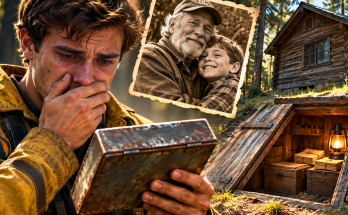
The morning after the great storm, I could not see the entrance.
Snow covered the passage.
The rockfall that once concealed my door had disappeared beneath a broad white drift.
I knew the position of the opening because I had built it.
Anyone else might have walked across the draw without noticing anything unusual.
I stood inside the chamber and looked at the snow pressing beyond the oak door.
Then I returned to the stove.
There was no reason to force my way outside while the weather remained uncertain.
I had food.
I had wood.
I had warmth.
Those were the three things I checked before making any unnecessary decision.
The shelter felt different after the blizzard.
Before the storm, I had treated it as a construction project that happened to contain my possessions.
Now I understood it as a home.
Not because it was comfortable in the ordinary sense.
The floor was still earth and gravel.
The wall was rough.
The ceiling was lower than I would have liked near the entrance.
And the small window admitted little light while snow surrounded it.
But the chamber had protected me when I needed protection.
That gave the place a meaning no furniture could provide.
I returned to Elias's journal.
I wrote down the storm's duration.
Three days and three nights.
I recorded the lowest outside temperature I had observed.
Thirty degrees below zero.
I noted that the chamber had stayed above forty-five degrees Fahrenheit.
Then I described the effect of the snow around the entrance.
The packed drift had reduced air movement.
It had covered gaps in the wall that might otherwise have allowed cold wind through.
It was not the kind of insulation people purchased from a store.
It was simply part of the environment.
Elias had understood that the landscape itself could be useful.
I was learning to make that understanding part of my daily routine.
A few days later, when the weather permitted, I began clearing enough snow to leave the chamber safely.
I worked carefully.
The snow was deep and heavy in places.
I did not attempt to uncover the entire front wall.
That would have wasted strength.
It would also have removed some of the protection the drift provided.
I opened only what I needed.
A narrow passage.
Enough room to move.
Enough room to reach the outside without crawling through deep snow every time.
When I emerged, I stopped and looked around.
The draw had changed completely.
Loose rocks were buried.
Low shrubs had disappeared.
The surrounding slopes were smooth where the wind had pressed snow into hollows.
The granite walls rose above the white ground.
The sky was clear again.
I took a long breath.
The air was so cold it hurt.
Then I went to check on Jericho.
He had endured the weather in the sheltered place I had arranged for him.
I examined him carefully.
I knew he was old.
I could not treat his survival as something guaranteed merely because he had managed previous winters.
I checked his food and water.
I made certain he could move without struggling through the deeper drifts.
Then I stood beside him for a while.
He lowered his head when I touched his neck.
"You've earned a quieter life than this," I told him.
I suppose I had said the same thing to myself.
Neither of us had received it.
I returned to the chamber before the cold became harder to manage.
Inside, I found myself noticing the difference immediately.
The air was warmer.
The stove had continued burning.
The granite held the temperature more steadily than the exposed wooden walls of our old cabin ever had.
I removed my gloves.
My fingers were cold, but they warmed without the painful delay I remembered from other winters.
I took the thermometer from its place near the door.
Almost fifty degrees.
Outside, the temperature remained far below freezing.
I looked at the reading for a long time.
Elias had written about the possibility.
I had built the shelter.
Now the numbers were confirming what my body already knew.
I could live there.
I did not know for how long.
I did not know what would happen if the company discovered me.
But winter itself no longer seemed certain to defeat me.
I began measuring my days by what needed doing rather than by how much I feared the next storm.
In the morning, I tended the fire.
Then I prepared food.
I inspected the shelter whenever the weather allowed.
I checked the chimney.
I examined the doorframe.
I looked for any signs of moisture along the floor.
The chamber remained dry.
That mattered because dampness could make a cold shelter miserable even when the stove was working.
The natural drainage Elias had noted was proving useful.
Water was not collecting inside.
I had no need to dig channels through the floor or repair walls weakened by seepage.
I kept the food on the driest ground.
I checked the sacks regularly.
The flour remained usable.
The beans stayed dry.
The salt pork was carefully rationed.
I had bought those provisions because I feared being trapped without access to town.
After the blizzard, I no longer considered that fear exaggerated.
There had been days when traveling twelve miles to Prospect would have been impossible.
A person could not simply decide to buy food when the snow blocked the mountain.
I kept count.
I knew approximately how many meals the supplies could provide.
I also understood that the food would be monotonous.
Beans.
Flour.
Salt pork.
A little lard.
Coffee when I chose to use it.
I did not complain.
Complaining would not put anything different on the table.
But sometimes I remembered meals Elias and I prepared during autumn.
Vegetables from our garden.
Bread baked while the weather remained mild.
The ordinary pleasure of eating beside someone who knew how much work had gone into the food.
I missed that.
I missed the small conversation during supper.
I missed hearing another person move through the room.
The chamber was warm enough.
It was not alive with company.
I had to learn the difference.
When the weather settled briefly, I examined the surrounding woods for signs of animals.
I had learned to set simple snares.
Food from the land could extend my purchased supplies.
During one such lull, I managed to catch two rabbits.
I carried them back to the shelter.
It was not a great quantity of meat.
But it mattered.
Every meal obtained without using the flour, beans, or salt pork meant those stores would last longer.
I cleaned and prepared the rabbits carefully.
Then I cooked them on the stove.
The smell filled the chamber.
For the first time in days, supper felt different.
I ate slowly.
I thought about how ordinary the meal would have seemed if Elias were alive.
He would have asked how I set the snares.
I would have told him.
He might have explained something about animal tracks or the movement of game after heavy snow.
Instead, I ate alone.
When I finished, I cleaned the pot.
Then I wrote another note in his journal.
Two rabbits.
Food stores supplemented.
I had begun recording such things with the same care he gave his geological observations.
At first, I felt foolish doing it.
A woman eating beans inside a rock chamber did not seem like a subject worthy of scientific records.
Then I remembered how Elias had treated ordinary facts.
He recorded things because facts could become useful later.
The depth of snow in one winter might explain the creek level the following spring.
The direction of wind might explain why ice formed in one place but not another.
A small detail could answer a question no one had asked yet.
So I wrote.
I recorded the amount of wood burned.
I recorded temperature changes.
I noted when the snow blocked the entrance and when the weather allowed me to clear it.
I described the way the granite seemed to hold warmth more effectively after the first weeks of steady heating.
My handwriting filled the empty margins beside his.
I could not bring him back.
But I could continue using what he had taught me.
Sometimes I sat with the journal open and remembered him speaking about stone.
He had never treated the mountains as something mysterious.
He respected their dangers.
But he believed those dangers could often be understood.
A slope failed for a reason.
A creek froze according to conditions that could be measured.
Wind followed patterns shaped by the terrain.
And heat moved according to principles that did not change because a person was frightened.
I had been frightened when Finch delivered the notice.
I had been frightened when I crawled into the hidden chamber.
I had been frightened while drilling through the ceiling.
And I had been frightened during the blizzard.
Those feelings were real.
But none of them changed the properties of granite.
None of them changed how insulation worked.
None of them changed the amount of heat produced by my stove.
That understanding helped me.
I did not have to feel brave every morning.
I only had to continue doing the things that kept the shelter functioning.
The middle of January arrived.
The weather remained bitterly cold.
The high country had settled into the kind of winter that could make a short journey dangerous.
I spent more time inside.
The stove consumed wood steadily.
The granite walls continued helping maintain a comfortable temperature.
I had become accustomed to waking without frost on my blankets.
I could sit beside the stove and read while storms moved beyond the rock.
There were still uncomfortable moments.
The coldest air collected near the entrance.
The small window did not provide as much daylight as I wanted.
I had to be careful with lamp oil.
And whenever I opened the door, I reminded myself that the world beyond it was far less forgiving than the chamber inside.
Still, I was managing.
One evening, I examined the remaining woodpile and calculated my consumption.
The rate remained close to what I had recorded during the first week of severe heating.
Approximately a quarter cord.
I had enough to continue, provided I gathered more whenever conditions allowed.
I could see that the shelter was reducing the demand for fuel.
That mattered to my strength as much as to my supply.
Every piece of wood I did not burn was one less piece I needed to cut and carry.
I had built a home that helped me conserve the resources required to maintain it.
I wished I could have shown the measurements to Elias.
He would have been interested in the numbers.
He would have wanted to compare them with the temperature outside.
He might have found a better way to seal the door or improve the stove's position.
I was certain he would have studied the results.
I closed the journal.
Then I held my hand against the granite wall.
It was no longer painfully cold.
The heat from the stove had spread into the surrounding mass.
The wall itself seemed to return some of that warmth to the room.
I remembered the first day I found the chamber.
I had stood in the darkness with a lantern, trying to imagine how it could become livable.
Now I could barely remember how frightened I had been of its emptiness.
The place had changed.
So had I.
I was still a widow.
Still alone.
Still living on land the company claimed.
I still owned only a small amount of money.
And the cabin Elias built still stood empty farther down the slope.
But there was one thing the company had misjudged.
They believed removing me from their records would remove me from the mountain.
I had not disappeared.
I had simply moved somewhere they did not know to look.
And while I was learning how to survive inside the rock, I had no idea how badly other families in Prospect were struggling with the same winter.