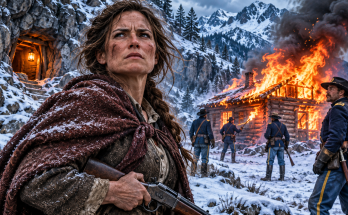
On February twelfth, I watched six soldiers approach the cabin Elias had built.
I was standing among the rocks above the old trail.
Dr. Coulter was beside me.
Below us, six men in blue uniforms were making their way through the snow.
Another man accompanied them.
I recognized him before I could clearly see his face.
Mr. Finch.
The young company agent who had delivered my eviction notice in November.
I felt my stomach tighten.
For three months, I had tried to keep that man's paper from becoming the end of my life.
Now he had returned with soldiers.
I did not know how much authority they possessed.
I did not know exactly what Sterling had told them.
But I knew they had not come to ask about my shelter.
They were heading straight toward the original cabin.
The place where Elias and I had lived for six years.
I gripped the edge of a granite boulder.
The stone was cold beneath my glove.
Coulter stood quietly beside me.
Neither of us spoke for a while.
The soldiers had come as far as they could on horseback before the snow became too deep.
They had left the horses and continued on snowshoes.
I could see the broad marks of their passage behind them.
Their movements were slow.
The trail was buried.
The wind had hardened the snow in places and left soft drifts in others.
Even trained men had to choose their footing carefully.
I had spent the winter learning how much effort it took to cross that ground.
Now I watched seven men make the journey because a mining company wanted one widow removed.
The thought left me cold.
Finch moved near the front of the group.
He looked different from the man who had stood at my door in November.
Then he had worn a thin wool coat and held a folded notice.
He had spoken politely.
He had seemed uncomfortable.
Now he was accompanied by men carrying weapons under military authority.
I wondered whether he felt more confident.
I wondered whether he remembered my face.
I wondered whether he had told the company that I would leave quietly.
Those questions did not matter much.
The men were already climbing toward the cabin.
Coulter watched their progress.
His expression was serious.
He had examined my hidden shelter only recently.
He had measured its walls, recorded its temperature, and studied Elias's journals.
He knew exactly where I lived.
The soldiers did not.
That difference was the only reason I could stand there watching them instead of meeting them at my door.
I had chosen the rocky vantage point because it overlooked the old cabin.
From there, I could see the trail and most of the clearing.
The boulders concealed us.
The soldiers would have needed to look carefully toward the higher ground to notice anyone standing there.
They were occupied with the cabin.
I recognized the young lieutenant leading them.
I did not know his name.
His face was set.
He moved with the alertness of someone carrying out an unpleasant assignment.
The other soldiers spread out as they approached the building.
They looked toward the windows.
Then toward the doorway.
I could almost hear Elias telling me to remain still.
He had always believed that making an unnecessary movement could reveal a position from a great distance.
I kept my hands against the rock.
I did not move.
The lieutenant reached the cabin first.
I watched him approach the front door.
That door was still in place.
It was not the oak door I had taken from our bedroom.
That one stood in the stone wall of my hidden home.
The exterior door remained where Elias had hung it years earlier.
The lieutenant forced it open.
He disappeared inside.
For a moment, I stopped breathing.
I knew what he would find.
The fireplace was cold.
The stove was gone.
Some furniture remained.
The kitchen table still stood on its uneven leg.
I had left enough belongings behind that the cabin appeared recently occupied.
But there was no person inside.
No fire.
No bed prepared for sleeping.
No sign that anyone had been living there through the winter.
The lieutenant came back out.
He spoke to the others.
The wind carried only fragments of the conversation.
But I understood the result.
The cabin was empty.
The soldiers had not found me.
I felt my shoulders loosen.
Only slightly.
I knew they might continue searching.
They could follow the creek.
They could examine the slopes.
They could find tracks near the draw.
And if they discovered the hidden entrance, I would have nowhere else to go.
Coulter turned toward me.
I kept my eyes on the soldiers.
The lieutenant spoke to Finch.
The company agent gestured toward the cabin.
I could see the frustration in his movements.
He had expected the matter to be settled.
Perhaps he had expected to find me still living there.
Perhaps he wanted the soldiers to drag me outside.
Instead, they had found an empty building.
The young lieutenant looked toward the doorway again.
One of his men moved around the side of the cabin.
Another examined the clearing.
I watched the familiar place surrounded by strangers.
I remembered standing on that same ground beside Elias.
We had stacked firewood near the wall.
We had repaired the roof after storms.
We had stood outside together on clear evenings and watched the sunlight leave Argentum Ridge.
Now soldiers moved through the yard as though it belonged to nobody who mattered.
I wanted to call down.
I wanted to tell them that the house was not abandoned.
That the man who built it was buried behind it.
That I had lived there until the company threatened to put me into the winter.
But I remained silent.
I had learned that speaking at the wrong moment could cost more than remaining quiet.
The soldiers had weapons.
They had orders.
And I had no reason to believe my words would change either.
Finch spoke again.
He pointed toward the cabin.
The lieutenant hesitated.
I could see it in the way he stood.
For a moment, he seemed unwilling to do whatever Finch was demanding.
I could not hear every word.
But then Finch made another sharp gesture.
The lieutenant looked toward the building.
One of the soldiers moved toward a pile of brush near the clearing.
Another followed.
I watched them gather dry material.
My first thought was that they intended to make a fire to warm themselves.
Then I saw where they were carrying it.
Against the cabin wall.
I stared.
Coulter shifted beside me.
He understood before I did.
The soldiers were preparing to burn the building.
I looked at him.
"No."
The word escaped before I could stop it.
He remained still.
Below us, the men continued gathering brush.
They carried it toward the logs.
They arranged it against the structure Elias had built.
I felt suddenly unsteady.
For months, I had expected the company to claim the land.
I had imagined men removing furniture.
I had imagined a sheriff telling me to leave.
I had never imagined anyone deliberately burning the house.
The cabin was empty.
The soldiers knew that.
They had searched it.
They had found no widow refusing to obey.
Still, they were preparing to destroy it.
I remembered the notice.
Thirty days.
Fifty dollars.
A release of further claims.
Nothing on that paper had prepared me for the sight below.
I turned toward Coulter.
"They're going to burn it."
He looked toward the soldiers.
His jaw tightened.
I could tell he was paying close attention to everything they did.
I wanted him to stop them.
I wanted anyone to stop them.
But we were concealed among rocks above armed soldiers carrying out official orders.
A confrontation might expose the hidden shelter without saving the cabin.
Coulter knew that.
So did I.
I hated understanding it.
The soldiers brought more brush.
One man looked toward the lieutenant.
The officer gave a short instruction.
Then another soldier produced a torch.
I watched the flame move toward the logs.
It was a small flame.
Almost insignificant against the size of the cabin.
For one terrible moment, I believed the wood might refuse to catch.
The logs were dry.
The brush had been arranged carefully.
The flame spread.
A thin line of smoke rose beside the wall.
Then the fire grew.
I gripped the rock so tightly that my fingers hurt.
I had built the hidden shelter because Sterling wanted to take the cabin.
I had believed that losing the right to live there was the worst thing they could do.
Now I watched men destroy the building itself.
And I could do nothing to stop them.
Coulter remained beside me.
He did not offer empty comfort.
He did not tell me the house could be replaced.
He watched.
I understood that he was becoming a witness to something important.
But at that moment, I did not care about reports.
I cared about the logs.
The windows.
The fireplace.
The roof Elias had built.
The small marks our lives had left inside.
The soldiers stood back as the flames spread.
I could see the lieutenant watching.
Finch remained nearby.
Nobody appeared to question whether the destruction was necessary.
The building was empty.
The woman they had been sent to remove was nowhere in sight.
Yet the fire continued.
I remembered Elias standing beside the unfinished cabin six years earlier.
He had smiled when the roof finally covered the walls.
We had been exhausted.
The room inside was bare.
There was no furniture except the few things we brought with us.
But we had a home.
Now I watched flames move along the same roof.
I felt a grief so sharp that it seemed to belong to the day Elias died.
I had thought that pain could not return in the same way.
I was wrong.
I wanted to cry.
I wanted to shout.
Instead, I stood very still.
The company had brought soldiers to erase the place where my married life had happened.
I could not save it.
But I could remember exactly who had done it.
And beside me stood a federal geologist who was watching the same thing.