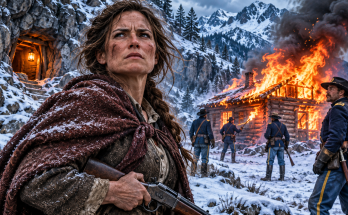
I had spent weeks making certain nobody could find me.
Then one January morning, a man called my name from the snow outside.
I was sitting near the stove when I heard him.
At first, I thought the sound had come from the wind moving through the draw.
The granite walls often carried noises in strange ways.
I put down Elias's journal and listened.
Then I heard it again.
"Mrs. Thorne?"
A man's voice.
Close enough that I could understand the words.
My hand moved toward Elias's Winchester rifle.
I did not know who had come.
I only knew that somebody had found his way into the narrow ravine where my shelter lay concealed.
I rose slowly.
The fire was burning steadily.
The chamber was warm.
Beyond the oak door, the temperature had fallen far below zero.
I took the rifle and moved toward the entrance.
The packed snow around the stone wall muffled my footsteps.
I listened again.
"Mrs. Thorne, are you here?"
The voice sounded strained.
I recognized something in it.
Not the man himself.
The fear.
I had heard it in my own voice after Elias died, when I spoke aloud because silence had become unbearable.
Still, fear did not make a stranger harmless.
I checked the rifle.
Then I eased the oak door open.
Cold air entered immediately.
The narrow passage I had cleared after the blizzard was partly filled again.
I pushed through the loose snow and emerged beneath the overhanging granite.
A man stood farther down the draw.
He wore snowshoes and a heavy coat whitened by frost.
His shoulders were bent.
His face looked raw from the wind.
He had been examining the rocks near my chimney.
When he saw movement near the snowbank, he stopped.
I stepped into view with the rifle in my hands.
He raised both arms.
"Don't shoot."
I recognized him then.
Tom Miller.
He worked in the mine at Prospect.
I had seen him in town before Elias died, though we had never been close acquaintances.
He had a wife and three young children.
I knew that much.
I also knew he had no business wandering around my property with a company eviction notice still hanging over me.
"What are you doing here, Mr. Miller?"
He looked from the rifle to my face.
"I was looking for wood."
I said nothing.
He swallowed.
"My family is running short. I thought there might be something left at your old cabin."
The words came out unevenly.
He had clearly spent a long time in the cold.
I kept the rifle lowered but ready.
"You found the cabin?"
"Yes, ma'am."
"Then why are you up here?"
He looked toward the rocks.
"I saw smoke."
I followed his gaze.
Above the granite shelf, a faint pale plume rose from the hidden chimney.
The freezing air made it more visible than usual.
I had noticed that on other mornings.
I had simply hoped no one else would notice.
Tom rubbed his gloved hands together.
"At first I thought I was seeing things."
He glanced back at the narrow passage behind me.
"Then I heard something moving under the snow."
I understood how strange it must have appeared.
A snow-covered bank shifting.
A woman emerging from a low passage.
A rifle appearing before he had even located a door.
I could have told him to leave.
I could have said there was nothing for him there.
I could have kept the location secret for another day.
Instead, I looked closely at his face.
He was frightened.
But not of me.
Something had happened at home.
"How bad is it?" I asked.
His eyes changed.
He lowered his arms a little.
"The wood's nearly gone."
I waited.
"We've been burning more than I expected. The house doesn't hold the heat."
I knew what he meant.
Our old cabin had required more fuel than I liked during the coldest nights.
Even a well-built wooden house could lose warmth quickly when the wind found its seams.
Tom's home had not been built with the same care Elias gave ours.
I had seen enough of the miners' cabins to know that.
He looked down.
"My youngest has a cough."
I felt something tighten in my chest.
"How long?"
"It's been getting worse."
He rubbed his mouth with one hand.
"My wife keeps him near the stove, but the room gets cold again before morning."
I looked toward the entrance.
Behind me was a chamber warmed by granite and a steady fire.
I had enough wood to survive.
I had provisions.
I had the knowledge Elias left.
Tom had walked twelve miles uphill through dangerous cold because he could no longer keep his children warm.
I had believed solitude was protecting me.
Now I was beginning to understand its cost.
"Come inside," I said.
He stared at me.
"Inside?"
"You're freezing."
He looked around the draw.
"Where?"
I moved aside.
"Follow me."
He hesitated.
Then he came toward the opening.
I watched his face as he saw the narrow passage.
The rockfall still concealed most of the entrance.
Snow covered the outer bank.
The doorway stood beneath a thick slab of granite.
From a distance, it looked like nothing more than an irregular patch of fallen stone.
Tom bent to enter.
I followed him and closed the door.
He stopped immediately.
I nearly walked into him.
He was staring at the stove.
Then at the walls.
Then at the stacks of firewood arranged neatly along the back of the chamber.
He pulled off one glove.
Held out his hand.
And looked at me as though he could not understand what he was feeling.
"It's warm."
I set the rifle aside.
"Yes."
He took another step.
The chamber stretched behind the stove.
Its walls were solid granite.
The ceiling was the great fallen slab Elias had described in his journal.
The thick front wall I built was almost completely hidden from the inside by the doorframe and stacked supplies.
Tom turned slowly.
"Mrs. Thorne, what is this place?"
"My home."
He looked at me.
Then at the room.
"But your cabin…"
"That was the cabin the company wanted."
He stood silently for a moment.
I could see him trying to understand.
He had gone to the original cabin expecting to find abandoned furniture and perhaps some firewood.
Instead, he had discovered that the supposedly displaced widow was living beneath the mountain.
He approached the stove.
"How long have you been here?"
"Since December."
He looked at the thermometer near the door.
Then he looked at the granite wall.
"How cold is it outside?"
"About twenty below."
He stared at the stove again.
"And in here?"
"Nearly fifty."
He gave a short, disbelieving laugh.
Not because he found it funny.
Because the difference seemed impossible.
He moved toward the back wall.
He placed his palm against the granite.
I watched him feel the temperature.
He expected cold stone.
Instead, he found a wall that had been absorbing warmth from the stove for weeks.
He looked over his shoulder.
"The rock isn't freezing."
"No."
"How?"
I glanced toward Elias's journal.
"My husband understood something about this place."
Tom turned.
"Mr. Thorne?"
"He found the formation two years ago."
I took the journal from beside the lamp.
I opened it to the drawing.
Tom stepped closer.
His hands were still shaking slightly from the cold.
He looked at Elias's careful lines.
The upper shelf.
The hidden space beneath.
The south-facing opening.
The great mass of granite behind it.
I pointed to the cross-section.
"This is where we're standing."
Tom leaned over the page.
He examined the drawing for a long time.
Then he looked around the chamber again.
"You built all this?"
"I built what was missing."
He stared at the stone wall.
"The doorway?"
"Yes."
"The stove?"
"I brought it from the cabin."
He looked toward the ceiling.
"And the pipe?"
I nodded.
He said nothing.
I knew what he was thinking.
I had been alone.
I had been given thirty days.
And somehow I had moved stone, built a wall, brought in a stove, and made the chamber suitable for winter.
I did not need him to say it aloud.
I had lived through the work.
Tom finally sat on a low place near the stove.
He looked tired enough to fall asleep where he sat.
I poured him coffee.
He held the cup in both hands.
"Thank you."
I sat opposite him.
"Tell me about your cabin."
He frowned.
"It's a cabin."
"That isn't what I asked."
He looked into the cup.
"The wind comes through the north side."
I nodded.
"The stove's against the other wall. We keep feeding it, but the room doesn't stay warm."
"How much wood have you used?"
He gave me a rough estimate.
I knew immediately why his supply was disappearing.
He was losing heat almost as quickly as he produced it.
I asked about the roof.
The windows.
The gaps between the boards.
He answered quietly.
At first, I think he believed I was merely interested.
Then he began to understand I was looking for a solution.
I took a small stick from the woodpile.
I moved to a clear patch of packed earth near the stove.
Then I began drawing.
A wall.
A stove.
The direction of the wind.
Tom watched.
I explained what Elias had taught me about the way heat moved through a building.
I showed him why exposed wooden walls lost warmth so quickly.
Then I drew a bank of snow against the northern side of his cabin.
He leaned forward.
"You want me to pile snow against the house?"
"Against the coldest wall, where it can help block the wind."
He looked doubtful.
"Won't that make things colder?"
"Not if you do it carefully and keep your chimney and necessary openings clear."
I pointed toward my own wall.
"Look at what happened here."
He turned.
The snow outside had buried much of the exposed stonework.
That same snow reduced the movement of freezing air through small gaps.
I explained that a thick layer of snow could help insulate the wall beneath it.
Tom listened without interrupting.
Then I drew another picture.
This one showed a stove with a mass of stone behind it.
"Build a rock heat sink near your stove."
He frowned.
"A what?"
"A place for the stones to absorb warmth and give some of it back after the fire settles."
I pointed to the granite surrounding us.
"That's part of what this mountain is doing."
He looked at the wall again.
I could see the idea taking shape.
"You're saying my stove could heat rocks?"
"Yes. If they're arranged safely with proper clearance, and if you use sound, dry stone."
"And the rocks stay warm?"
"For a time."
He rubbed his forehead.
"Longer than the air?"
"That's the idea."
He sat quietly.
I knew he was comparing the explanation with what he had seen in his own house.
A stove burning hard.
A family gathered close.
The room cooling whenever the fire weakened.
I did not promise him a miracle.
His cabin would still need fuel.
The weather would still be dangerous.
His youngest child would still need care.
But I could help him use his firewood more effectively.
I walked to my stack.
I selected as much wood as he could reasonably carry.
Tom stood quickly.
"Mrs. Thorne, I can't take that."
"Your children need it."
He looked at the pile.
"You're out here alone."
"I know how much I have."
He shook his head.
"I didn't come to ask you for charity."
"I know."
That was true.
He had come looking for abandoned wood.
He had not expected to find me.
I told him to bring the small sled he had used for the journey.
We could secure the wood so he could take it downhill.
He stared at me.
Then he sat again.
His face looked worn.
For the first time, I saw how much effort it had taken for him to ask anyone for help.
I understood that feeling.
I had nearly refused Mr. Abernathy's gift for the same reason.
Pride could be useful.
It could also be foolish.
"Tom," I said, "take the wood."
He nodded.
I let him finish his coffee.
Then I showed him the shelter more carefully.
I explained the south-facing entrance.
The low winter sun.
The thick granite roof.
The dry floor.
The protected position of the draw.
He listened as though each detail mattered.
And it did.
I had spent weeks learning that no single feature made the shelter safe.
The protection came from the way the features worked together.
Tom finally stood near the door.
"I wish I'd known this before winter."
I looked at Elias's journal.
"So do I."
We loaded the wood onto his makeshift sled.
I helped secure it with rope.
The work was awkward in the snow, but we managed.
He pulled on his gloves.
Then he looked toward the chamber one last time.
"Will you be all right here?"
I almost smiled.
"I've been all right so far."
He looked at the stonework.
Then at the snow-covered ridge.
"I believe you."
Before leaving, he turned back.
"Mrs. Thorne?"
"Yes?"
"Thank you for telling me how it works."
I watched him carefully.
Most people would have thanked me for the wood.
He understood I had given him something else.
The wood would burn.
The knowledge might keep helping him.
"Use it," I said.
He nodded.
Then he began the journey downhill.
I stood outside until the draw concealed him.
The wind was cold.
I returned through the narrow entrance and shut the oak door.
For a while, I sat beside the stove without opening my journal.
Someone else now knew where I lived.
The secret I had protected since December was no longer mine alone.
I should have felt only afraid.
Instead, I kept thinking about Tom's youngest child.
A small boy coughing beside a stove that could not keep the room warm.
I had opened my door because I could not bear the thought of sending his father away empty-handed.
Looking back, I know that decision changed everything.
But that afternoon, I did not think about the company.
I thought about whether Tom could reach Prospect before darkness.
And whether the wood on his sled would be enough to help his family through the night.